All species › Passerines › New World sparrows › Black-headed Brushfinch
Black-headed Brushfinch | Arremon atricapillus
Zwartkopstruikgors | Cerquero cabecinegro | Tico-tico-de-capuz-preto
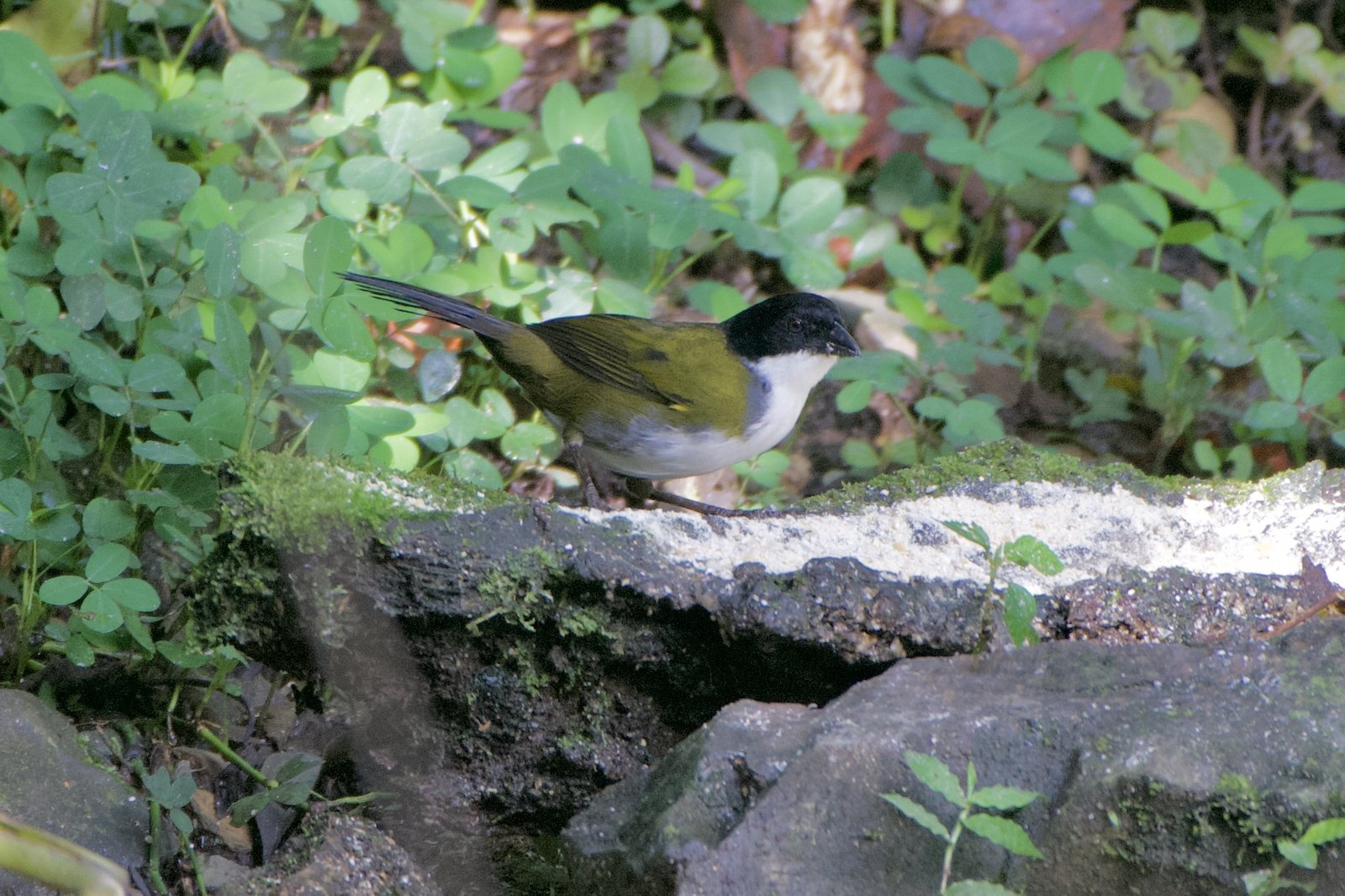
The Black-headed Brushfinch is a large brushfinch of the lower mountain slopes of northern and western Colombia, with an almost entirely black head. It was formerly included in Stripe-headed Brushfinch Arremon torquatus in the broad sense and is now treated as a separate species. It lives in pairs in the undergrowth, at lower elevations than the related brushfinches of the Andes.
Voice
Very high, thin calls, roughly tseet. The song is a short series of high, thin whistles, mainly in the early morning.
Recording: Fernando Castro — CC BY-NC-SA 4.0 · xeno-canto
Identification
19 cm, sturdy, with a black bill and a fairly long tail. The head is black, with at most a faint, narrow grey median crown stripe and supercilium. The throat is white, without a breast band. The back, wings and tail are olive-green; the breast and flanks are grey and the centre of the belly is white. The sexes are alike. Juveniles are duller and browner.
Confusion species
Grey-browed Brushfinch Arremon assimilis lives higher and has a distinct grey median crown stripe and supercilium. Chestnut-capped Brushfinch Arremon brunneinucha has a chestnut crown and a black breast band. Orange-billed Sparrow Arremon aurantiirostris is smaller, with an orange bill, a white supercilium and a black breast band, and lives lower. Tanager Finch Oreothraupis arremonops has a black head with grey stripes and an orange-rufous body.
Habitat
Undergrowth of humid lower montane forest, forest edges, old secondary forest and shade coffee plantations, roughly between 600 and 2000 m. It forages on the ground among leaf litter for insects, other invertebrates and seeds. Little is known about the nest.
Where the bird is most at home, classified by the vegetation units of the Andes and the west coast.


Range and movements
In Colombia on the slopes of the Western and Central Andes, from the north south to about Valle del Cauca, and on the slopes of the middle Magdalena Valley, including the Serranía de San Lucas. Absent from Ecuador, Peru, Bolivia and the Galápagos. Outside the guide area in the far east of Panama.
- Resident
- dark = core range, pale = thinly spread
How and when to look
Search forest fragments and shade coffee plantations on middle slopes in Antioquia and along the Magdalena Valley. Pairs keep low in dense undergrowth; listen for their high calls in the early morning.
Conservation status
Least Concern. Much forest has been cleared on the lower slopes, but the species also lives in secondary forest and shade coffee.
Scientific name
Arremon atricapillus | (Lawrence, 1874)
Lawrence described the species in 1874 as Buarremon atricapillus; because it was later moved to another genus, the author and year stand in brackets. The genus Arremon was introduced in 1816 by Vieillot. The genus name comes from Greek arrhēmōn, 'silent, without speech'. The species name comes from Latin ater, 'black', and capillus, 'hair of the head': 'black-capped'. The specimen the first description was based on came from Bogotá, Colombia.