All species › Waders, gulls and terns › Skimmers, noddies, terns and gulls › Black-headed Gull
Black-headed Gull | Chroicocephalus ridibundus
Kokmeeuw | Gaviota reidora | Gaivota-de-cabeça-preta
Black-headed Gull is one of the most numerous gulls of Europe and Asia and also breeds in small numbers in north-eastern North America. Birds from those regions sometimes reach the Caribbean. In the guide area it has been recorded only as a very rare vagrant.
Voice
A hoarse, grating kree-ah and short, cackling calls.
Recording: David Bissett — CC BY-NC-SA 4.0 · xeno-canto
Identification
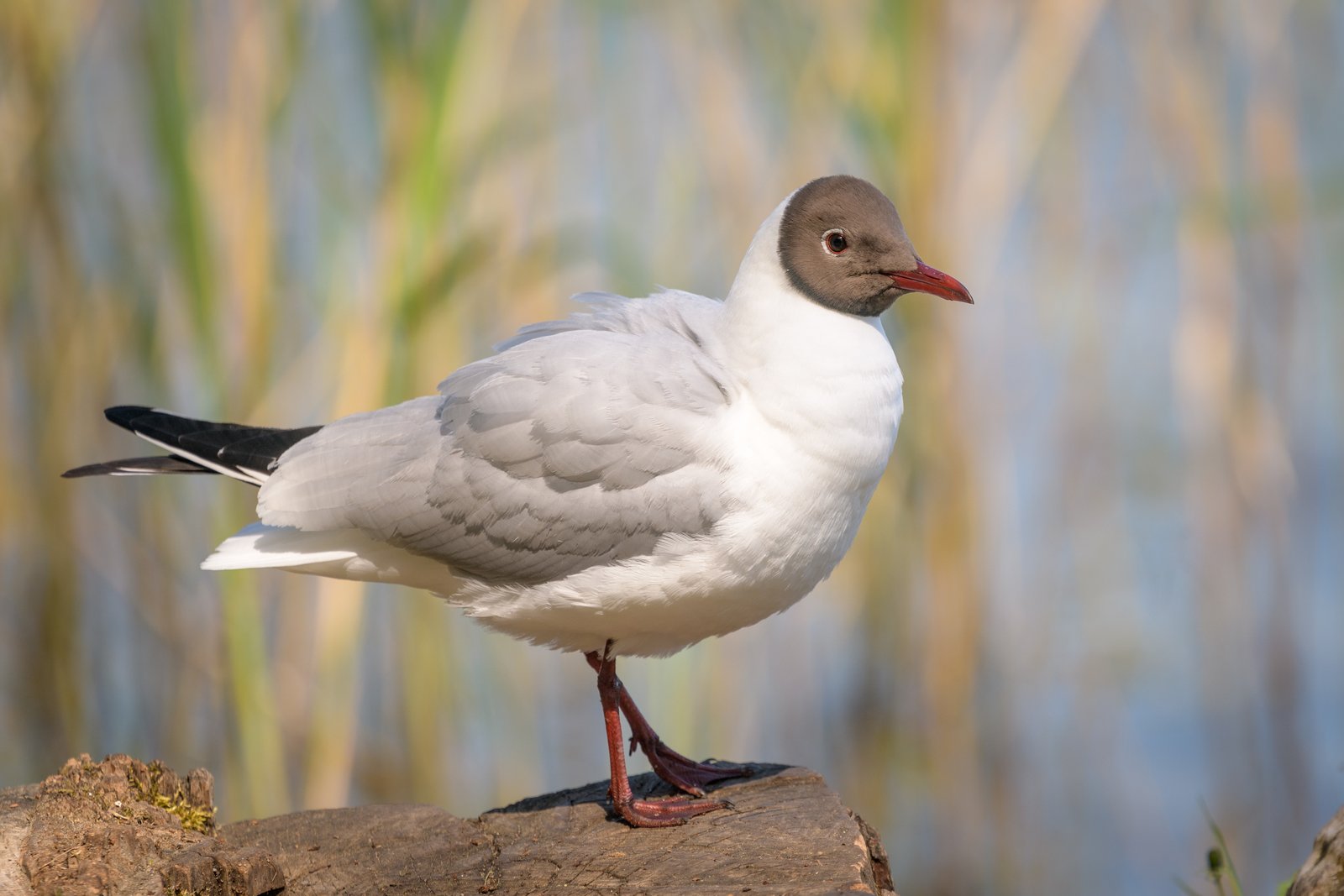
35–39 cm, with a rather thin, dark red bill and red legs. Adults have a pale grey mantle, a white leading edge to the outer wing and a black wingtip; the undersides of the primaries are dark grey. In breeding plumage a chocolate-brown hood that does not reach the nape, with a narrow white eye-ring; in non-breeding plumage a white head with a dark ear spot. Juveniles have brown marks on the upperwing, a black tail band and an orange-tinged bill with a dark tip. The sexes are alike.
Confusion species
Bonaparte's Gull Chroicocephalus philadelphia is smaller, with a black bill and pale undersides to the primaries. Grey-headed Gull Chroicocephalus cirrocephalus is larger, with a pale iris, a pale grey hood in breeding plumage and more black in the wingtip. Brown-hooded Gull Chroicocephalus maculipennis has a white spot in the black wingtip and a dark iris with a white eye-ring.
Habitat
Coasts, estuaries, harbours, rubbish dumps and lowland lakes. It eats a wide range of food: insects, worms, small fish and refuse, often in flocks with other gulls. It does not breed in the guide area.
Where the bird is most at home, classified by the vegetation units of the Andes and the west coast.


Range and movements
Only a very rare vagrant in the guide area, with a few records on the coast. Breeds in Europe, Asia and in small numbers in north-eastern North America; winters south to Africa, southern Asia and the Caribbean.
How and when to look
A vagrant is most likely among flocks of Laughing and Franklin's Gulls in harbours and estuaries on the coast; look for the red bill and legs and the dark undersides of the primaries.
Conservation status
Least Concern. The world population is very large, although numbers are declining in parts of Europe.
Scientific name
Chroicocephalus ridibundus | (Linnaeus, 1766)
Linnaeus described the species in 1766 as Larus ridibundus; because it was later moved to another genus, the author and year stand in brackets. The genus Chroicocephalus was introduced in 1836 by Eyton. The genus name is from Greek khrōikos, 'coloured', and -kephalos, '-headed', after the coloured head in breeding plumage. The species name is Latin ridibundus, 'laughing', after the call. The specimen the first description was based on came from European seas.