All species › Waders, gulls and terns › Skimmers, noddies, terns and gulls › Brown-hooded Gull
Brown-hooded Gull | Chroicocephalus maculipennis
Patagonische kokmeeuw | Gaviota cáhuil | Gaivota-maria-velha
Brown-hooded Gull is the commonest hooded gull of southern South America, from Chile and Argentina to southern Brazil. Outside the breeding season birds move north along both coasts. In the guide area it has been recorded only as a very rare vagrant.
Voice
A shrill, grating kee-ah and laughing, cackling calls.
Recording: Bernard BOUSQUET — CC BY-NC-SA 4.0 · xeno-canto
Identification
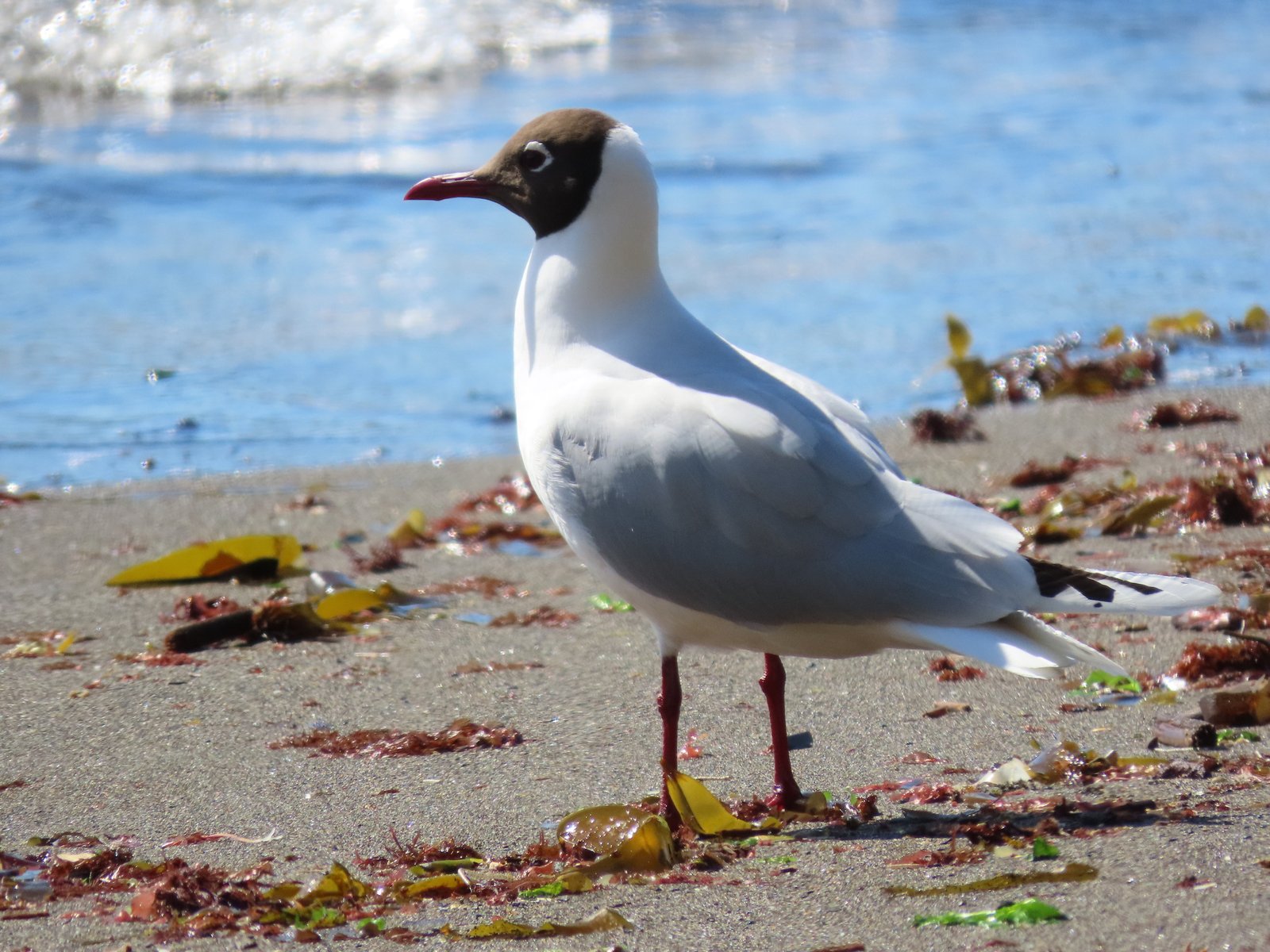
35–38 cm, with a dark red bill and red legs and a dark iris with narrow white eye crescents. Adults have a pale grey mantle and a white outer wing with a black trailing edge and white mirrors in the black wingtip. In breeding plumage a dark chocolate-brown hood that extends farther back than in Black-headed Gull; in non-breeding plumage a white head with a dark ear spot. Juveniles have a brown-mottled upperwing, a black tail band and a pale bill with a dark tip. The sexes are alike.
Confusion species
Andean Gull Chroicocephalus serranus is larger and bulkier, with a blacker hood and a large white wedge in the wingtip, and lives mainly in the high Andes. Black-headed Gull Chroicocephalus ridibundus is slightly smaller, with a smaller hood and no white mirrors in the wingtip. Grey-headed Gull Chroicocephalus cirrocephalus has a pale iris and a pale grey hood in breeding plumage.
Habitat
Coasts, estuaries, harbours, lakes, rivers and farmland in the lowlands; it follows ploughing tractors and forages at rubbish dumps. It eats insects, worms, small fish and refuse. It does not breed in the guide area.
Where the bird is most at home, classified by the vegetation units of the Andes and the west coast.


Range and movements
Only a very rare vagrant in the guide area, with a few records in Peru. Breeds in Chile, Argentina, Uruguay and southern Brazil; outside the breeding season it moves north along the coast of Chile and the Atlantic coast.
How and when to look
A vagrant is most likely among flocks of Andean and Grey-headed Gulls on the south coast of Peru, especially in the austral winter; look for the smaller size, the chocolate-brown hood and the white mirrors in the wingtip.
Conservation status
Least Concern. The species benefits locally from farming and refuse around towns.
Scientific name
Chroicocephalus maculipennis | (Lichtenstein, 1823)
Lichtenstein described the species in 1823 as Larus maculipennis; because it was later moved to another genus, the author and year stand in brackets. The genus Chroicocephalus was introduced in 1836 by Eyton. The genus name is from Greek khrōikos, 'coloured', and -kephalos, '-headed', after the coloured head in breeding plumage. The species name is from Latin macula, 'spot', and penna, 'feather', after the marked wingtips. The specimen the first description was based on came from Montevideo, Uruguay.