All species › Waders, gulls and terns › Skimmers, noddies, terns and gulls › European Herring Gull
European Herring Gull | Larus argentatus
Zilvermeeuw | Gaviota argéntea | Gaivota-prateada-europeia
The European Herring Gull is the common large, grey-backed gull of the coasts of north-western Europe. Birds from there occasionally cross the Atlantic and have been recorded as vagrants in North America and the Caribbean. In the guide area it is known only as a very rare vagrant; the identification of such birds is not always certain.
Voice
A loud, laughing kyow-kyow-kyow and a short ga-ga-ga. Vagrants are rarely heard.
Recording: Sam Hambly — CC BY-NC-SA 4.0 · xeno-canto
Identification
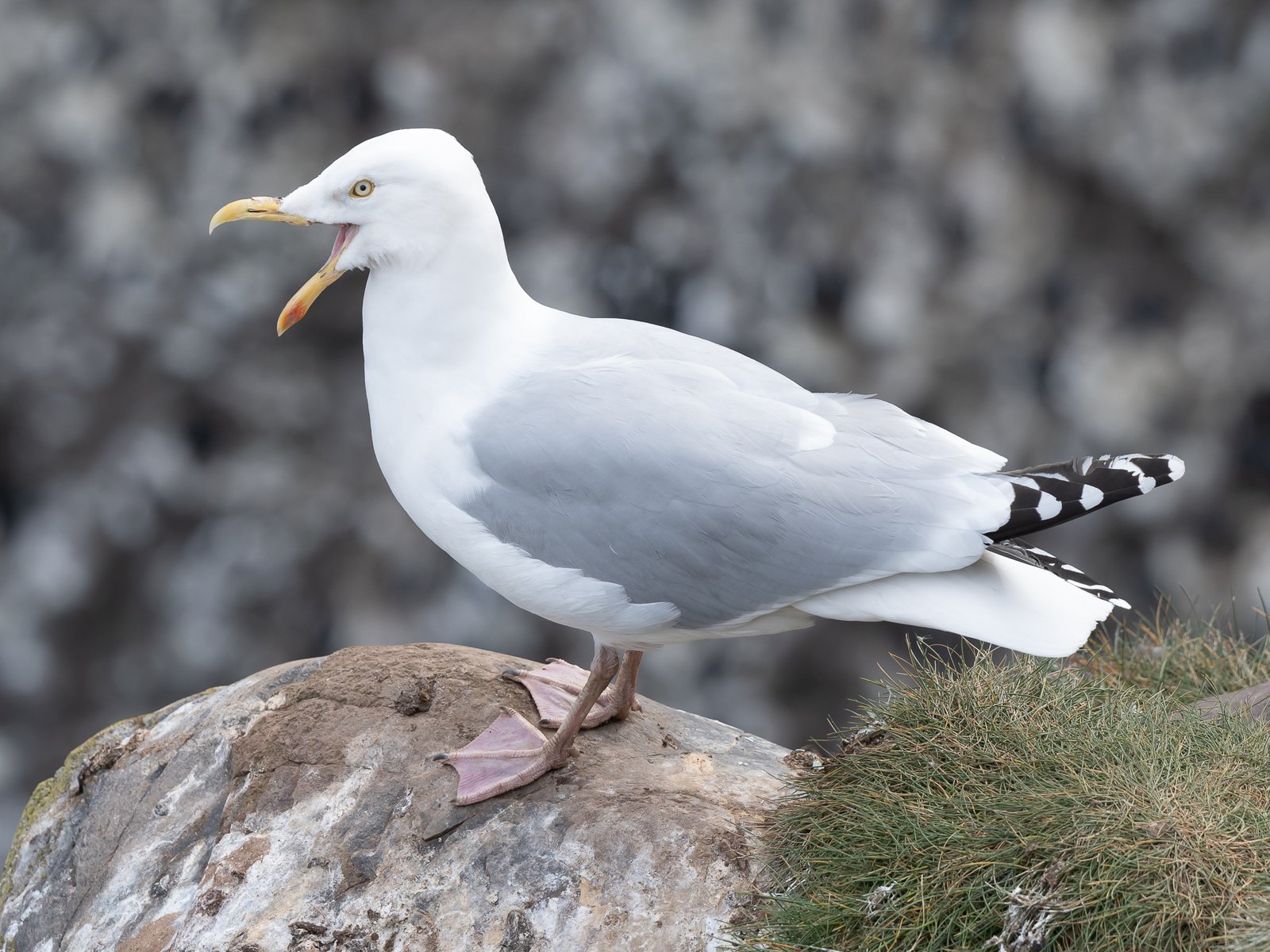
55–64 cm, a large, heavy gull with a stout bill and pink legs. Adults have a pale grey mantle, black wingtips with white spots, a yellow bill with a red spot on the lower mandible and a pale iris; in winter the head is streaked greyish brown. Immatures are mottled brown, with a pale rump, a white tail base with a dark tail band and a dark bill. Adult plumage is reached only after about four years. The sexes are alike.
Confusion species
American Herring Gull Larus smithsonianus is very similar and is the more likely species in the guide area; immatures are more uniformly greyish brown, with a darker rump and an almost entirely dark tail. Lesser Black-backed Gull Larus fuscus has a dark grey mantle and yellow legs. Adult Kelp Gull Larus dominicanus has a blackish-brown mantle. Ring-billed Gull Larus delawarensis is clearly smaller, with a shorter bill.
Habitat
Coasts, estuaries, harbours and rubbish dumps. It eats fish, invertebrates, carrion and refuse. It does not breed in the guide area.
Where the bird is most at home, classified by the vegetation units of the Andes and the west coast.


Range and movements
In the guide area only as a very rare vagrant, with at most a few records on the coast. Breeds in north-western and northern Europe; winters largely in and around the breeding range. Rarely wanders to North America and the Caribbean.
How and when to look
A vagrant can only be found among flocks of large gulls in harbours, estuaries and at rubbish dumps on the coast. Good photographs of the rump, tail and wing are needed to separate it from American Herring Gull.
Conservation status
Least Concern. The population is large, but has declined strongly in parts of Europe.
Scientific name
Larus argentatus | Pontoppidan, 1763
Pontoppidan described the species in 1763 and placed it straight away in the genus where it still stands. The genus Larus was introduced in 1758 by Linnaeus. The genus name comes from Greek laros or Latin larus, a word for a gull or another large seabird. The species name comes from Latin argentatus, 'silvered', for the silver-grey mantle. The specimen the first description was based on came from Christiansø, Denmark.