All species › Passerines › Thrushes and allies › Black-hooded Thrush
Black-hooded Thrush | Turdus olivater
Kapucijnerlijster | Zorzal cabecinegro | Sabiá-de-cabeça-preta
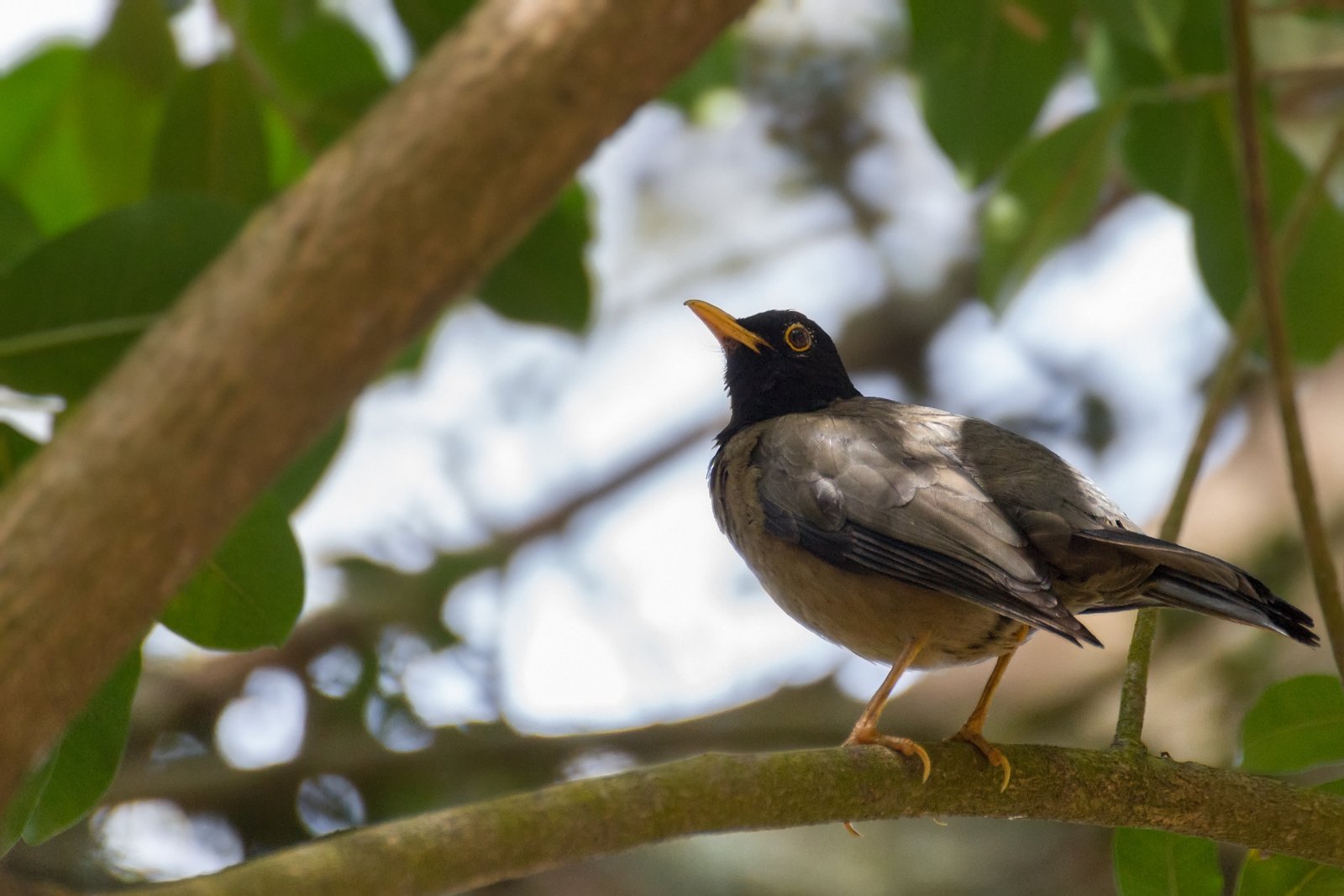
The Black-hooded Thrush is a thrush of montane forest in northern South America, the male of which has a black hood on an olive-brown body. In the guide area it occurs only in northern Colombia, in the isolated mountain ranges and the northern Eastern Cordillera. Its range is highly fragmented, with different subspecies in different mountain massifs.
Voice
The song is a varied series of clear, fluty phrases, often repeated and kept up for a long time, mainly in the early morning. The call is a soft chuk.
Recording: Rolf A. de By — CC BY-NC-SA 4.0 · xeno-canto
Identification
23–24 cm. The male has a black head, throat and upper breast, sharply contrasting with the olive-brown upperparts and the buff to ochre underparts. The bill and narrow eye-ring are yellow, the legs yellowish brown. The female is olive-brown above, with a browner head without a black hood, a pale, brown-streaked throat and ochre-brown underparts; her bill is darker. Young birds have pale spots on the upperparts and dark spots on the underparts.
Confusion species
Chestnut-bellied Thrush Turdus fulviventris also has a black head, but a slate-grey back, a grey breast and a rufous belly. The male Yellow-legged Thrush Turdus flavipes has a black head, but also black wings and tail and a grey back and belly. Great Thrush Turdus fuscater is larger and uniformly dark. Females resemble other brown thrushes, such as Clay-colored Thrush Turdus grayi, which is paler and more sandy brown and lives in lower, open country.
Habitat
Humid montane forest, cloud forest, forest edges, old secondary forest and shade-coffee plantations, roughly between 800 and 3000 m. It searches the ground and the lower and middle strata for insects and fruit. The nest is a cup in a tree or shrub.
Where the bird is most at home, classified by the vegetation units of the Andes and the west coast.


Range and movements
In Colombia in the Sierra Nevada de Santa Marta, the Serranía de Perijá and the northern Eastern Cordillera; an isolated subspecies is known from the Central Cordillera in Cauca. Absent from Ecuador, Peru, Bolivia and the Galápagos. Outside the guide area in the mountains of Venezuela, on the tepuis and in adjacent Guyana and Brazil.
- Resident
- dark = core range, pale = thinly spread
How and when to look
Look in the Sierra Nevada de Santa Marta, for example along the road to San Lorenzo, in the early morning along forest edges and at fruiting trees.
Conservation status
Least Concern. In Colombia it depends on montane forest in a small number of mountain ranges, where deforestation is a local threat; the subspecies in Cauca is poorly known.
Scientific name
Turdus olivater | (de Lafresnaye, 1848)
De Lafresnaye described the species in 1848 as Merula olivatra; because it was later moved to another genus, the author and year stand in brackets. The genus Turdus was introduced in 1758 by Linnaeus. The genus name comes from Latin turdus, 'thrush'. The species name comes from Latin oliva, 'olive', and ater, 'black', referring to the olive back and black hood. The specimen the first description was based on came from Caracas, Venezuela.