All species › Passerines › Thrushes and allies › Great Thrush
Great Thrush | Turdus fuscater
Reuzenlijster | Zorzal grande | Sabiá-grande
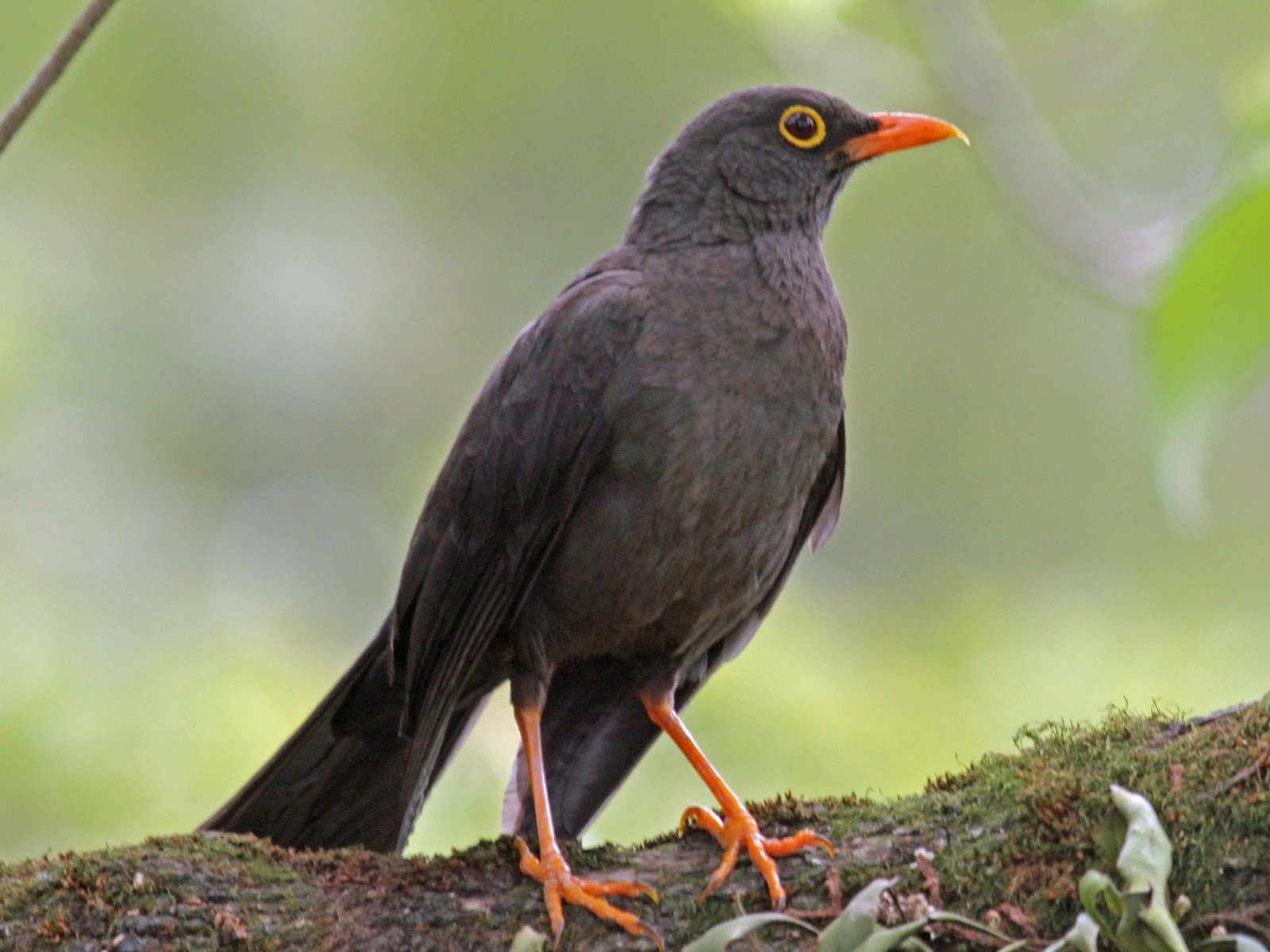
The Great Thrush is the largest thrush in South America, a dark, blackbird-like bird with an orange bill and orange legs. It is common in the high Andes, from cloud forest to the edge of the páramo, and also in gardens and parks of high-altitude cities. Its loud calls and song are part of the morning chorus of the Andes.
Voice
The song is a varied, somewhat hoarse series of fluty phrases, often given before dawn and kept up for a long time. Frequently heard are a loud, sharp kweep and a repeated, forceful kurt-kurt as an alarm call.
Recording: Sebastián Contreras Merchán — CC BY-NC-SA 4.0 · xeno-canto
Identification
28–33 cm, large and sturdy, with long legs. The plumage is plain dark sooty brown to olive-brown, almost blackish in some subspecies, and somewhat paler in birds from Peru and Bolivia. The bill and legs are orange to orange-yellow. The male has a narrow orange-yellow eye-ring, which is smaller or absent in the female. Young birds are browner, with pale spots on the upperparts and dark spots on the underparts.
Confusion species
Chiguanco Thrush Turdus chiguanco in Ecuador, Peru and Bolivia is smaller, paler greyish brown and has no eye-ring; it lives mainly in drier, more open country. The male Glossy-black Thrush Turdus serranus is smaller and glossy black, with an orange bill, eye-ring and legs; it lives in the interior of montane forest. Males of Black-hooded Thrush Turdus olivater have a black head on an olive-brown body.
Habitat
Cloud forest, forest edges, elfin forest, Polylepis groves, scrub at the edge of the páramo, fields with hedges, pasture with trees, and gardens and parks, at roughly 1800 to 4000 m. It searches the ground for earthworms and other invertebrates, and also eats many berries and fruits.
Where the bird is most at home, classified by the vegetation units of the Andes and the west coast.


Range and movements
In Colombia in all three cordilleras and in the Sierra Nevada de Santa Marta; in Ecuador throughout the Andes; in Peru and Bolivia in the Andes from north to south. Absent from the Galápagos. Outside the guide area in the Andes and coastal mountains of Venezuela.
- Resident
- dark = core range, pale = thinly spread
How and when to look
One of the commonest birds in Bogotá, Quito and other high-altitude cities, often on lawns in parks and gardens. In páramo and cloud forest often on trails and along forest edges.
Conservation status
Least Concern. Common, and benefits from semi-open farmland and urban green space.
Scientific name
Turdus fuscater | d'Orbigny, ACVMD & de Lafresnaye, 1837
D'Orbigny, ACVMD & de Lafresnaye described the species in 1837 and placed it straight away in the genus where it still stands. The genus Turdus was introduced in 1758 by Linnaeus. The genus name comes from Latin turdus, 'thrush'. The species name comes from Latin fuscus, 'dusky', and ater, 'black': 'dusky black'. The specimen the first description was based on came from La Paz, Bolivia.