All species › Passerines › Thrushes and allies › Glossy-black Thrush
Glossy-black Thrush | Turdus serranus
Fluweellijster | Zorzal serrano | Sabiá-preto-brilhante
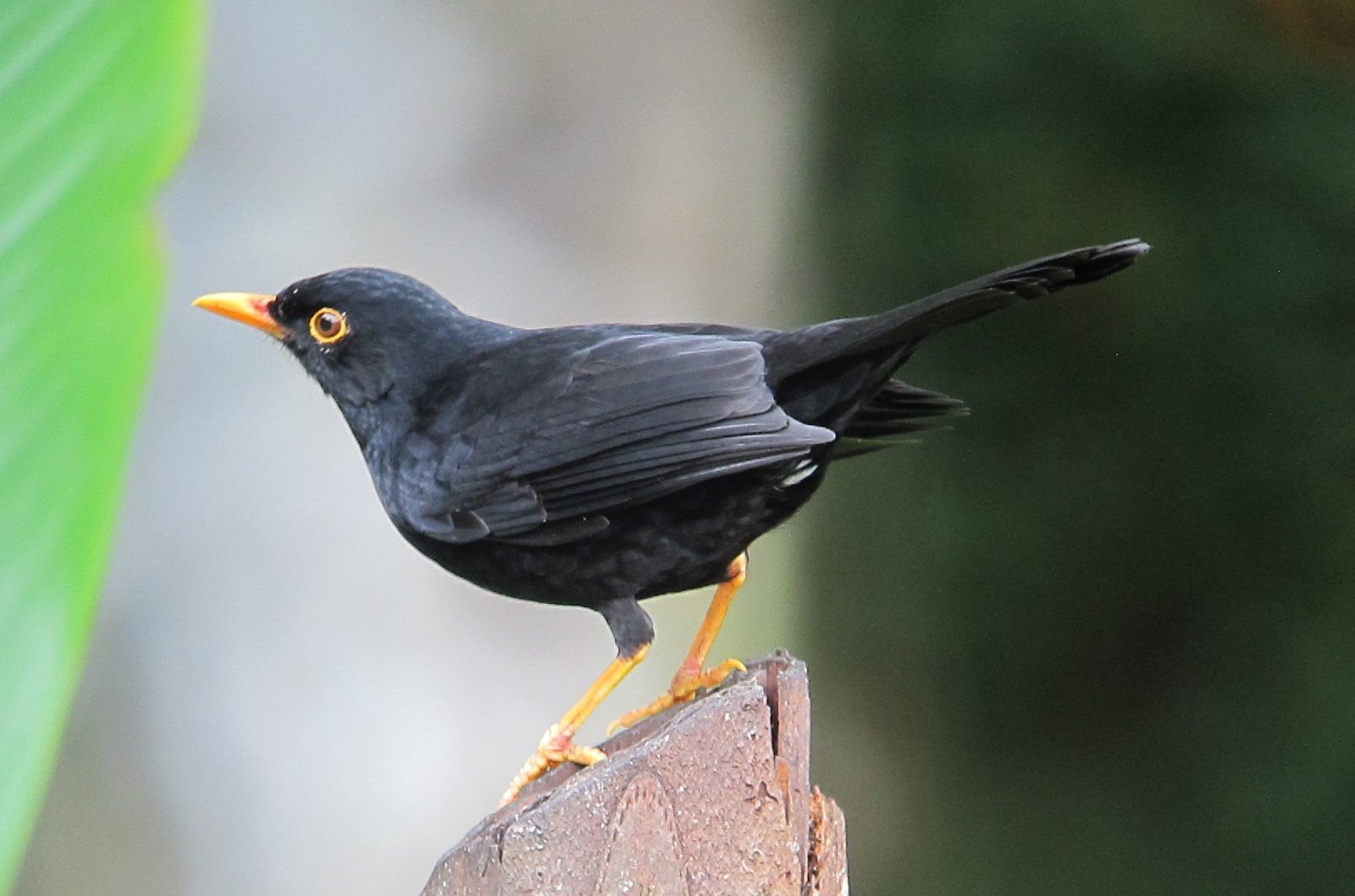
The Glossy-black Thrush is a thrush of humid montane forest in the Andes, the male of which is glossy black with an orange bill, eye-ring and legs. It lives more in the forest interior than most other Andean thrushes and often sings for long periods from the top of a tall tree. The female is plain dark brown.
Voice
The song is a short, simple, rising phrase of a few clear notes, repeated monotonously for long periods, often from a high, exposed perch. The call is a soft chuk and a high, thin tseep.
Recording: Daan van der Hoeven — CC BY-NC-SA 4.0 · xeno-canto
Identification
24–25 cm. The male is entirely glossy black, with an orange-yellow bill, an orange-yellow eye-ring and orange-yellow legs. The female is plain dark olive-brown, slightly paler on the belly, with a faintly streaked throat, a duller, yellowish brown bill and yellowish legs; the eye-ring is faint or absent. Young birds are brown, with pale spots on the upperparts and dark spots on the underparts.
Confusion species
Great Thrush Turdus fuscater is much larger, sooty brown and not glossy, with long legs, and lives more in open country and forest edge. The male Pale-eyed Thrush Turdus leucops is also glossy black, but has a whitish iris and no orange eye-ring. Black Solitaire Entomodestes coracinus in western Colombia and Ecuador has white patches on the cheek and wing. Females can be told from Chiguanco Thrush Turdus chiguanco, which is paler greyish brown and lives in drier, open country.
Habitat
The interior and edges of humid montane forest and cloud forest, also old secondary forest, roughly between 1200 and 3000 m, locally lower. It searches the canopy and middle strata for fruit and berries, and the ground for insects and earthworms. The nest is a cup in a tree, often among moss and epiphytes.
Where the bird is most at home, classified by the vegetation units of the Andes and the west coast.


Range and movements
In Colombia in all three cordilleras, in the Sierra Nevada de Santa Marta and in the Serranía de Perijá. In Ecuador on both slopes of the Andes. In Peru along the whole length of the eastern slope of the Andes, locally also in the north-west. In Bolivia in the Yungas of the eastern slope. Absent from the Galápagos. Outside the guide area in Venezuela and north-western Argentina.
- Resident
- dark = core range, pale = thinly spread
How and when to look
Listen in the early morning in cloud forest for the monotonously repeated song and look for the singer at the top of a tall tree. At fruiting trees the birds come lower.
Conservation status
Least Concern. Dependent on humid montane forest, and therefore locally sensitive to deforestation.
Scientific name
Turdus serranus | Tschudi, 1844
Tschudi described the species in 1844 and placed it straight away in the genus where it still stands. The genus Turdus was introduced in 1758 by Linnaeus. The genus name comes from Latin turdus, 'thrush'. The species name comes from Spanish serrano, 'of the mountains (sierra)', referring to its montane forest habitat. The specimen the first description was based on came from Peru.