All species › Passerines › Thrushes and allies › Chiguanco Thrush
Chiguanco Thrush | Turdus chiguanco
Chiguancolijster | Zorzal chiguanco | Sabiá-chiguanco
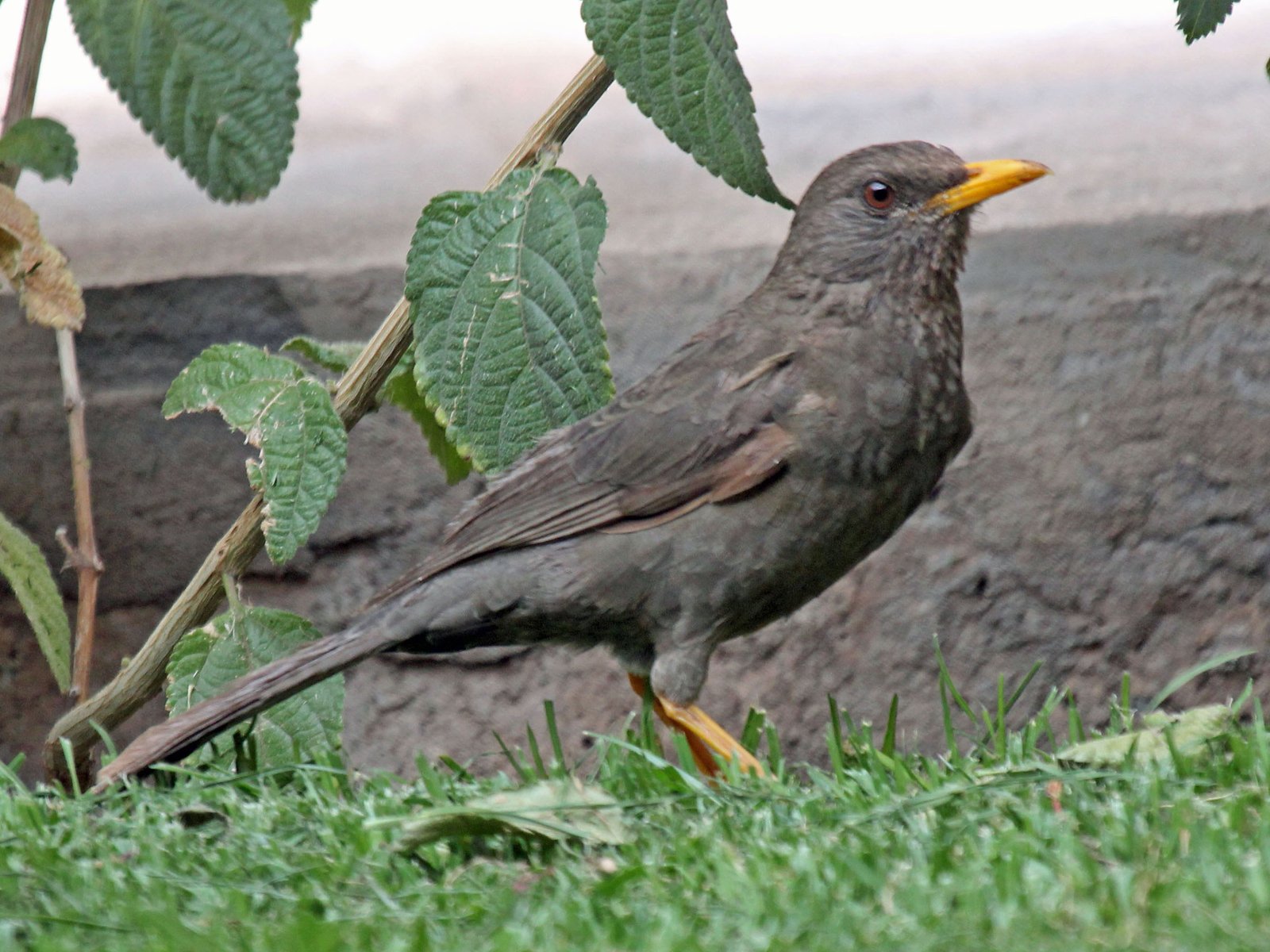
The Chiguanco Thrush is a plain greyish brown thrush with an orange-yellow bill and yellow legs, the common thrush of the dry and open parts of the central Andes. It lives in farmland, scrub, villages and gardens, and in Peru also on the coast. Its name comes from Quechua.
Voice
The song is a slow series of short, fluty phrases with pauses, often given before dawn. The call is a dry chuk, when alarmed rapidly repeated into a rattling chuk-chuk-chuk.
Recording: Jacob Wijpkema — CC BY-NC-SA 4.0 · xeno-canto
Identification
26–28 cm, slender and fairly long-tailed. The plumage is plain greyish brown to olive-grey, with a slightly paler, faintly streaked throat and a paler belly. The bill is orange-yellow to yellow and the legs are yellow; there is no eye-ring. The male of the southern subspecies, in Bolivia, is darker, almost blackish brown. The female is browner and duller than the male. Young birds have pale spots on the upperparts and dark spots on the underparts.
Confusion species
Great Thrush Turdus fuscater is larger and darker, the male with a yellow eye-ring; it lives mainly in more humid forest and scrub. The female Glossy-black Thrush Turdus serranus is darker brown and lives in the interior of humid montane forest. Plumbeous-backed Thrush Turdus reevei in the Tumbesian region has a bluish grey back and a whitish iris.
Habitat
Fields and terraces with hedges, dry scrub, Polylepis groves, riparian woodland, eucalyptus plantations, villages, gardens and parks, from sea level in the coastal valleys and lomas of Peru to about 4200 m. It searches the ground for earthworms, insects and other invertebrates, and also eats fruit and berries. The nest is a cup in a shrub, tree or wall.
Where the bird is most at home, classified by the vegetation units of the Andes and the west coast.


Range and movements
In Ecuador in the dry inter-Andean valleys, mainly in the centre and south of the country. In Peru widespread in the Andes, on both slopes, and locally in the coastal valleys. In Bolivia in the Andes, on the altiplano and in the dry valleys of the eastern slope. Absent from Colombia and the Galápagos. Outside the guide area in northern Chile and north-western Argentina.
- Resident
- dark = core range, pale = thinly spread
How and when to look
Look in fields, gardens and along hedges in the Andean villages and towns, for example around Cusco and Arequipa; birds often feed in the open on the ground.
Conservation status
Not Evaluated in its current circumscription. Common and widespread, and benefits from small-scale farmland and plantings around settlements.
Scientific name
Turdus chiguanco | d'Orbigny, ACVMD & de Lafresnaye, 1837
D'Orbigny, ACVMD & de Lafresnaye described the species in 1837 and placed it straight away in the genus where it still stands. The genus Turdus was introduced in 1758 by Linnaeus. The genus name comes from Latin turdus, 'thrush'. The species name is the Aymara name chiguanco for this thrush, taken from d'Orbigny (1834). The specimen the first description was based on came from Tacua, Peru.