All species › Passerines › Thrushes and allies › Andean Slaty Thrush
Andean Slaty Thrush | Turdus nigriceps
Witoksellijster | Zorzal plomizo andino | Sabiá-ferreiro-andino
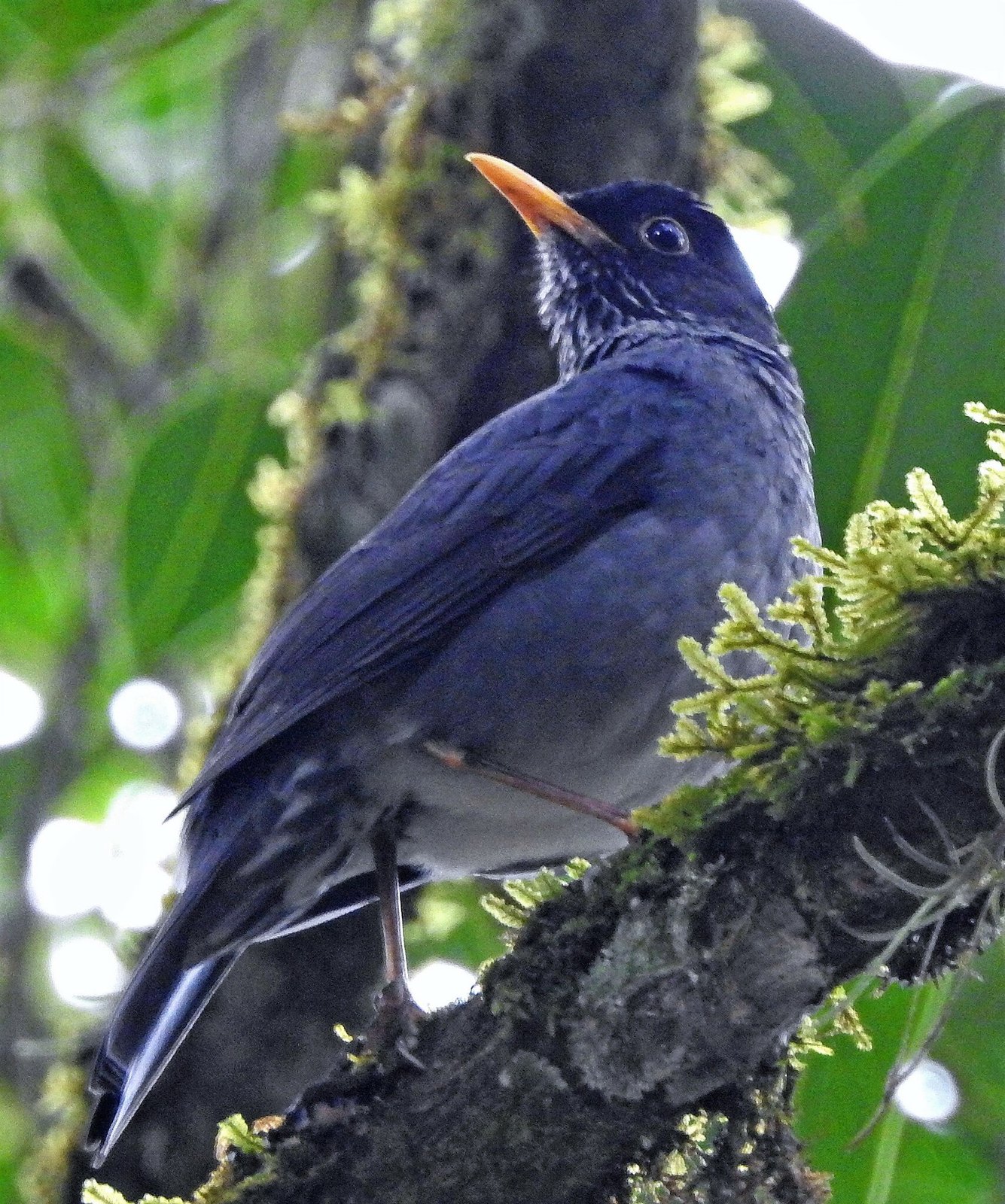
The Andean Slaty Thrush is a small, slate-grey thrush of montane forest on the slopes of the Andes. The male is grey with a dark head and a yellow bill, the female brownish. It breeds in the rainy season and afterwards partly moves north or to lower slopes, so over much of the guide area it is present seasonally.
Voice
The song is a series of high, thin and somewhat hoarse phrases, repeated at short intervals, less full and melodious than in most other thrushes. The call is a sharp chuk.
Recording: Eduardo Quintanilla — CC BY-NC-SA 4.0 · xeno-canto
Identification
21–22 cm. The male is slate-grey above, with a darker, almost blackish head. The throat is white with black streaks, the breast grey and the belly white. The bill, narrow eye-ring and legs are yellow. The female is olive-brown above, with a whitish, brown-streaked throat, a greyish brown breast and a white belly; her bill is duller. Young birds are browner, with pale spots on the upperparts and dark spots on the underparts.
Confusion species
Plumbeous-backed Thrush Turdus reevei in the Tumbesian region has a bluish grey back, a whitish iris and paler buff flanks. Ecuadorian Thrush Turdus maculirostris is olive-brown without grey, and is closer to the female, but has a less streaked throat. The female Creamy-bellied Thrush Turdus amaurochalinus in Bolivia is greyer brown, with dark lores and a creamy white belly.
Habitat
Humid and semi-humid montane forest, the lower forests of the Yungas, forest edges and tall scrub, and in south-western Ecuador and north-western Peru also semi-deciduous forest, roughly between 700 and 2500 m; lower outside the breeding season. It searches the ground and the lower strata for insects and fruit. The nest is a cup in a tree or shrub.
Where the bird is most at home, classified by the vegetation units of the Andes and the west coast.


Range and movements
In Ecuador in the south-west, mainly in Loja and El Oro, where it breeds in the rainy season. In Peru as a breeding bird in the north-west and as an austral winter visitor along the eastern slope of the Andes. In Bolivia as a breeding bird in the Yungas and the foothills of the eastern slope. Absent from Colombia and the Galápagos. Outside the guide area in north-western Argentina.
- Resident
- Summer visitor (c. Apr–Sep)
- Winter visitor (c. Oct–Mar)
- Passage (Mar–Apr, Oct–Nov)
- dark = core range, pale = thinly spread
How and when to look
Look in the rainy season, from January to May, in the montane forests of Loja and El Oro; the males then sing from the canopy. In Bolivia during the breeding season along forest edges in the Yungas.
Conservation status
Least Concern. Locally the species depends on montane forest, which is heavily fragmented in south-western Ecuador and north-western Peru.
Scientific name
Turdus nigriceps | Cabanis, 1874
Cabanis described the species in 1874 and placed it straight away in the genus where it still stands. The genus Turdus was introduced in 1758 by Linnaeus. The genus name comes from Latin turdus, 'thrush'. The species name comes from Latin niger, 'black', and -ceps (from caput), 'head': 'black-headed'. The specimen the first description was based on came from Peru.