All species › Woodpeckers and allies › New World barbets › Black-spotted Barbet
Black-spotted Barbet | Capito niger
Zwarte baardvogel | Cabezón negro | Capitão-de-bigode-carijó
The Black-spotted Barbet is a barbet of the rainforests of the Guianas, eastern Venezuela and north-eastern Brazil. It does not occur in the guide area. Gilded Barbet of the western Amazon was formerly treated as a subspecies of this species, so older literature and records from the guide area appear under this name.
Voice
A low, hollow series of hoop notes, as in Gilded Barbet. Also rasping calls.
Recording: GABRIEL LEITE — CC BY-NC-SA 4.0 · xeno-canto
Identification
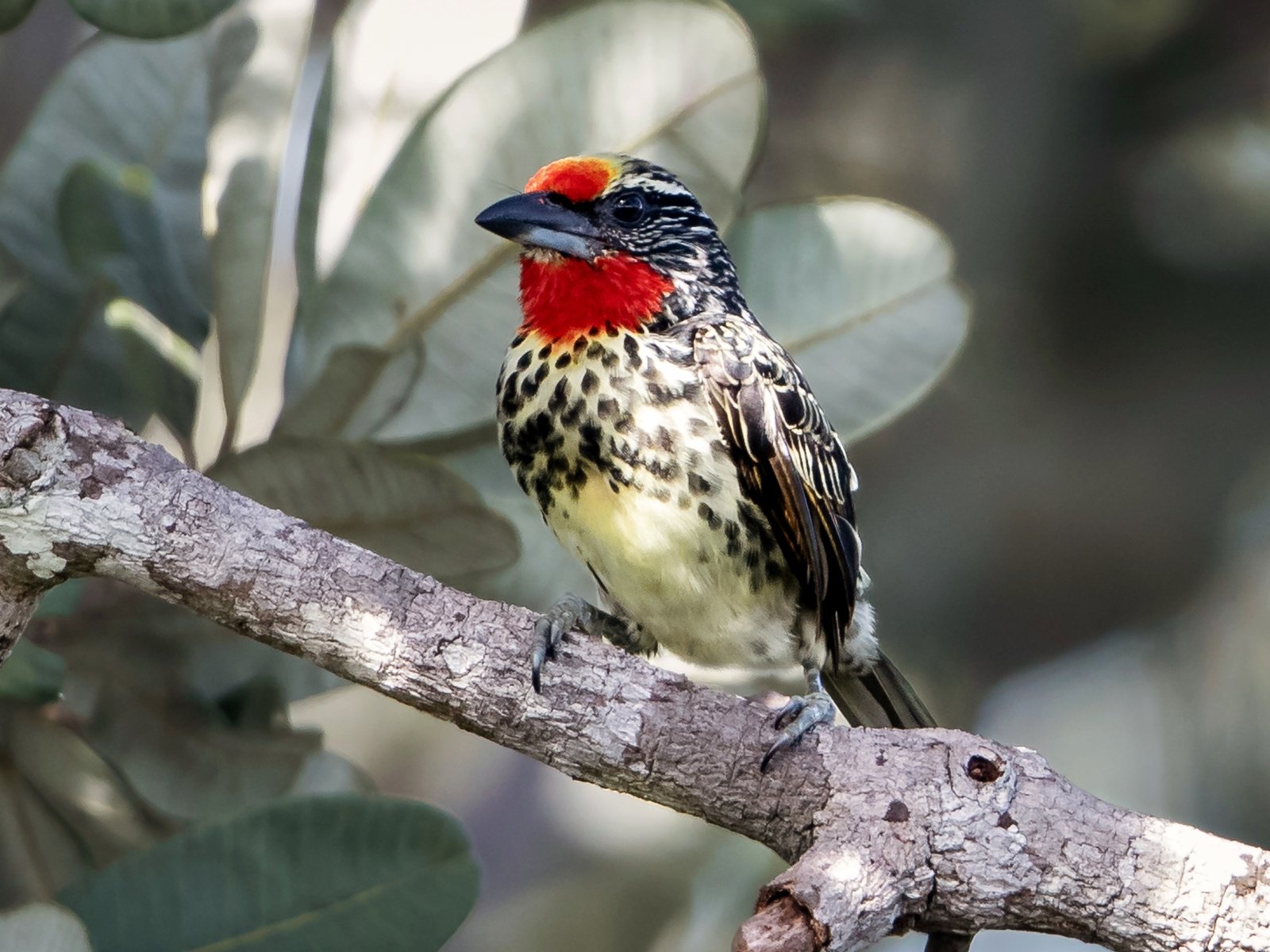
17–19 cm, stocky, with a heavy, conical black bill. The male is black above with yellow streaks on the back and a yellow supercilium; the throat is red to orange and the rest of the underparts is yellow, with black spots on the flanks. The female is much more heavily spotted with black below and has more yellow streaks on the upperparts.
Confusion species
Gilded Barbet Capito auratus, west of the range and throughout the Amazonian part of the guide area, is very similar and differs mainly in the colour of the throat and breast and in details of the pattern; in the field the two species are separated mainly by range.
Habitat
Humid terra firme lowland forest, forest edges and tall secondary forest, mainly in the canopy. It eats fruit and insects and joins mixed flocks. It nests in a self-excavated tree cavity.
Where the bird is most at home, classified by the vegetation units of the Andes and the west coast.


Range and movements
Does not occur in the guide area: absent from Colombia, Ecuador, Peru, Bolivia and the Galápagos. The range lies in eastern Venezuela, Guyana, Suriname and French Guiana, and north-eastern Brazil north of the Amazon.
- Resident
- dark = core range, pale = thinly spread
How and when to look
Not to be seen in the guide area. To see the species, search the rainforests of the Guianas for pairs in the canopy of forest edges.
Conservation status
Least Concern. The species has a large range in largely intact rainforest.
Scientific name
Capito niger | (Müller, 1776)
Müller described the species in 1776 as Bucco niger; because it was later moved to another genus, the author and year stand in brackets. The genus Capito was introduced in 1816 by Vieillot. The genus name comes from Latin capito, 'big-headed'. The species name comes from Latin niger, 'black'. The specimen the first description was based on came from Cayenne, French Guiana.