All species › Woodpeckers and allies › New World barbets › Five-colored Barbet
Five-colored Barbet | Capito quinticolor
Vijfkleurenbaardvogel | Cabezón cincocolores | Capitão-de-cinco-cores
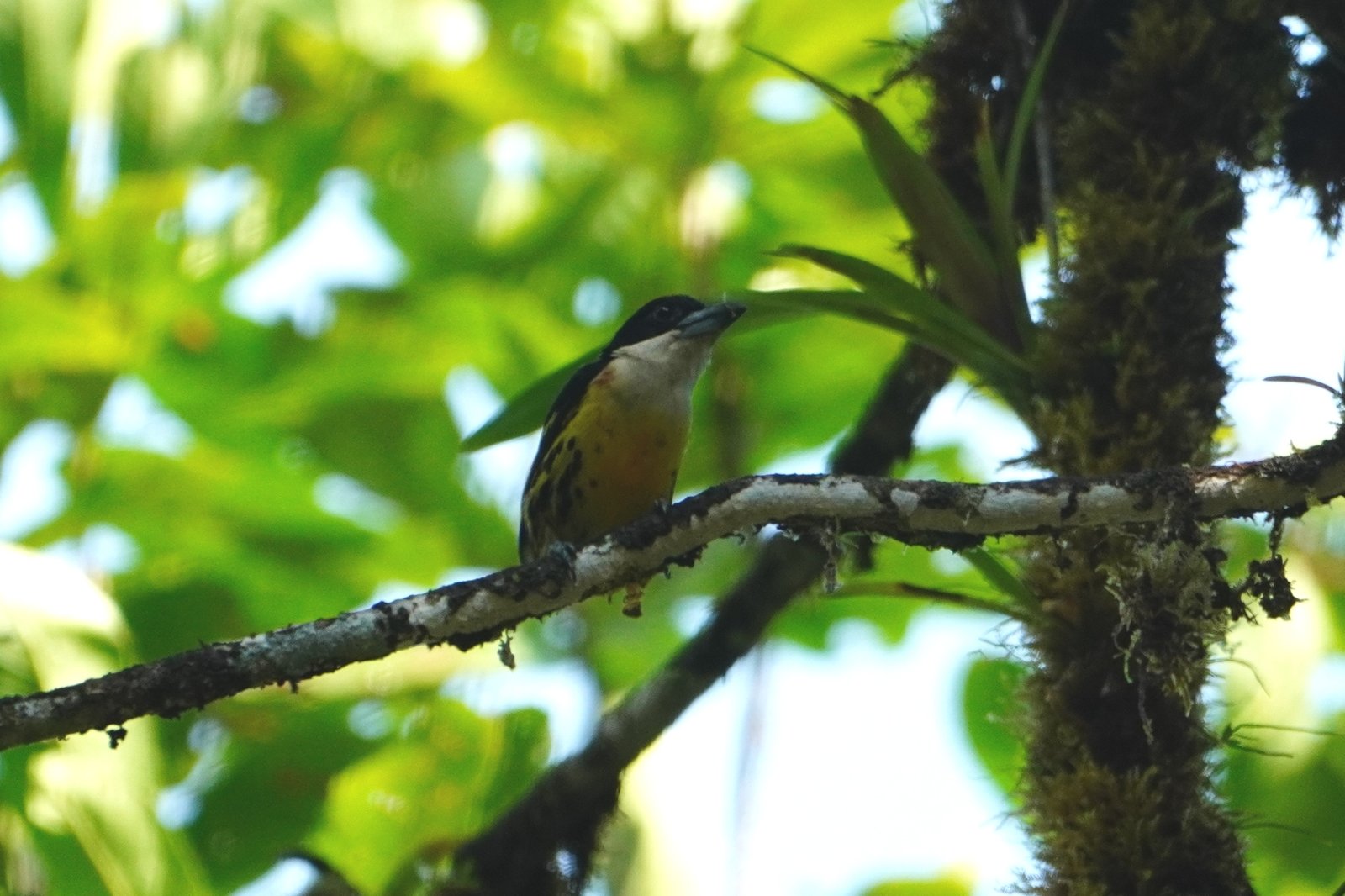
The Five-colored Barbet is a barbet of the Chocó rainforest in western Colombia and north-western Ecuador. It lives mainly in the interior of wet lowland forest, from the middle levels up to the canopy. The name refers to the combination of red, black, yellow, orange and white in the plumage.
Voice
Both sexes sing a low, hollow, rapidly repeated rolling trill of hoop notes. Also a guttural, rasping churr.
Recording: Olaf Jahn — CC BY-NC-SA 4.0 · xeno-canto
Identification
17–18 cm, stocky, with a heavy, conical bill. The male has a red crown and nape, black upperparts with a yellow V on the mantle and yellow wing bars. The throat and breast are yellow, becoming golden to orange on the belly; the flanks have black spots. The female is black above with dense golden-yellow streaks and has the same colours below, but with black spots throughout.
Confusion species
Orange-fronted Barbet Capito squamatus, further south in western Ecuador and extreme south-western Colombia, has an orange forehead and a white crown, with no red on the head and nape and no yellow markings on the back. No other Capito occurs alongside this species west of the Andes.
Habitat
Wet primary and mature secondary rainforest, forest edges and disturbed forest in the lowlands, mostly from sea level to about 350 m, locally to 600 m. It forages in the forest interior from the middle levels to the canopy, and lower at forest edges. It eats mainly fruit and some insects, and sometimes joins mixed flocks. Little is known about breeding; it probably breeds from April to July in a self-excavated tree cavity.
Where the bird is most at home, classified by the vegetation units of the Andes and the west coast.


Range and movements
In Colombia in the Pacific lowlands, from central Chocó south through Valle del Cauca, Cauca and Nariño. In Ecuador only in the north-west, in Esmeraldas. Absent from Peru, Bolivia and the Galápagos. Endemic to the guide area.
- Resident
- dark = core range, pale = thinly spread
How and when to look
Search wet lowland forest in Chocó and Esmeraldas, especially along forest trails and at fruiting trees in the middle canopy. Listen for the hollow, rolling song and watch for pairs in mixed flocks.
Conservation status
Near Threatened; from 2009 to 2020 the species was listed as Vulnerable. The population is thought to be small and is declining through the loss and fragmentation of lowland forest on the Pacific coast, through logging, oil palm plantations and mining, among other causes.
Scientific name
Capito quinticolor | Elliot, 1865
Elliot described the species in 1865 and placed it straight away in the genus where it still stands. The genus Capito was introduced in 1816 by Vieillot. The genus name comes from Latin capito, 'big-headed'. The species name combines Latin quinque, 'five', with color, 'colour', meaning 'five-coloured'. The specimen the first description was based on came from Colombia.