All species › Woodpeckers and allies › New World barbets › Sira Barbet
Sira Barbet | Capito fitzpatricki
Sirabaardvogel | Cabezón del Sira | Capitão-do-sira
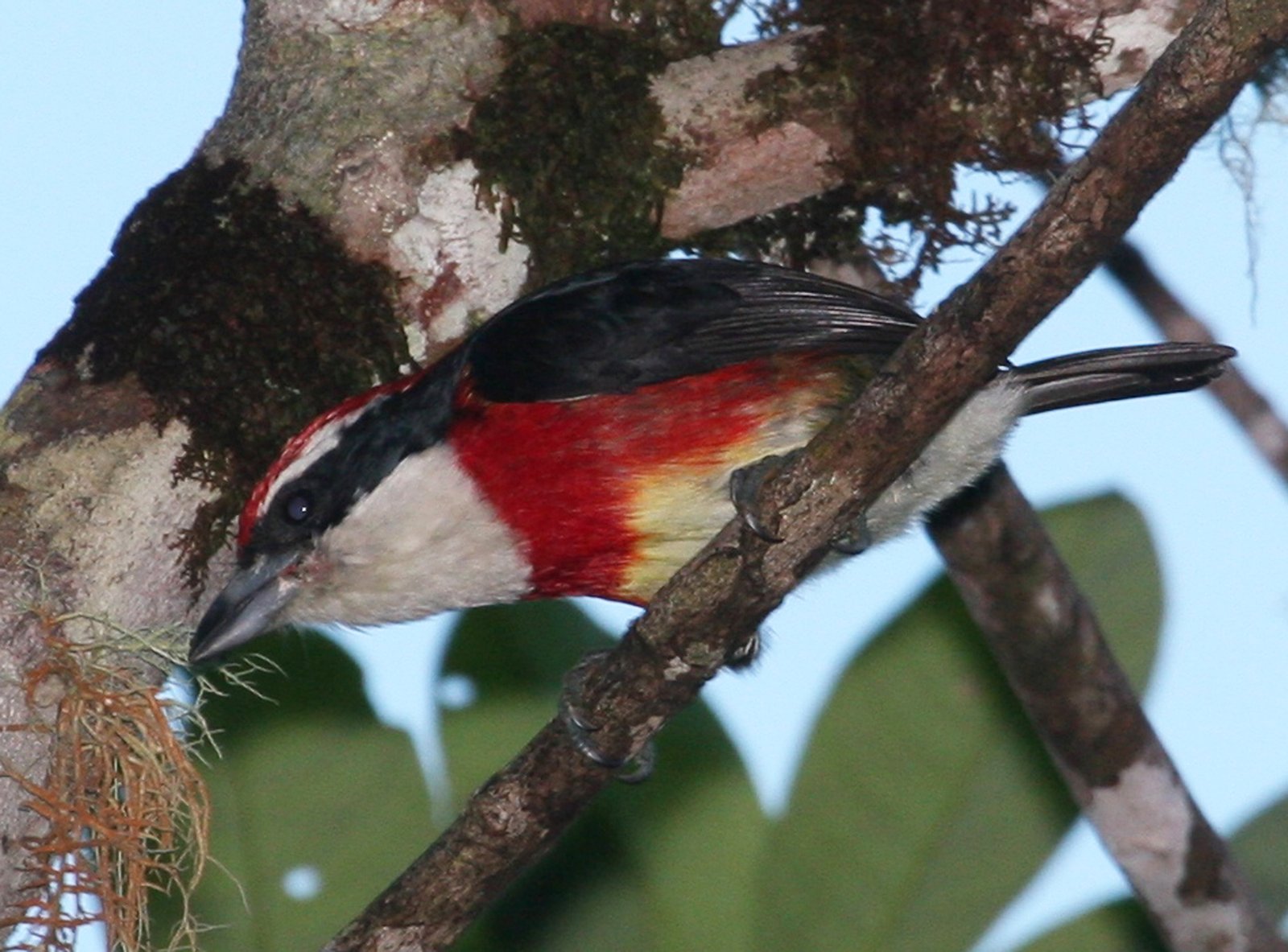
The Sira Barbet is a barbet that was described in 2012 from the Cerros del Sira, an isolated mountain massif in eastern Peru. It lives in the canopy of montane forest on the eastern slope of the southern part of that massif and occurs nowhere else. Not all taxonomic lists recognize it as a species; some treat it as part of Scarlet-banded Barbet.
Voice
A low, hollow, rapidly repeated series of notes, as in related Capito species. The song is poorly described.
No recording with a suitable Creative Commons licence is available for this species yet.
Identification
19–20 cm, with a large head and a heavy, pale bill. The male has a crimson crown and nape, a black mask and a broad white supercilium. The upperparts are black, with a fairly broad white band across the shoulders that narrows towards the tail. The face, throat, neck and upper breast are white. A broad, dark crimson band crosses the breast and extends down the flanks, where it merges into a variable amount of black or grey. The rest of the underparts is white. The female differs only slightly from the male.
Confusion species
Scarlet-banded Barbet Capito wallacei, on the Cordillera Azul further north, has a narrower and paler red breast band and yellow on the flanks and lower breast. Gilded Barbet Capito auratus occurs at lower elevations in the same massif and has a black head with a yellow supercilium, an orange throat and yellow underparts spotted with black.
Habitat
Tall montane forest up to 30 m high with epiphytes and mosses above an open understorey, and also lower forest with a denser understorey. Mostly between 950 and 1250 m, up to about 1700 m. It stays in the upper canopy and eats mainly fruit, often in pairs or with mixed flocks. Almost nothing is known about breeding.
Where the bird is most at home, classified by the vegetation units of the Andes and the west coast.


Range and movements
Only in Peru: on the eastern slope of the southern Cerros del Sira, in the Ucayali region, largely within the El Sira Communal Reserve. Absent from Colombia, Ecuador, Bolivia and the Galápagos. Endemic to Peru. No map is available for this species.
How and when to look
The Cerros del Sira can be reached only by expeditions along rivers and footpaths. Search the canopy of montane forest between 950 and 1250 m, preferably at fruiting trees.
Conservation status
Near Threatened. The known range is very small and the population is thought to be small, but the habitat lies largely within a protected area and no immediate threat is known.
Scientific name
Capito fitzpatricki | Seeholzer, Winger, Harvey, Cáceres A & Weckstein, 2012
Seeholzer, Winger, Harvey, Cáceres A & Weckstein described the species in 2012 and placed it straight away in the genus where it still stands. The genus Capito was introduced in 1816 by Vieillot. The genus name comes from Latin capito, 'big-headed'. The species name honours John W. Fitzpatrick, an American ornithologist, expert on the birds of Peru and director of the Cornell Lab of Ornithology. The specimen the first description was based on came from Cerros del Sira, Ucayali, Peru.