All species › Woodpeckers and allies › New World barbets › Scarlet-banded Barbet
Scarlet-banded Barbet | Capito wallacei
Roodbandbaardvogel | Cabezón de Loreto | Capitão-de-faixa-escarlate
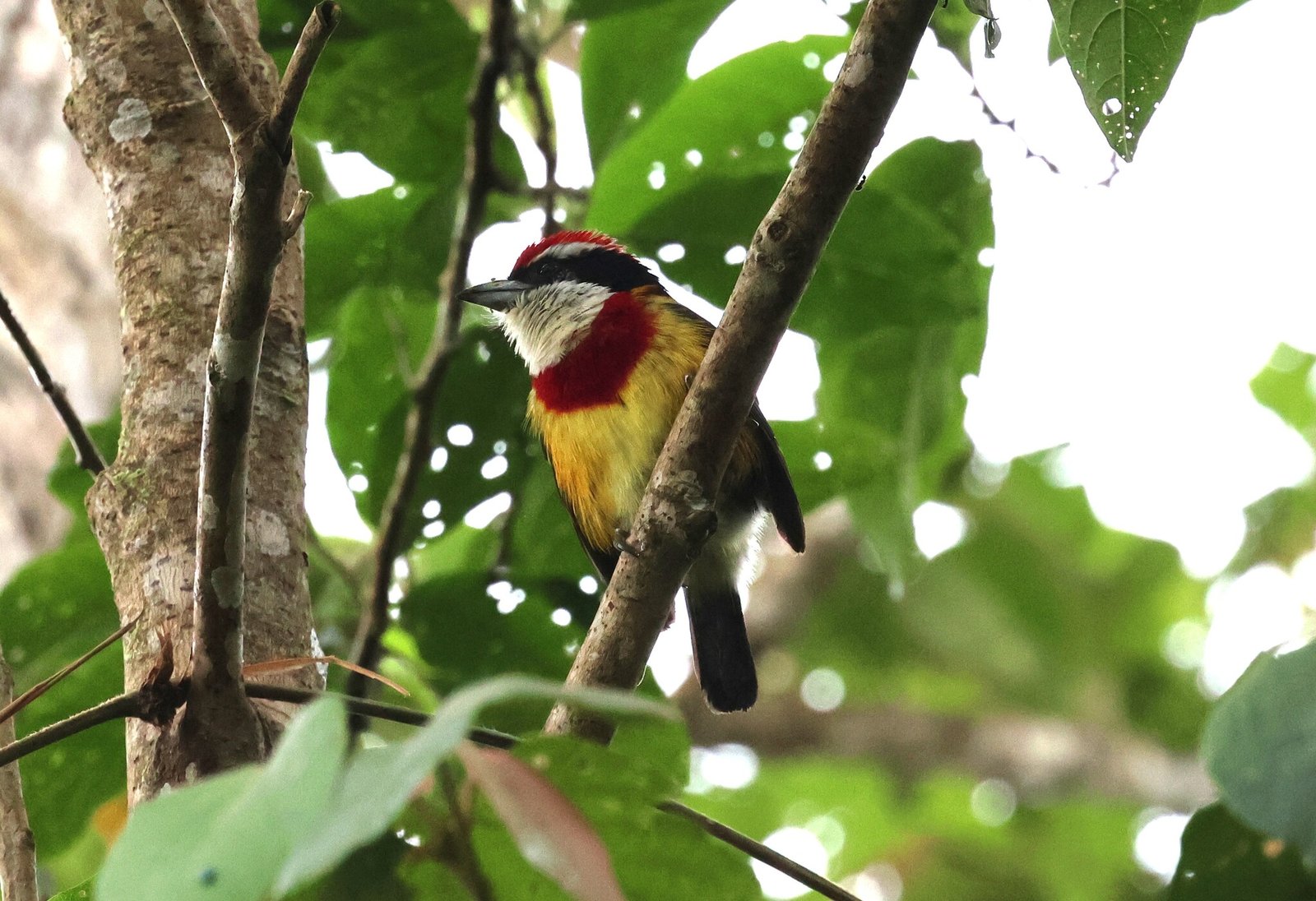
The Scarlet-banded Barbet is a barbet that was described only in 2000, after its discovery in 1996 on a remote ridge of the Cordillera Azul in northern Peru. It lives in the canopy of cloud forest on the ridges and occurs nowhere else. The broad scarlet breast band gives the species its name.
Voice
A low, hollow, rapidly repeated series of notes, as in related Capito species. The song is poorly described.
Recording: Juan Chalco — CC BY-NC-SA 4.0 · xeno-canto
Identification
19 cm, with a large head and a heavy, pale bill. The crown and nape are crimson. A black mask runs through the eye, with a broad white supercilium above it. The upperparts are black, with a white band across the shoulders that narrows towards the tail. The face, throat and upper breast are white; a broad scarlet band crosses the breast, with yellow on the lower breast and flanks below it. The rest of the underparts is white. The sexes are nearly alike.
Confusion species
Sira Barbet Capito fitzpatricki, in the Cerros del Sira further south, is very similar but has a wider and darker red breast band, and red instead of yellow on the flanks. Gilded Barbet Capito auratus, in the lower foothill forest below the range, has a black head with a yellow supercilium, an orange throat and yellow underparts spotted with black, without a red breast band.
Habitat
Tall cloud forest with mosses and epiphytes on the ridges of the Cordillera Azul, roughly between 1300 and 1600 m. It stays in the canopy, often in pairs and with mixed flocks. It eats mainly fruit and also insects. Like its relatives, it probably nests in a self-excavated tree cavity.
Where the bird is most at home, classified by the vegetation units of the Andes and the west coast.


Range and movements
Only in Peru: on a few ridges of the Cordillera Azul in eastern San Martín and south-western Loreto. Absent from Colombia, Ecuador, Bolivia and the Galápagos. Endemic to Peru.
- Resident
- dark = core range, pale = thinly spread
How and when to look
The range lies largely in and around Cordillera Azul National Park and can be reached only on foot over long distances. Search the canopy and fruiting trees from the ridges early in the morning.
Conservation status
Vulnerable. The known range is very small and the population is small. The national park protects much of the habitat, but deforestation in the lower surroundings may isolate the area further.
Scientific name
Capito wallacei | O'Neill, Lane, Kratter, Capparella & Fox Joo, 2000
O'Neill, Lane, Kratter, Capparella & Fox Joo described the species in 2000 and placed it straight away in the genus where it still stands. The genus Capito was introduced in 1816 by Vieillot. The genus name comes from Latin capito, 'big-headed'. The species name honours Major Robert Browne Wallace (1918–2002), US Army officer, businessman, philanthropist and environmentalist. The specimen the first description was based on came from Cordillera Azul, Peru.