All species › Woodpeckers and allies › New World barbets › White-mantled Barbet
White-mantled Barbet | Capito hypoleucus
Witrugbaardvogel | Cabezón dorsiblanco | Capitão-de-dorso-branco
The White-mantled Barbet is a barbet found only in Colombia, in the middle Magdalena Valley and on the adjacent slopes of the Central and Eastern Andes. It lives mainly in the canopy of forest and forest remnants and visits fruiting trees, including in plantations. Its closest relatives are Scarlet-banded Barbet and Sira Barbet in Peru.
Voice
A low, hollow, rapidly repeated series of notes, like a purring trill, often from a tall tree crown. Also rasping calls.
Recording: Ross Gallardy — CC BY-NC-SA 4.0 · xeno-canto
Identification
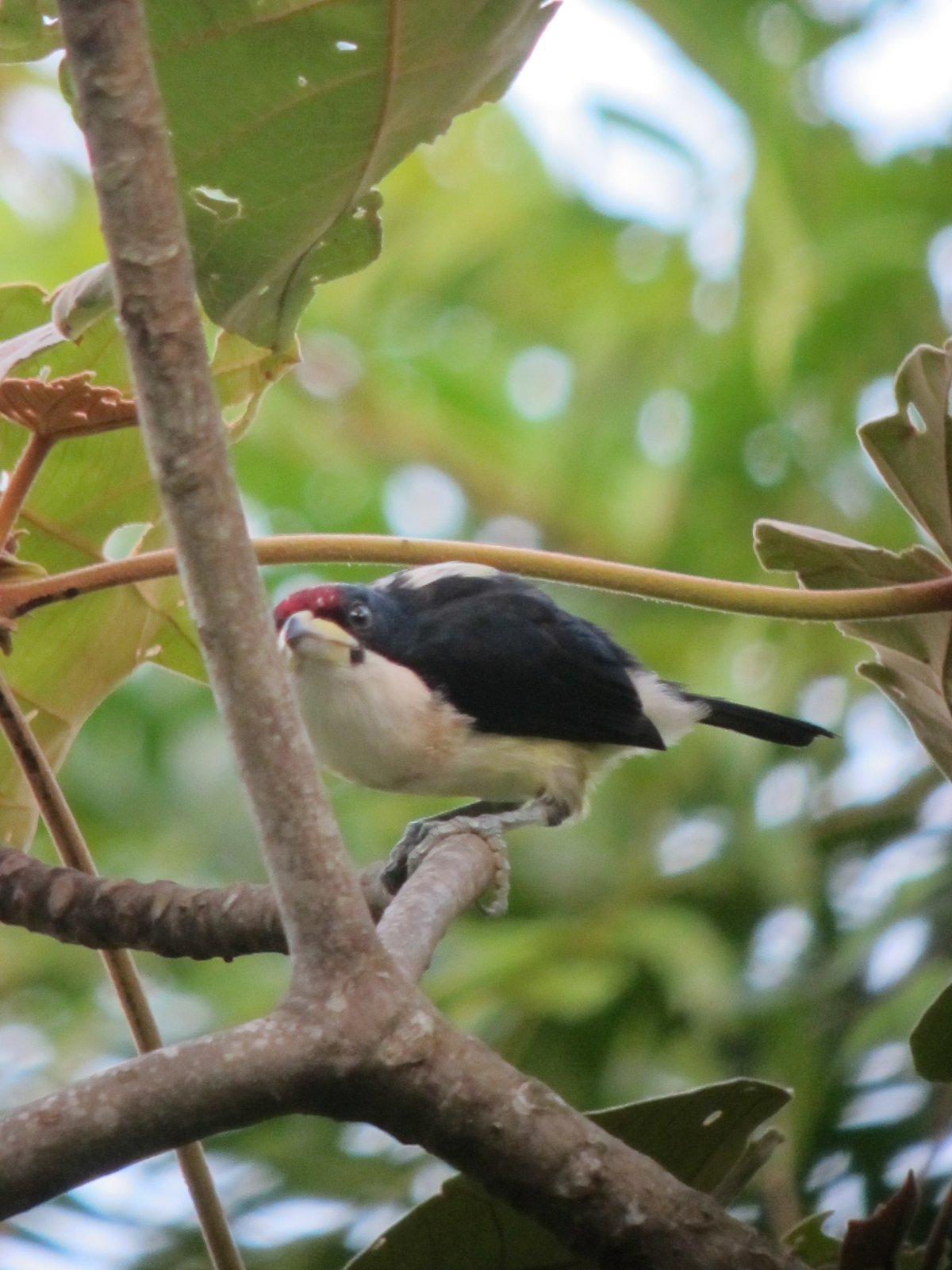
19 cm, with a large head and a heavy, yellowish bill. The forehead and crown are red; the rest of the upperparts is black, with narrow pale lines on the nape and scapulars. The underparts are white with a yellowish wash, with cinnamon on the breast. The eye is red and the legs are greenish grey. The sexes are nearly alike; the female has a black spot at the base of the lower mandible.
Confusion species
No other Capito occurs within its range. Gilded Barbet Capito auratus lives in the Amazonian lowlands east of the Andes and has yellow and orange underparts with black spots. Barbets of the genus Eubucco are smaller, with a green back.
Habitat
Humid montane and hill forest, forest remnants among pasture, secondary forest and plantations with fruiting trees, from about 200 to 1800 m, mostly between 600 and 1500 m. It usually stays high in the canopy. It eats mainly fruit, including Cecropia and mango, and also insects. It nests in a self-excavated cavity in a tree.
Where the bird is most at home, classified by the vegetation units of the Andes and the west coast.


Range and movements
Only in Colombia: in the middle Magdalena Valley and on its slopes, in Antioquia, Bolívar, Caldas and Santander, among others. Absent from Ecuador, Peru, Bolivia and the Galápagos. Endemic to Colombia.
- Resident
- dark = core range, pale = thinly spread
How and when to look
Search fruiting trees in forest remnants and coffee plantations in the foothills of the Magdalena Valley, for example around San Rafael and elsewhere in north-eastern Antioquia. Listen for the low, purring series from the tree crowns.
Conservation status
Least Concern. The range is small, however, and much of the original forest has disappeared through deforestation, illicit crops and small-scale gold mining. In Colombia the species is considered threatened.
Scientific name
Capito hypoleucus | Salvin, 1897
Salvin described the species in 1897 and placed it straight away in the genus where it still stands. The genus Capito was introduced in 1816 by Vieillot. The genus name comes from Latin capito, 'big-headed'. The species name combines Greek hupo, 'below', with leukos, 'white', meaning 'white below'. The specimen the first description was based on came from Valdivia, Antioquia, Colombia.