All species › Woodpeckers and allies › New World barbets › Orange-fronted Barbet
Orange-fronted Barbet | Capito squamatus
Geschubde baardvogel | Cabezón escamoso | Capitão-de-fronte-laranja
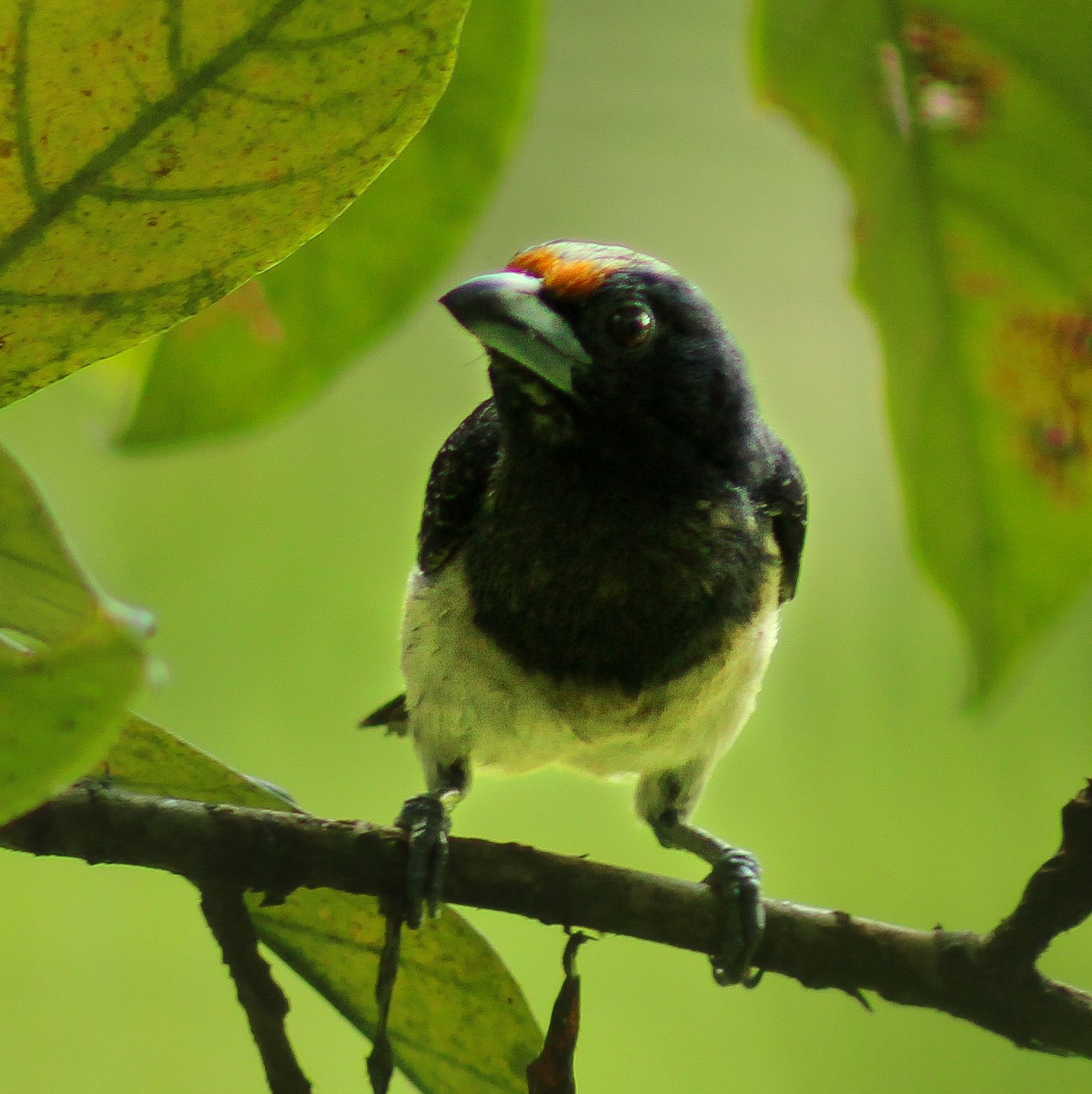
The Orange-fronted Barbet is a barbet of humid lowland and hill forest on the Pacific side of Ecuador and in extreme south-western Colombia. Male and female differ clearly: the male has a white crown and a pale breast, the female a black throat and breast. The scientific name squamatus ('scaled') refers to the fine white markings on the female's upperparts.
Voice
The song is a low-pitched, very fast, soft, purring trill. The call is a rasping tyik or trrik.
Recording: Olaf Jahn — CC BY-NC-SA 4.0 · xeno-canto
Identification
16–18 cm, a stocky bird with a large head, a heavy, conical bill and a fairly short tail. The male has an orange to orange-red forehead, a white crown, a black head and black upperparts, with some white feathers that remain visible in the folded wing. The underparts from chin to belly are yellowish white, sometimes tinged orange, with fine black spots on the flanks and a black vent. The female has a yellow-orange forehead and a black head, throat and breast; the upperparts are black with fine white markings on the wing coverts.
Confusion species
Five-colored Barbet Capito quinticolor, in the Chocó north of the range, has a red crown and nape, a yellow V on the mantle and yellow to orange underparts. White-mantled Barbet Capito hypoleucus occurs only in the interior of Colombia and has a red crown. No other barbets occur in western Ecuador.
Habitat
Humid lowland and hill forest, primary and secondary, and forest edges; also semi-open country with trees, such as orchards, cacao plantations and pasture with scattered trees. Mostly from sea level to about 800 m, locally to 1500 m. It eats mainly fruit and berries, supplemented by insects and spiders; it forages in pairs at all levels of the vegetation and joins mixed flocks. It nests in a self-excavated cavity in a tree, several metres above the ground.
Where the bird is most at home, classified by the vegetation units of the Andes and the west coast.


Range and movements
In Colombia only in the extreme south-west, in Nariño. In Ecuador in the western lowlands and the foothills of the Andes, from Esmeraldas south to El Oro. Absent from Peru, Bolivia and the Galápagos. Endemic to the guide area.
- Resident
- dark = core range, pale = thinly spread
How and when to look
Search forest edges and fruiting trees in the western lowlands of Ecuador, for example in Esmeraldas and the foothills west of the Andes. Watch for pairs moving with mixed flocks and listen for the purring song.
Conservation status
Least Concern. The range is small and the population is declining due to deforestation in western Ecuador, but the species tolerates semi-open, human-modified land with trees.
Scientific name
Capito squamatus | Salvin, 1876
Salvin described the species in 1876 and placed it straight away in the genus where it still stands. The genus Capito was introduced in 1816 by Vieillot. The genus name comes from Latin capito, 'big-headed'. The species name comes from Latin squamatus, 'scaly'. The specimen the first description was based on came from Santa Rita, Ecuador.