All species › Woodpeckers and allies › New World barbets › Spot-crowned Barbet
Spot-crowned Barbet | Capito maculicoronatus
Roodflankbaardvogel | Cabezón pechiblanco | Capitão-de-coroa-pintada
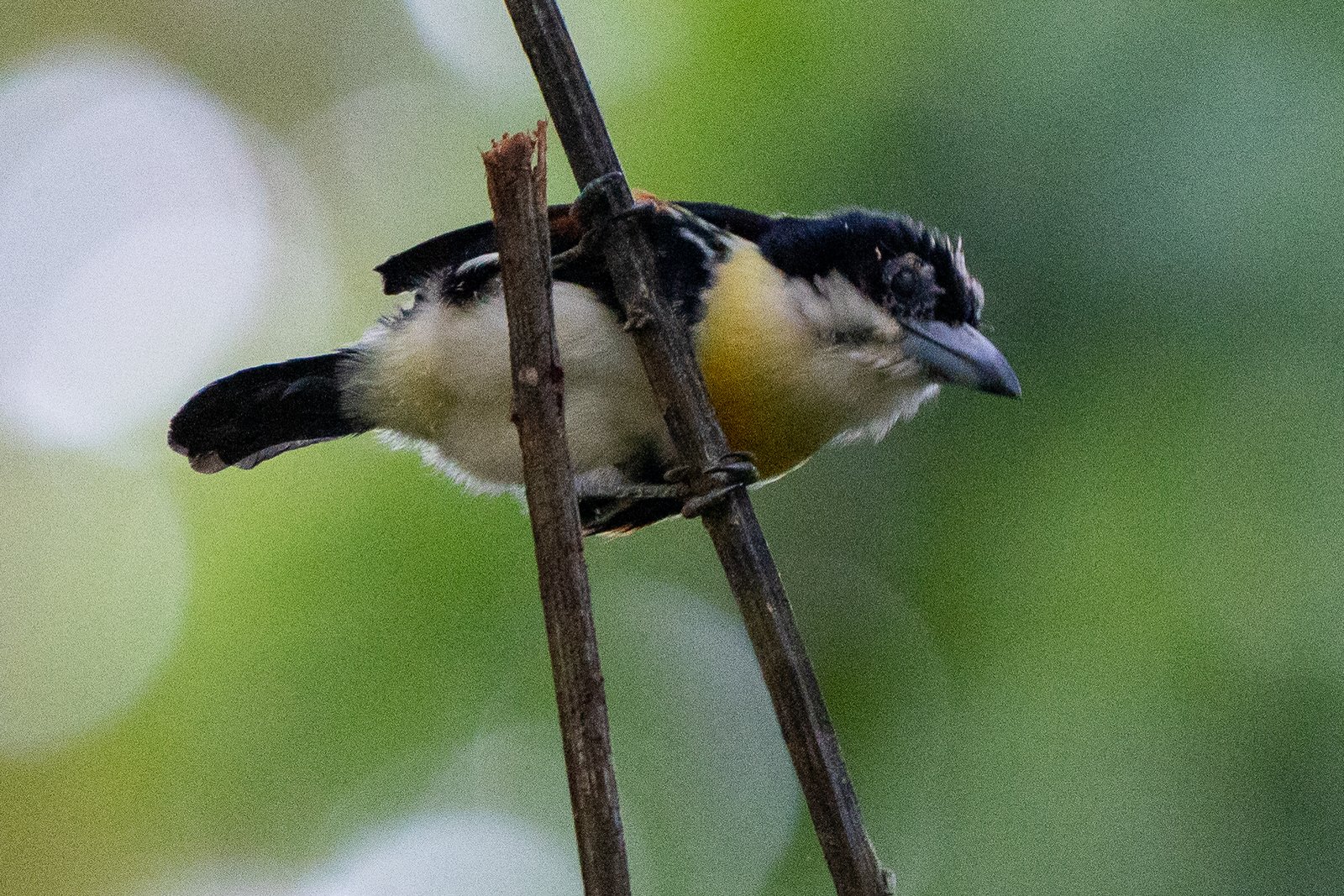
The Spot-crowned Barbet is a black-and-white barbet of humid forest in eastern Panama and north-western Colombia. Colombian birds have an orange to red patch on the flanks, to which the Dutch name refers. Male and female differ in the colour of the throat and breast.
Voice
A series of harsh, rasping notes that gradually changes in sound; it serves as both song and call.
Recording: Jerome Fischer — CC BY-NC-SA 4.0 · xeno-canto
Identification
16–18 cm, robust, with a heavy, conical bill. The upperparts are mostly black, the crown black with brownish-white spots. The male has a white throat, a yellow to orange upper breast and a white lower breast and belly with black spots; on the flanks an orange to red patch. The female has a black throat and upper breast. The Colombian subspecies has more white on the crown and a redder flank patch. Juveniles are duller.
Confusion species
Five-colored Barbet Capito quinticolor lives further south on the Pacific slope; the male has a red crown and yellow streaks on the back. White-mantled Barbet Capito hypoleucus has a white mantle and a red forehead and lives in the Magdalena valley. Orange-fronted Barbet Capito squamatus has an orange forehead and a white patch on the back, and lives in south-western Colombia and western Ecuador.
Habitat
Humid primary forest in the lowlands and hill country, also forest edges and secondary forest, from the lowlands up to about 1000 m, locally to 1200 m. It eats fruit and insects in the canopy, often with mixed flocks. It nests in a cavity in dead wood.
Where the bird is most at home, classified by the vegetation units of the Andes and the west coast.


Range and movements
In Colombia in the north-west: the Chocó, Urabá and the northern Pacific lowlands, east to Antioquia and south to Valle del Cauca. Absent from Ecuador, Peru, Bolivia and the Galápagos. Outside the guide area in eastern and central Panama.
- Resident
- dark = core range, pale = thinly spread
How and when to look
Search forest edges and fruiting trees in the lowlands and foothills of the Chocó, for example around Bahía Solano or in Urabá. The harsh call series gives the bird away in the canopy.
Conservation status
Least Concern. The species tolerates secondary forest and forest edges, but deforestation in the Chocó is a local threat.
Scientific name
Capito maculicoronatus | Lawrence, 1861
Lawrence described the species in 1861 and placed it straight away in the genus where it still stands. The genus Capito was introduced in 1816 by Vieillot. The genus name comes from Latin capito, 'big-headed'. The species name combines Latin macula, 'spot', with coronatus, 'crowned', meaning 'spot-crowned'. The specimen the first description was based on came from Atlantic side of the Isthmus, Panama.