All species › Passerines › Tanagers and allies › Black-throated Flowerpiercer
Black-throated Flowerpiercer | Diglossa brunneiventris
Zwartkeelberghoningkruiper | Pinchaflor gorjinegro | Fura-flor-de-garganta-preta
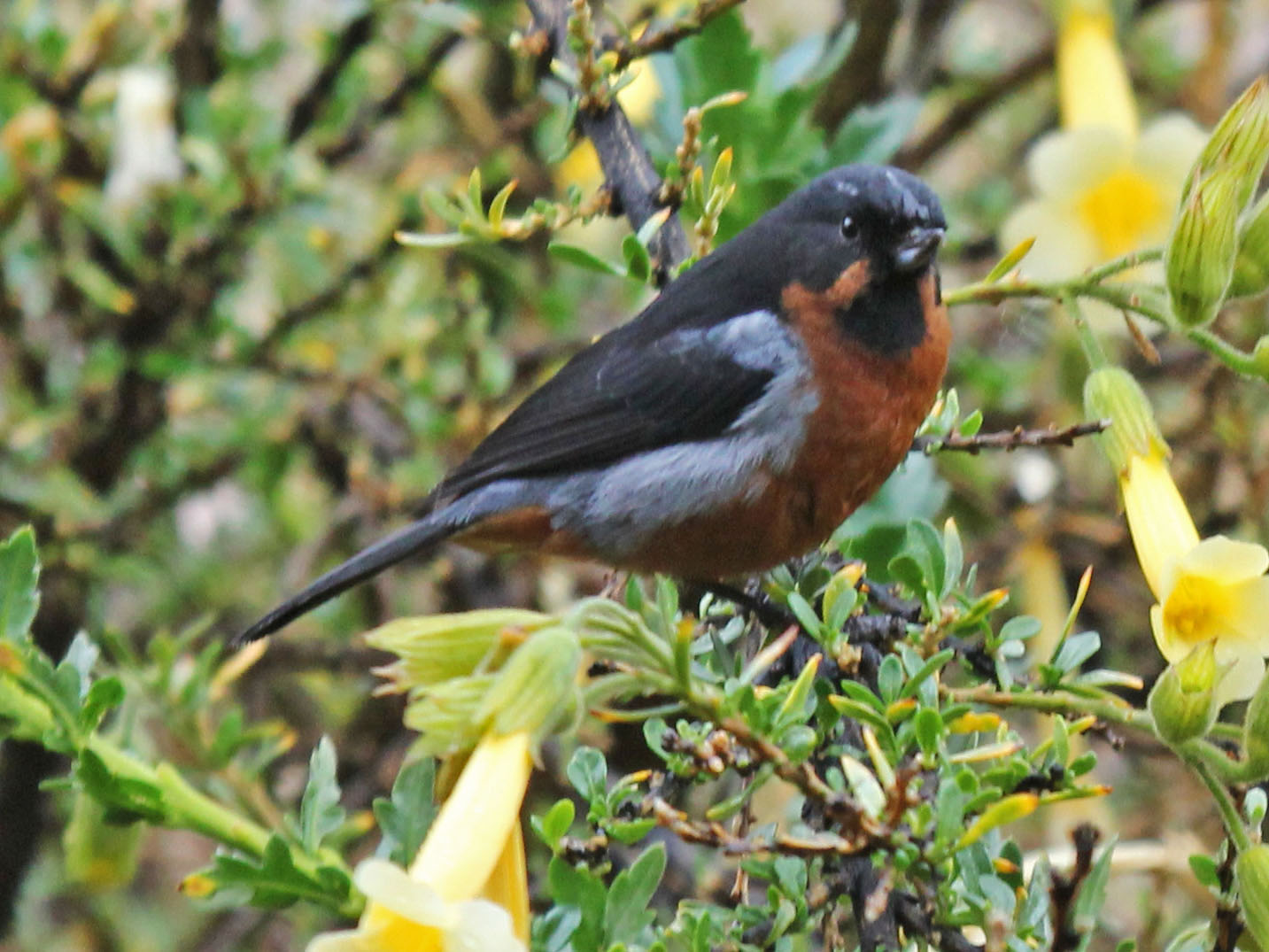
The Black-throated Flowerpiercer is a black flowerpiercer with a chestnut belly and a grey malar stripe, found in scrub and hedgerows in the Andes of Peru and Bolivia. It also occurs in drier valleys and in village gardens. A small, isolated population lives far to the north in the Central Andes of Colombia.
Voice
The song is a fast, high, twittering and trilling series of notes; the call is a short, metallic tsit.
Recording: Nick Athanas — CC BY-NC-SA 3.0 · xeno-canto
Identification
14 cm, with an upturned bill with a hooked tip. The head, throat and upperparts are black, with a blue-grey shoulder patch and a grey rump. A narrow grey malar stripe separates the black throat from the cheek. The breast and belly are chestnut, the flanks grey. The sexes are alike; juveniles are browner and streaked below.
Confusion species
Grey-bellied Flowerpiercer Diglossa carbonaria in Bolivia has a grey rather than chestnut belly; intermediate birds are reported locally. Moustached Flowerpiercer Diglossa mystacalis lives in wetter forest at the treeline and has a white or creamy malar stripe and a black belly with rufous undertail coverts. Black Flowerpiercer Diglossa humeralis in the north is entirely black. Rusty Flowerpiercer Diglossa sittoides is blue-grey above and has a rusty throat.
Habitat
Scrub, hedgerows, Polylepis groves, shrubby slopes, field margins and gardens, also in fairly dry inter-Andean valleys, mostly between about 2500 and 4200 m. It pierces the side of flower corollas for nectar and also eats insects. The nest is a cup in a shrub.
Where the bird is most at home, classified by the vegetation units of the Andes and the west coast.


Range and movements
In Colombia only a small, isolated population in the Central Andes. Absent from Ecuador. In Peru widespread in the Andes, from north to south, on both slopes and in the inter-Andean valleys. In Bolivia in the western Andes, south to about Cochabamba. Absent from the Galápagos. Outside the guide area in the far north of Chile.
- Resident
- dark = core range, pale = thinly spread
How and when to look
Look in villages and along hedgerows in the Peruvian highlands at flowering shrubs and garden flowers; the bird is restless and also present in built-up areas.
Conservation status
Least Concern. Common and widespread in Peru; the isolated population in Colombia is small.
Scientific name
Diglossa brunneiventris | de Lafresnaye, 1846
De Lafresnaye described the species in 1846 and placed it straight away in the genus where it still stands. The genus Diglossa was introduced in 1832 by Wagler. The genus name comes from Greek diglōssos, 'double-tongued' or 'speaking two languages'. The specific name comes from Medieval Latin brunneus, 'brown', and Latin venter, 'belly': brown-bellied. The specimen the first description was based on came from Peru.