All species › Swifts › Hummingbirds › Black-throated Hermit
Black-throated Hermit | Phaethornis atrimentalis
Zwartkeelheremietkolibrie | Ermitaño golinegro | Rabo-branco-de-garganta-escura
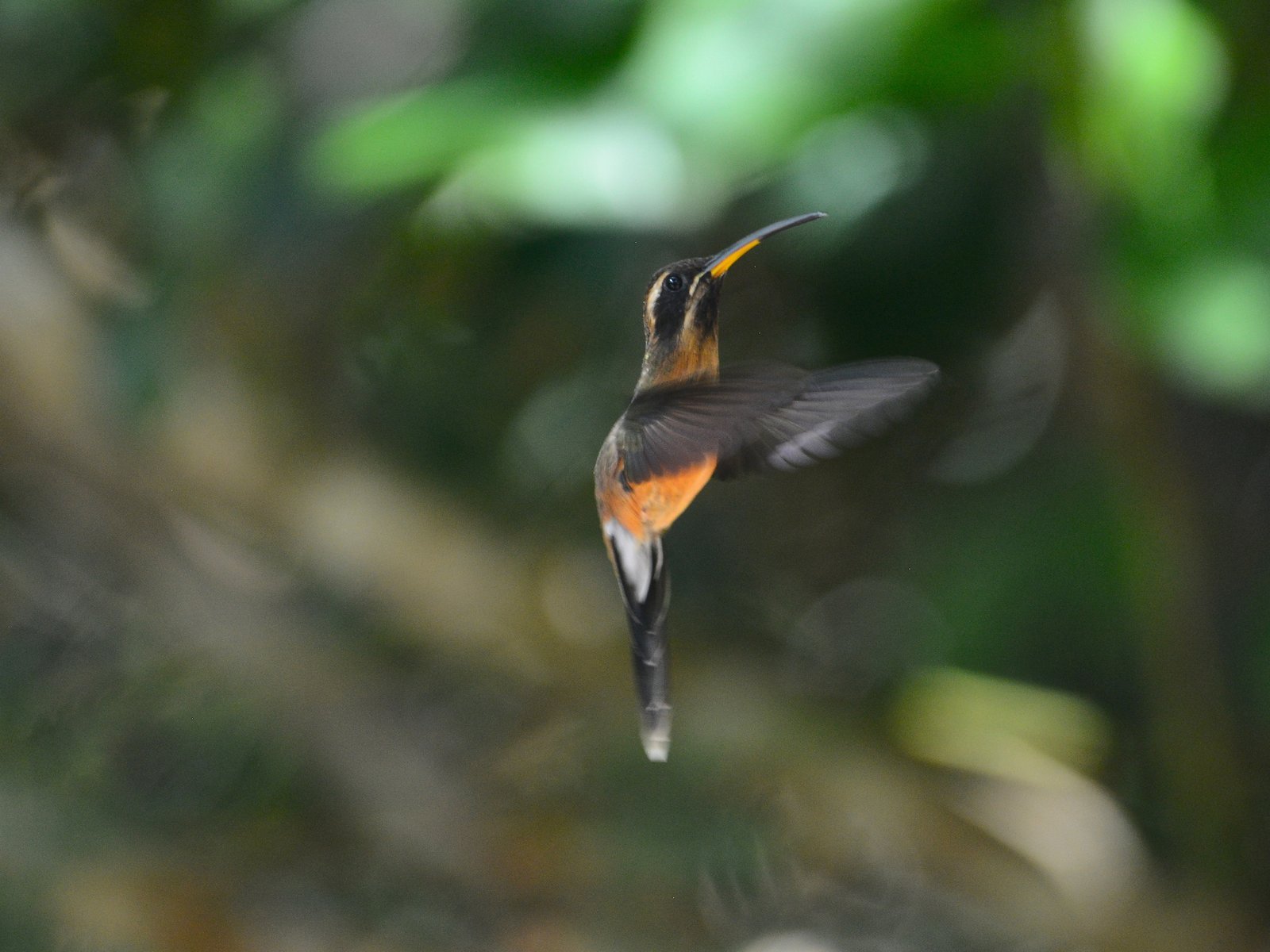
The Black-throated Hermit is a small hermit of the understorey of Amazonian forest and the foothills on the eastern side of the Andes. It belongs to the group of small, rufous hermits and is identified by the blackish stripe down the centre of the throat. Like other hermits it follows a fixed route along flowers, and males sing in groups (leks) in the undergrowth.
Voice
The male's song is a high, squeaky, rapidly repeated series of notes, kept up for long periods from a low perch in the lek. The call is a thin, sharp tsip, often in flight.
Recording: Mauricio Cuéllar Ramírez — CC BY-NC-SA 4.0 · xeno-canto
Identification
9 cm, with a slightly decurved bill and a graduated tail. The upperparts are bronzy green, the rump and uppertail coverts rufous. The head has a dark mask, with a buff supercilium and malar stripe. The underparts are warm cinnamon, with a blackish stripe down the centre of the throat. The tail is dark with buff tips; the central feathers are slightly elongated, with whitish tips. The sexes are nearly alike.
Confusion species
Reddish Hermit Phaethornis ruber is even smaller and brighter rufous below, without a dark throat; the male has a narrow black breast band. Grey-chinned Hermit Phaethornis griseogularis has a grey chin and throat and lives mainly higher, in foothill and montane forest. Stripe-throated Hermit Phaethornis striigularis has a finely streaked throat and lives west of the Andes.
Habitat
Understorey and edges of humid lowland forest, várzea, secondary forest and riverside scrub, from the lowlands up to about 1100 m. It visits flowers of, among others, heliconias, Heliconia, along a fixed route and catches small arthropods. The nest is a cone-shaped cup of plant fibres and spider silk, fixed to the underside of a hanging leaf.
Where the bird is most at home, classified by the vegetation units of the Andes and the west coast.


Range and movements
In Colombia east of the Andes, mainly in the south. In Ecuador in the Amazonian lowlands and the foothills of the eastern slope. In Peru in the northern and central Amazonian lowlands and foothills. Absent from Bolivia and the Galápagos. Outside the guide area in the far west of Brazil.
- Resident
- dark = core range, pale = thinly spread
How and when to look
Wait at flowering heliconias along forest edges and trails in the lowlands and foothills of Ecuador and northern Peru, for example around the lodges along the Napo. A singing lek is heard before the birds are seen; they perch low and stay long on the same twig.
Conservation status
Least Concern. The species also uses secondary forest and forest edges.
Scientific name
Phaethornis atrimentalis | Lawrence, 1858
Lawrence described the species in 1858 and placed it straight away in the genus where it still stands. The genus Phaethornis was introduced in 1827 by Swainson. The genus name combines Ancient Greek phaethōn, 'sun', with ornis, 'bird'. The species name combines Latin ater, 'black', with mentum, 'chin', after the dark chin and throat. The specimen the first description was based on came from Napo, Ecuador.