All species › Swifts › Hummingbirds › Stripe-throated Hermit
Stripe-throated Hermit | Phaethornis striigularis
Kleine streepkeelheremietkolibrie | Ermitaño enano | Rabo-branco-de-garganta-listrada
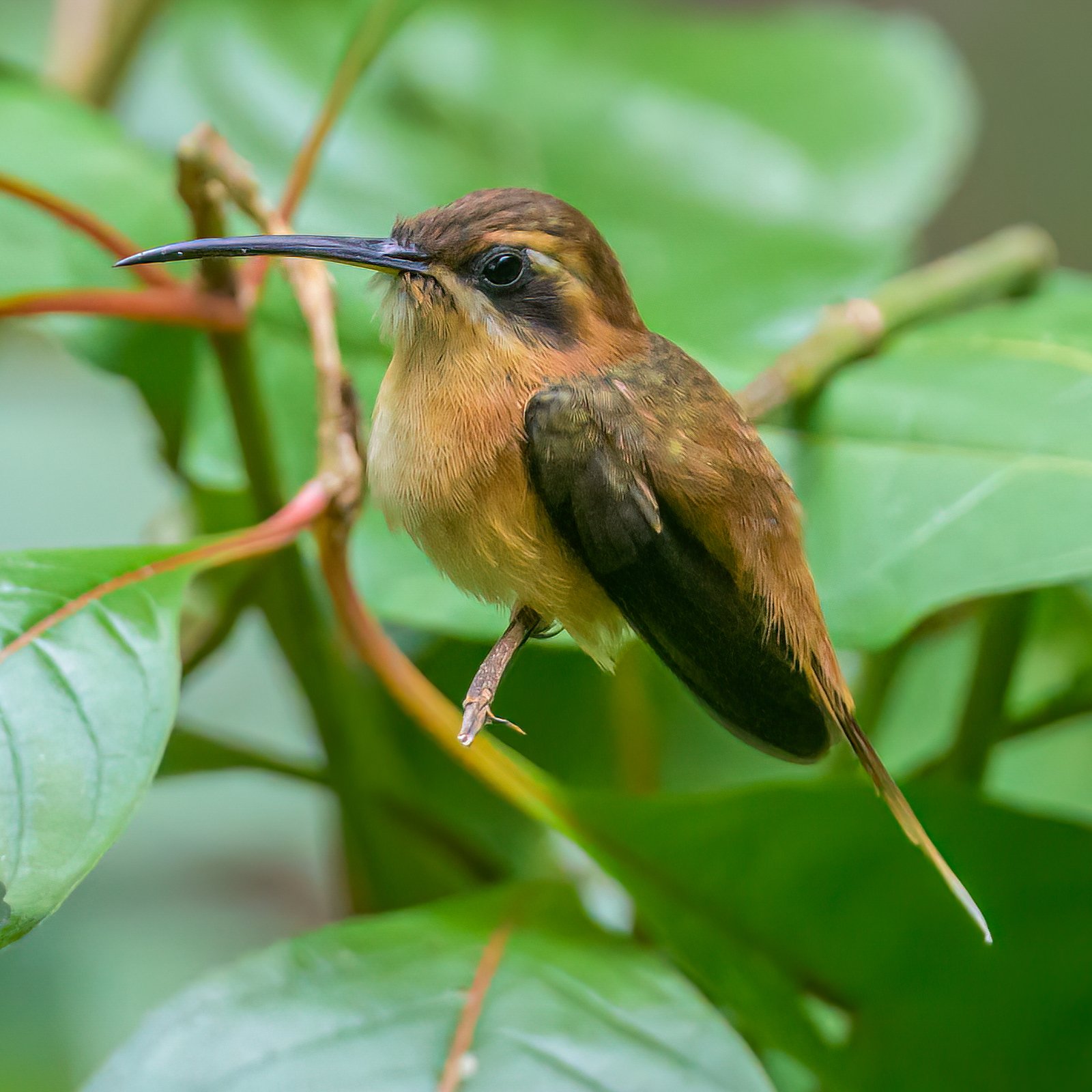
The Stripe-throated Hermit is the smallest hermit west of the Andes. It lives in the understorey of humid forest, secondary forest and shady plantations and visits a fixed route of flowers. Males sing in groups (leks) from low branches in the undergrowth.
Voice
The song is a high, squeaky, constantly repeated series of notes from the lek. The call is a thin tseep, often in flight.
Recording: Juan Freile — CC BY-NC-SA 4.0 · xeno-canto
Identification
9 cm, with a slightly decurved bill and a graduated tail. The upperparts are bronzy green, the rump rufous. The head has a dark mask with a buff supercilium and malar stripe. The underparts are buffy brown to cinnamon; the throat is paler, with fine dark streaks. The tail is dark with buff tips; the central feathers are slightly elongated, with pale tips. The sexes are nearly alike.
Confusion species
White-whiskered Hermit Phaethornis yaruqui and Long-billed Hermit Phaethornis longirostris are much larger, with long white central tail feathers. Pale-bellied Hermit Phaethornis anthophilus is larger and whitish below, without a rufous rump. Black-throated Hermit Phaethornis atrimentalis is very similar, but has a blackish throat stripe and lives east of the Andes.
Habitat
Understorey and edges of humid lowland and lower montane forest, secondary forest, scrub and shady plantations, from sea level up to about 1500 m. It visits flowers of heliconias and other understorey plants and catches small arthropods. The cone-shaped nest hangs from the underside of a leaf.
Where the bird is most at home, classified by the vegetation units of the Andes and the west coast.


Range and movements
In Colombia in the Pacific and Caribbean lowlands, the Magdalena and Cauca valleys and the north-east. In Ecuador in the western lowlands and foothills, south to about El Oro. Absent from Peru, Bolivia and the Galápagos. Outside the guide area from southern Mexico to Panama and in northern Venezuela.
- Resident
- dark = core range, pale = thinly spread
How and when to look
Watch flowering heliconias along forest trails and in shady cacao and coffee plantations in western Ecuador and Colombia. Birds fly fast and low from flower to flower; waiting at a flowering plant gives the best chance.
Conservation status
Least Concern. It tolerates secondary forest and plantations with shade trees.
Scientific name
Phaethornis striigularis | Gould, 1854
Gould described the species in 1854 and placed it straight away in the genus where it still stands. The genus Phaethornis was introduced in 1827 by Swainson. The genus name combines Ancient Greek phaethōn, 'sun', with ornis, 'bird'. The species name combines Latin stria, 'stripe', with gula, 'throat', after the striped throat. The specimen the first description was based on came from Bogotá, Colombia.