All species › Birds of prey › Kites, Old World vultures, eagles and hawks › Black-winged Kite
Black-winged Kite | Elanus caeruleus
Grijze wouw | Elanio común | Peneireiro-cinzento
The Black-winged Kite is the open-country kite of Africa, southern Europe and southern Asia, the Old World counterpart of the White-tailed Kite. For a long time the two were treated as one species. In the guide area it is listed only as an extremely rare vagrant, with no regular site or season.
Voice
A high, whistled pee-u and a rasping call at the nest; usually silent away from the breeding range.
Recording: Tony Rinaud — CC BY-NC-SA 4.0 · xeno-canto
Identification
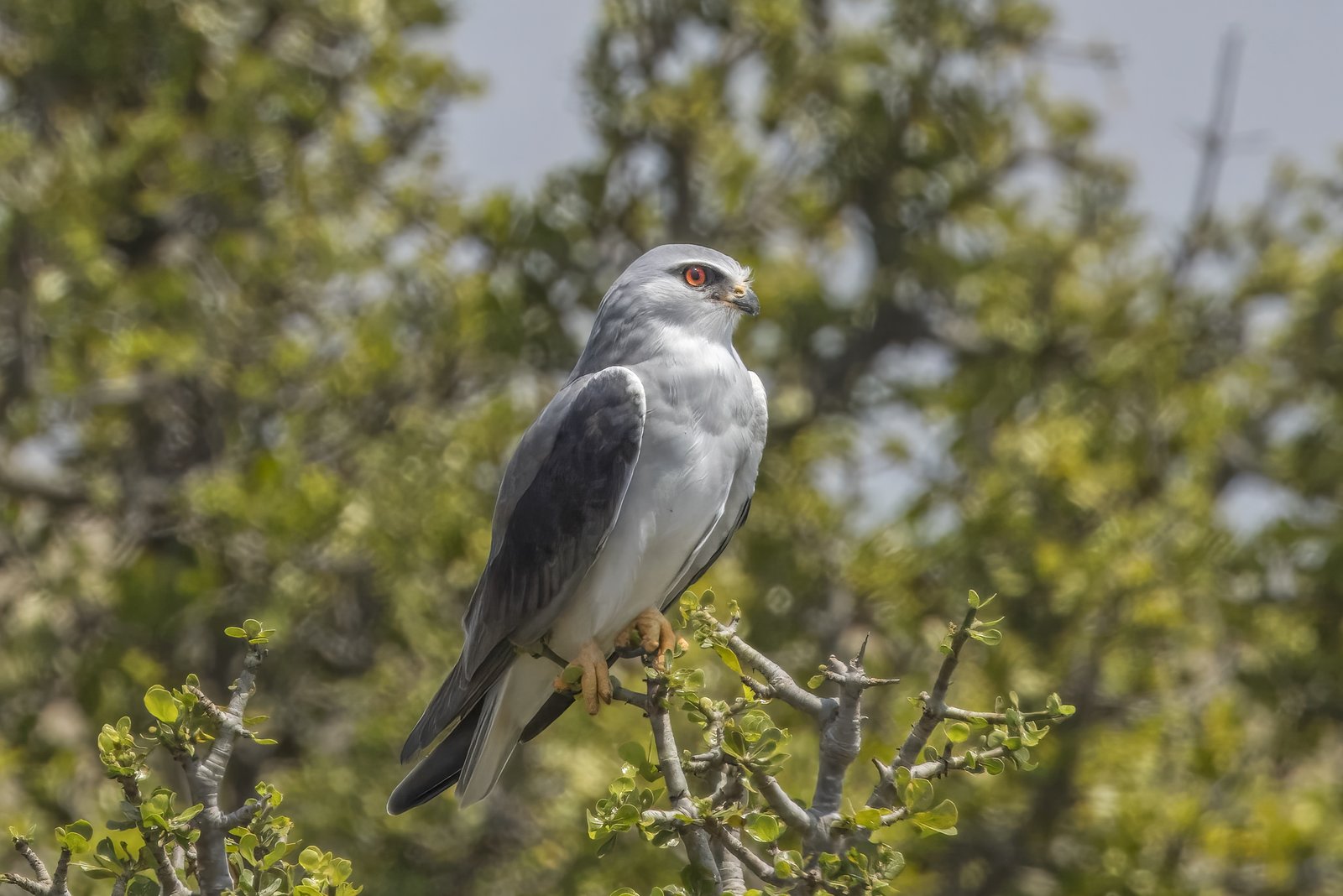
31–35 cm, compact, with a large head, long, pointed wings and a fairly short, slightly notched tail. The adult is pale grey above and white below, with a black patch on the upperwing coverts, a black patch in front of and above the eye and a red iris. In flight the primaries are blackish below, contrasting with the white underwing coverts. The sexes are alike. Juveniles have a brownish-tinged head and breast and pale fringes to the back feathers.
Confusion species
White-tailed Kite Elanus leucurus is widespread in the guide area; it is larger, with a clearly longer white tail, a smaller black carpal patch on the underwing and only dark tips to the primaries. A claim of Black-winged Kite needs good photographs of the underwing and tail.
Habitat
In its own range savanna, grassland, farmland and other open country with scattered trees, mainly in the lowlands. It hunts from a perch or after hovering, taking small rodents, lizards and large insects.
Where the bird is most at home, classified by the vegetation units of the Andes and the west coast.


Range and movements
In the guide area only an exceptional vagrant; there is no regular population in Colombia, Ecuador, Peru or Bolivia or on the Galápagos, and no convincingly documented record is known. Outside the guide area in sub-Saharan Africa, the Iberian Peninsula and Morocco, and from the Middle East to South and South-East Asia and New Guinea.
How and when to look
Any Elanus-type kite in the guide area is almost certainly a White-tailed Kite. With an unusual bird, check the tail length and the colour of the underside of the primaries.
Conservation status
Least Concern. At most a vagrant in the guide area.
Scientific name
Elanus caeruleus | (Desfontaines, 1789)
Desfontaines described the species in 1789 as Falco caeruleus; because it was later moved to another genus, the author and year stand in brackets. The genus Elanus was introduced in 1809 by De Savigny. The genus name comes from Greek elanos, 'kite'. The species name comes from Latin caeruleus, 'blue', for the blue-grey plumage. The specimen the first description was based on came from Algiers, Algeria.