All species › Birds of prey › Kites, Old World vultures, eagles and hawks › Cooper's Hawk
Cooper's Hawk | Astur cooperii
Coopers sperwer | Gavilán de Cooper | Gavião-de-cooper
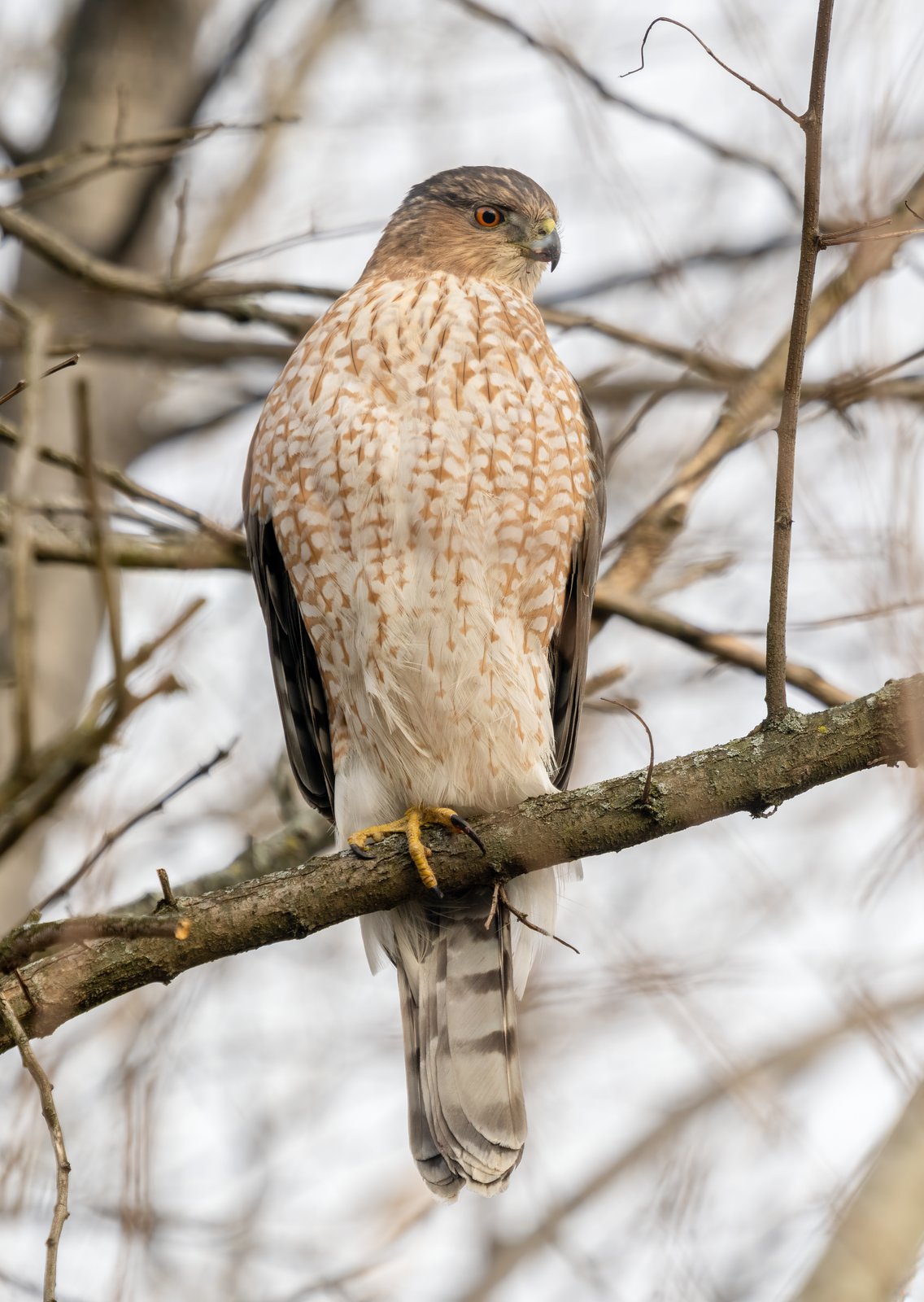
Cooper's Hawk is a medium-sized North American hawk that often hunts in gardens and parks. In the guide area it is only a very rare vagrant in the northern winter. It closely resembles the smaller Sharp-shinned Hawk.
Voice
A harsh, repeated kek-kek-kek; usually silent in winter.
No recording with a suitable Creative Commons licence is available for this species yet.
Identification
37–45 cm, with short, rounded wings and a long, rounded tail with a broad white tip; the female is clearly larger than the male. Adults are blue-grey above, with a dark cap contrasting with the paler nape, and white with dense rufous barring below. The tail has three or four dark bands. Eye orange to red, legs yellow. Juveniles are brown above and white with fine dark streaks below, especially on the breast.
Confusion species
Sharp-shinned Hawk Accipiter striatus is smaller, with a smaller head, a square-tipped tail with a narrower white tip and, in the Andean form, rufous thighs. Bicolored Hawk Astur bicolor has plain grey underparts and rufous thighs.
Habitat
Forest edges, semi-open country with trees, parks and gardens. It hunts medium-sized birds such as doves and thrushes with fast attacks from cover, sometimes small mammals.
Where the bird is most at home, classified by the vegetation units of the Andes and the west coast.


Range and movements
In the guide area recorded only as a very rare vagrant, mainly in northern Colombia; not or scarcely in Ecuador, Peru, Bolivia and the Galápagos. It breeds in southern Canada, the United States and northern Mexico and winters south to Central America.
How and when to look
There is no reliable site; a medium-sized hawk with a rounded tail and a broad white tip in northern Colombia between October and March merits careful checking.
Conservation status
Least Concern. After a decline caused by pesticides and persecution in the twentieth century, the North American population has recovered.
Scientific name
Astur cooperii | (Bonaparte, 1828) (GBIF: Ericameria cooperi)
Bonaparte described the species in 1828 as Falco cooperii; because it was later moved to another genus, the author and year stand in brackets. The genus Astur was introduced in 1799 by De Lacépède. The genus name comes from Latin astur, 'hawk'. Lacépède erected the genus in 1799. The species name honours William Cooper (1798–1864), American naturalist and collector, a co-founder of the Lyceum of Natural History in New York. The specimen the first description was based on came from Bordentown, New Jersey, USA.