All species › Birds of prey › Kites, Old World vultures, eagles and hawks › Red-tailed Hawk
Red-tailed Hawk | Buteo jamaicensis
Roodstaartbuizerd | Guaraguao colirrojo | Gavião-de-cauda-vermelha
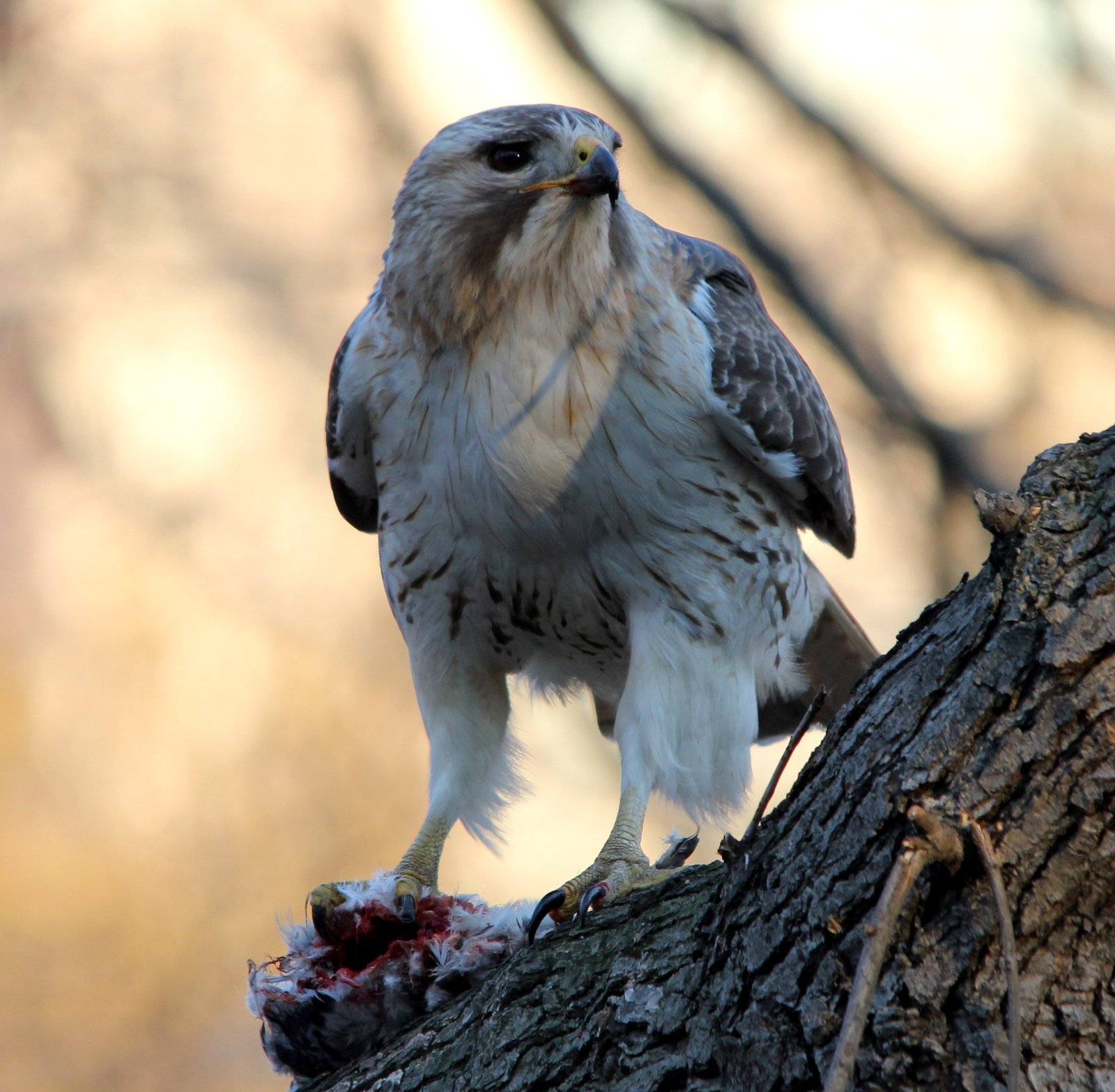
The Red-tailed Hawk is the most widespread buteo of North America, from Alaska to Panama. In the guide area it is only a very rare vagrant; the nearest resident birds live in the mountains of Costa Rica and western Panama. Adults are recognised by the rufous upper side of the tail.
Voice
A hoarse, descending scream, keeeer; often silent in winter.
Recording: Manuel Grosselet — CC BY-NC-SA 4.0 · xeno-canto
Identification
45–56 cm; the female is larger. A bulky buteo with broad, rounded wings and a broad, rather short tail. The commonest light morph is dark brown above, with pale spots on the scapulars, and white below with a band of dark streaks across the belly. In adults the upper side of the tail is rufous. In flight the pale underwing has a dark leading edge between body and wrist and a dark carpal patch. There are also rufous and dark morphs. Juveniles have a brownish-grey tail with narrow dark bands and more streaking below.
Confusion species
Swainson's Hawk Buteo swainsoni is slimmer, with longer, more pointed wings, dark flight feathers and a dark breast band instead of a belly band. Variable Hawk Geranoaetus polyosoma has a white tail with a broad black band near the tip. White-tailed Hawk Geranoaetus albicaudatus also has a white tail with a black band, grey upperparts and rufous shoulders.
Habitat
Open and semi-open country with scattered trees, forest edges, pasture and fields, from sea level into the mountains. It hunts from a high perch or while hanging in the wind, taking rodents, rabbits, birds and reptiles.
Where the bird is most at home, classified by the vegetation units of the Andes and the west coast.


Range and movements
In the guide area recorded only as a very rare vagrant, in northern Colombia; there are no or hardly any records from Ecuador, Peru, Bolivia and the Galápagos. It breeds from Alaska and Canada through the United States, Mexico and Central America to western Panama and on some Caribbean islands; northern birds move south in winter as far as Central America.
How and when to look
There is no regular site; a bulky buteo with a rufous tail or a dark leading edge to the underwing in northern Colombia deserves careful checking and documentation with photographs.
Conservation status
Least Concern. The North American population is large and has increased in recent decades.
Scientific name
Buteo jamaicensis | (Gmelin, 1788)
Gmelin described the species in 1788 as Falco jamaicensis; because it was later moved to another genus, the author and year stand in brackets. The genus Buteo was introduced in 1799 by De Lacépède. The genus name is Latin buteo, the Roman name for the Common Buzzard. The species name refers to Jamaica, not necessarily to the whole range. The specimen the first description was based on came from Jamaica.