All species › Birds of prey › Kites, Old World vultures, eagles and hawks › Swainson's Hawk
Swainson's Hawk | Buteo swainsoni
Prairiebuizerd | Aguililla de Swainson | Gavião-papa-gafanhoto
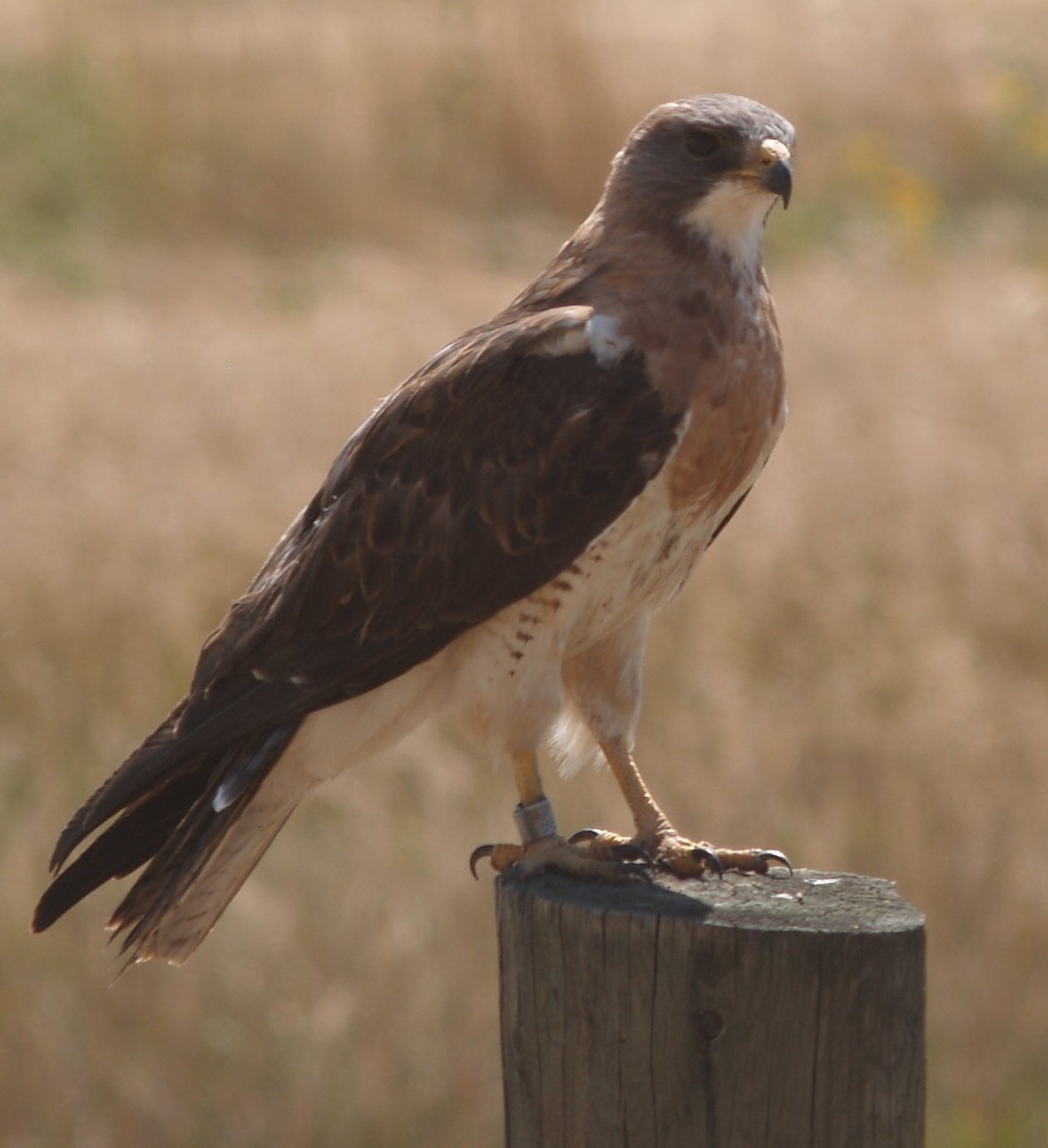
Swainson's Hawk is a slim, long-winged buteo from western North America that makes one of the longest migrations of any raptor: from the prairies to the pampas of Argentina. It migrates in large flocks, often together with Broad-winged Hawks and Turkey Vultures, and passes through the guide area mainly in autumn and spring. On the wintering grounds it feeds largely on insects.
Voice
Usually silent on migration and in winter. The call is a high, thin, drawn-out scream, kreeeeer.
Recording: Sue Riffe — CC BY-NC-SA 4.0 · xeno-canto
Identification
48–56 cm; the female is slightly larger. Long, rather pointed wings that reach or pass the tail tip on a perched bird. The light morph is greyish brown above, with a white throat and forehead, a broad dark brown breast band and a pale belly. In flight the white underwing coverts contrast strongly with the dark flight feathers; no other buteo in the guide area shows this pattern. There are also rufous and dark morphs. The tail is grey with narrow dark bands and a broader band near the tip. When gliding it holds the wings in a shallow V. Juveniles are buff with dark blotches on the breast and flanks, a pale head and a dark moustachial stripe.
Confusion species
Broad-winged Hawk Buteo platypterus is smaller and more compact, with shorter wings and pale flight feathers with a dark trailing edge. Red-tailed Hawk Buteo jamaicensis is bulkier, with a dark leading edge to the underwing, a band of streaks across the belly and, in adults, a rufous tail. White-tailed Hawk Geranoaetus albicaudatus has a white tail with a black band near the tip and rufous shoulders, and on a perched bird the wings extend well beyond the tail.
Habitat
Open country: grassland, pasture, fields, savanna and rice fields; it roosts at night in woodlots or on pylons. On migration in large flocks in thermals over open country and valleys. In winter it feeds mainly on grasshoppers and other large insects, often on the ground or behind ploughing machinery; on the breeding grounds mainly on rodents. It breeds in North America.
Where the bird is most at home, classified by the vegetation units of the Andes and the west coast.


Range and movements
In Colombia a passage migrant, locally in large flocks, in the Andean valleys and the eastern lowlands; a few birds winter. In Ecuador and Peru a scarce passage migrant, with most records in the east. In Bolivia a scarce passage migrant and winter visitor in the lowlands. Absent from the Galápagos. It breeds in western North America and winters mainly in the pampas of Argentina.
- Winter visitor (c. Oct–Mar)
- Passage (Mar–Apr, Oct–Nov)
- dark = core range, pale = thinly spread
How and when to look
In October and in March and April in Colombia, watch for flocks of migrating raptors over open valleys and the edges of the Llanos; in a flock of Broad-winged Hawks, Swainson's Hawk stands out by its long, pointed wings with dark flight feathers.
Conservation status
Least Concern. In the mid-1990s tens of thousands of birds died in Argentina from insecticides used on farmland; since those chemicals were restricted the population has been stable.
Scientific name
Buteo swainsoni | Bonaparte, 1838
Bonaparte described the species in 1838 and placed it straight away in the genus where it still stands. The genus Buteo was introduced in 1799 by De Lacépède. The genus name is Latin buteo, the Roman name for the Common Buzzard. The species name honours William Swainson (1789–1855), English naturalist and illustrator. The specimen the first description was based on came from (per the description).