All species › Birds of prey › Kites, Old World vultures, eagles and hawks › Galapagos Hawk
Galapagos Hawk | Buteo galapagoensis
Galapagosbuizerd | Gavilán de Galápagos | Gavião-de-galápagos
The Galapagos Hawk is the only diurnal raptor that breeds on the Galápagos and occurs nowhere else. It has an unusual breeding system: on many islands a single female defends a territory together with two or more males, and all the males help to raise the young. The birds show little fear of people and often perch in the open on rocks or shrubs.
Voice
A harsh, repeated call, kee-kee-kee, and a hoarse scream, mainly at the nest and in territorial defence.
Recording: Juan M Aguilar — CC BY-NC-SA 4.0 · xeno-canto
Identification
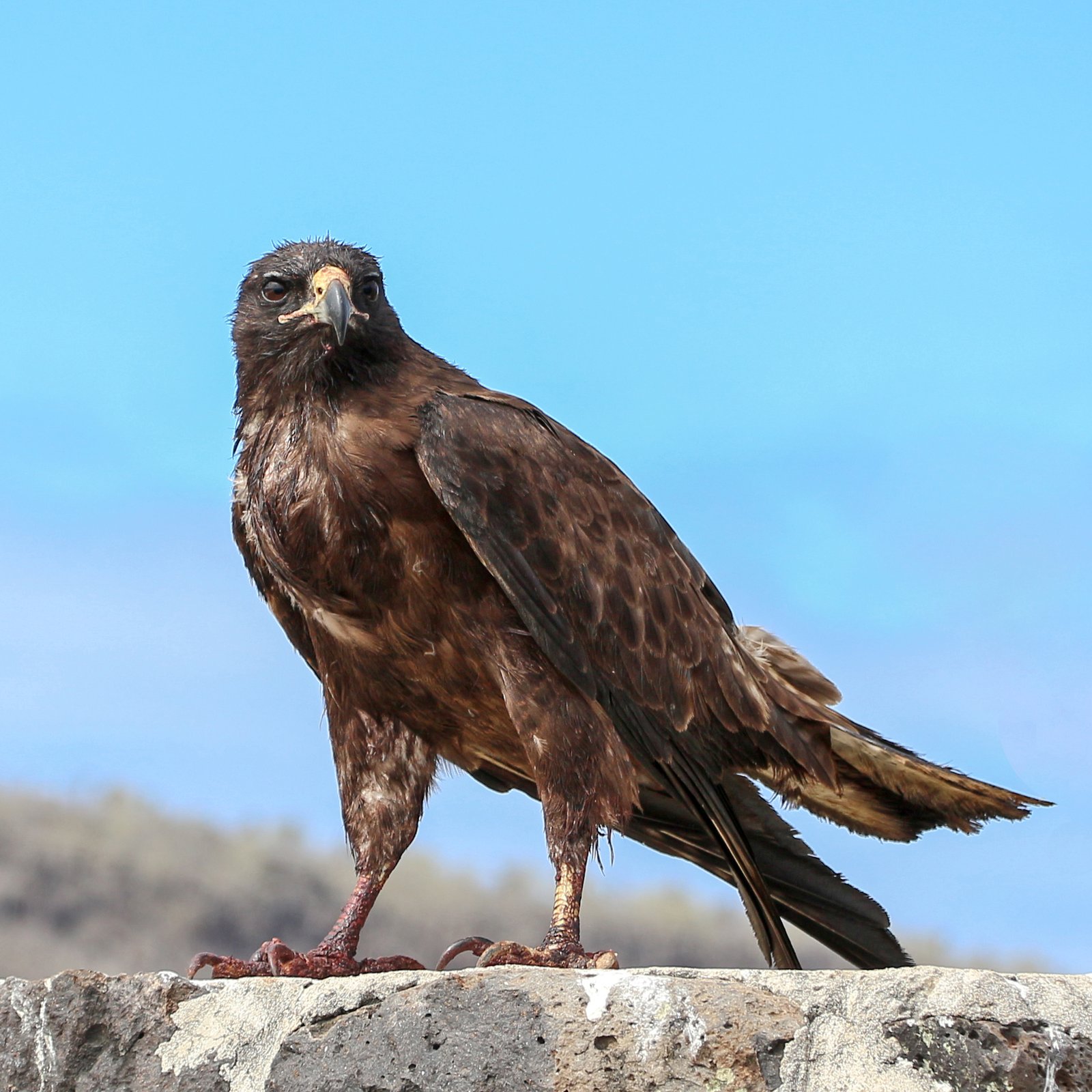
51–58 cm; the female is clearly larger than the male. A heavy buteo with broad wings and a rather long tail. Adults are uniform dark chocolate brown, sometimes with paler feather edges on the back; the tail is grey with narrow dark bands. Bill dark with a yellow cere, legs yellow. In flight the flight feathers are pale grey and barred below, contrasting with the dark underwing coverts. Juveniles are paler brown, with buff spots and streaks below, a pale supercilium, a dark moustachial stripe and a brownish, finely barred tail; they take several years to acquire adult plumage.
Confusion species
On the Galápagos confusion is limited. Peregrine Falcon Falco peregrinus is a scarce winter visitor, smaller and slimmer, with pointed wings, a dark hood and pale underparts. Osprey Pandion haliaetus is seen occasionally, has long, angled wings and is white below. Short-eared Owl Asio flammeus also hunts by day, but is much smaller, with a round head.
Habitat
All zones of the islands it inhabits, from the lava coast and the arid zone to the humid highlands and the pampa. It hunts from a perch or from the air, taking lava lizards, centipedes, rats, young iguanas, hatchling sea turtles and small birds, and also eats carrion. The nest is a stick nest in a tree, on a rock or on a lava ledge.
Where the bird is most at home, classified by the vegetation units of the Andes and the west coast.


Range and movements
Endemic to the Galápagos (Ecuador). It now breeds on Española, Santa Fe, Fernandina, Isabela, Santiago, Pinta, Marchena and Pinzón, among others. It has disappeared from San Cristóbal and Floreana, and no longer breeds on Santa Cruz, where birds are seen only occasionally. It occurs nowhere else.
- Resident
How and when to look
Search along the visitor trails on Española (Punta Suárez), Fernandina (Punta Espinoza) and Santiago (Puerto Egas); birds there often perch on a rock or post right next to the trail.
Conservation status
Vulnerable. The total population consists of a few hundred adult birds on a small number of islands. The species disappeared from the inhabited islands through persecution in the past; introduced cats and rats and disturbance remain a threat.
Scientific name
Buteo galapagoensis | (Gould, 1837)
Gould described the species in 1837 as Polyborus galapagoensis; because it was later moved to another genus, the author and year stand in brackets. The genus Buteo was introduced in 1799 by De Lacépède. The genus name is Latin buteo, the Roman name for the Common Buzzard. The species name refers to the Galápagos Islands. The specimen the first description was based on came from Galápagos Islands, Ecuador.