All species › Birds of prey › Kites, Old World vultures, eagles and hawks › Short-tailed Hawk
Short-tailed Hawk | Buteo brachyurus
Kortstaartbuizerd | Gavilán colicorto | Gavião-de-cauda-curta
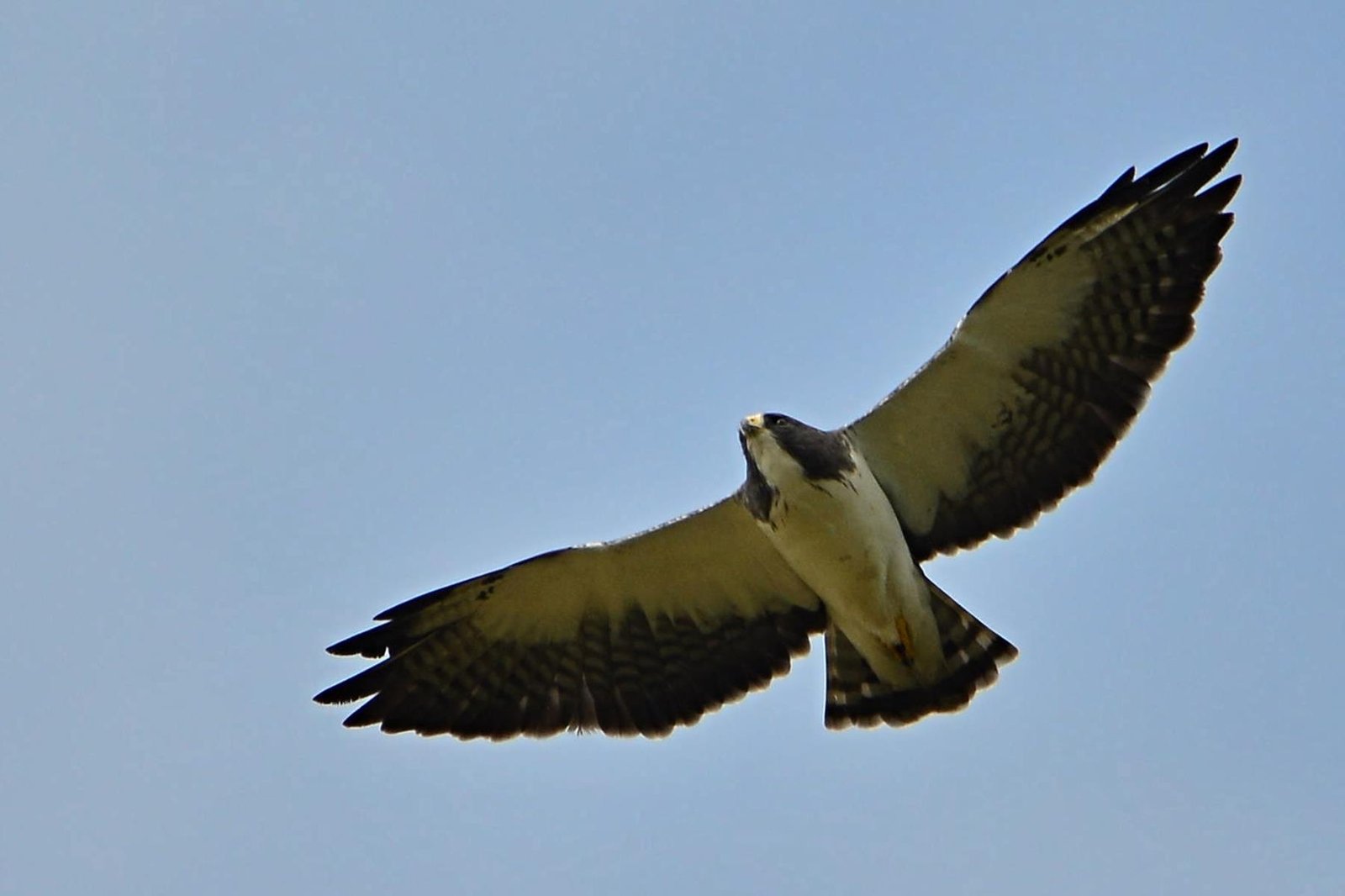
The Short-tailed Hawk is a small buteo that spends most of its time high in the air. It hunts mainly birds, which it takes from a great height in a steep stoop, often after hanging motionless in the wind for a while. There are a light and a dark morph, which occur side by side.
Voice
A high, drawn-out scream, keeeer, mainly in flight and at the nest; usually silent outside the breeding season.
Recording: Rolf A. de By — CC BY-NC-SA 4.0 · xeno-canto
Identification
39–46 cm; the female is slightly larger. Compact, with broad wings that reach the tail tip on a perched bird, and a rather short tail. The light morph is dark greyish brown above, with a dark head and cheeks forming a hood that contrasts with the white throat and clean white underparts. In flight the underwing coverts are white, the flight feathers pale grey with fine barring and a dark trailing edge. The dark morph is entirely blackish brown, with paler, barred flight feathers below. The tail is grey with narrow dark bands and a broader band near the tip. Juvenile light birds have fine streaks on the head and breast sides; juvenile dark birds are spotted white below.
Confusion species
White-throated Hawk Buteo albigula lives higher in the Andes, has dark flank streaks and rufous-barred thighs, and on a perched bird the wings fall short of the tail tip. Broad-winged Hawk Buteo platypterus has a tail with broad black and white bands; juveniles are clearly streaked below. Zone-tailed Hawk Buteo albonotatus resembles the dark morph, but has longer, narrower wings, flies with the wings held in a V like Turkey Vulture Cathartes aura and has broad white tail bands.
Habitat
Forest edges, semi-open country with woodlots, riverine forest, secondary forest, plantations and montane forest up to about 2500 m, locally higher; also in the dry forest of the west. It hunts mainly small and medium-sized birds, as well as lizards and small mammals. The nest is a stick nest high in a tree.
Where the bird is most at home, classified by the vegetation units of the Andes and the west coast.


Range and movements
In Colombia widespread in the lowlands and on the slopes of the Andes. In Ecuador in the lowlands and foothills of the west and east and in the lower Andean valleys. In Peru mainly in the eastern lowlands and on the east slope, locally in the north-west. In Bolivia in the lowlands and the Yungas. Absent from the Galápagos. Outside the guide area from Florida and Mexico through Central America to northern Argentina.
- Resident
- dark = core range, pale = thinly spread
How and when to look
Scan high in the sky over forest edges and clearings in mid-morning, when thermals begin to rise; the bird often hangs in one place for a long time before stooping. Look for the dark hood above the white underparts.
Conservation status
Least Concern. The species is widespread and tolerates a mosaic of forest and open country.
Scientific name
Buteo brachyurus | Vieillot, 1816
Vieillot described the species in 1816 and placed it straight away in the genus where it still stands. The genus Buteo was introduced in 1799 by De Lacépède. The genus name is Latin buteo, the Roman name for the Common Buzzard. The species name comes from Greek brakhus, 'short', and oura, 'tail'. The specimen the first description was based on came from Cayenne, French Guiana.