All species › Birds of prey › Kites, Old World vultures, eagles and hawks › White-throated Hawk
White-throated Hawk | Buteo albigula
Witkeelbuizerd | Busardo gorgiblanco | Gavião-de-garganta-branca
The White-throated Hawk is a small, dark buteo of the montane forests of the Andes. It breeds in the Nothofagus forests of Chile and Argentina and moves north along the Andes in the southern winter, as far as Colombia and Venezuela. In the guide area it is scarce and closely resembles Short-tailed Hawk, which is commoner at lower elevations.
Voice
Usually silent in the guide area. The call is a high, shrill whistle, keeeh, mainly in flight.
Recording: Bernabe Lopez-Lanus — CC BY-NC-SA 3.0 · xeno-canto
Identification
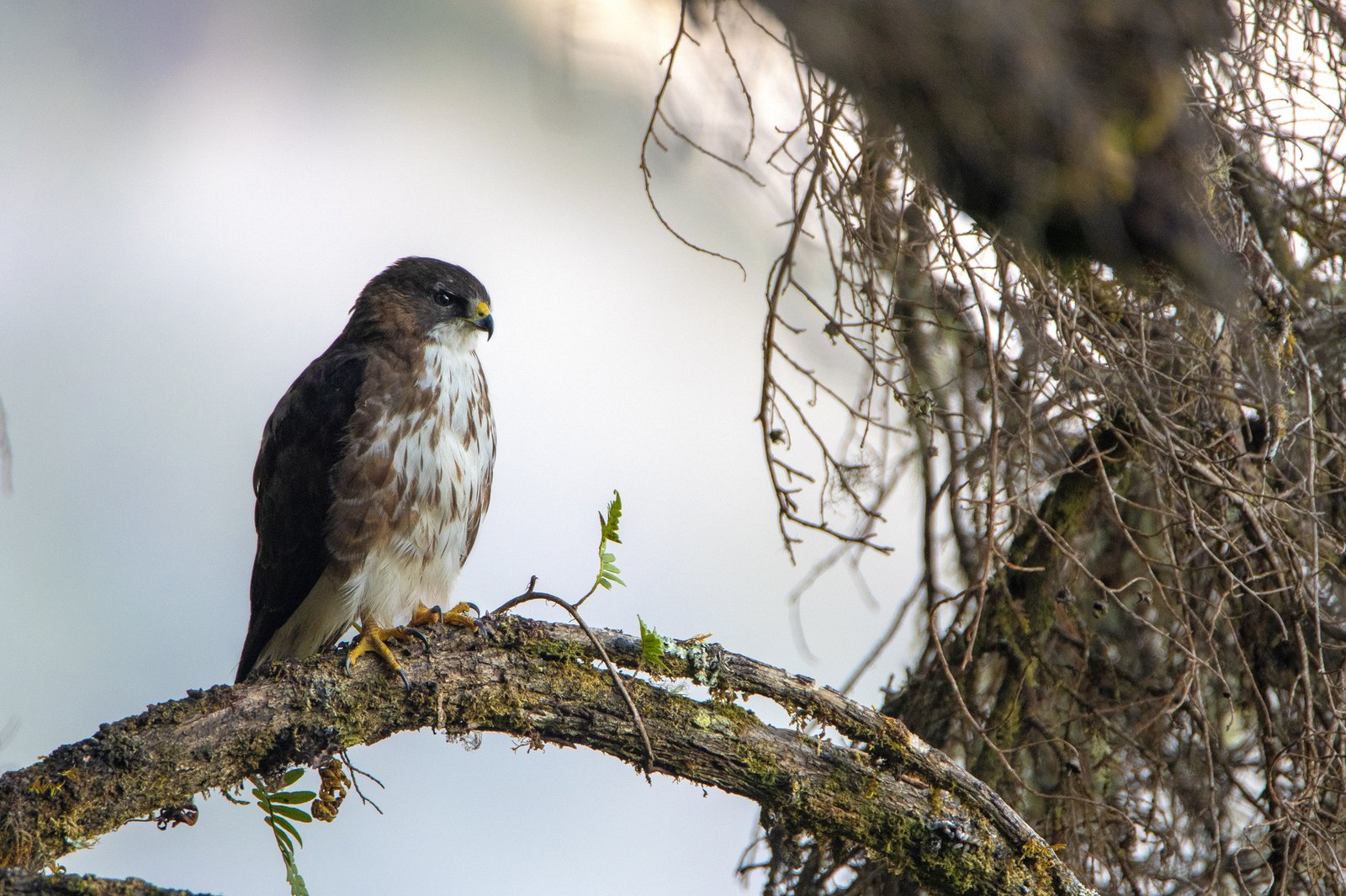
38–43 cm; the female is slightly larger. A compact buteo with rather short, broad wings; on a perched bird the wingtips fall short of the tail tip. The upperparts are dark greyish brown, the head is dark, with dark cheeks contrasting sharply with the white throat. The underparts are white, with dark brown spots and streaks on the breast sides and flanks; the thighs are finely barred rufous. The tail is greyish brown with narrow dark bands and a broader band near the tip. In flight the underwings are mostly pale, with a dark trailing edge and dark tips. Juveniles are buff below and more heavily streaked.
Confusion species
The light morph of Short-tailed Hawk Buteo brachyurus is clean white below without flank streaks, has white thighs, and on a perched bird the wings reach the tail tip; it usually lives lower. Juvenile Broad-winged Hawk Buteo platypterus is also streaked below, but has a paler head with a distinct dark moustachial stripe and is present in the guide area mainly from October to April. Variable Hawk Geranoaetus polyosoma is larger, with a white tail with a broad black band near the tip, and lives in open country.
Habitat
Edges of cloud forest and upper montane forest, clearings in forest, Polylepis woodland and scrub near the treeline, in the guide area mainly between about 1800 and 3500 m. It hunts from a perch at the forest edge or from the air, taking small birds, rodents, lizards and large insects. It nests in tall trees in the south; breeding in the guide area is not known with certainty.
Where the bird is most at home, classified by the vegetation units of the Andes and the west coast.


Range and movements
In Colombia scarce and local in the Andes. In Ecuador rare, on both slopes of the Andes. In Peru scattered in the Andes, mainly on the east slope. In Bolivia on the east slope of the Andes, in the Yungas. Absent from the Galápagos. It breeds in central and southern Chile and adjacent western Argentina and moves north in the southern winter as far as western Venezuela.
- Resident
- Summer visitor (c. Apr–Sep)
- Passage (Mar–Apr, Oct–Nov)
- dark = core range, pale = thinly spread
How and when to look
From April to September, watch from viewpoints above cloud forest for buteos circling over the forest edge in mid-morning. A small buteo with dark cheeks and streaked flanks at high elevation deserves careful comparison with Short-tailed Hawk.
Conservation status
Least Concern. The species is scarce throughout its range; loss of montane forest in the Andes and of Nothofagus forest on the breeding grounds affects its habitat.
Scientific name
Buteo albigula | Philippi, 1899
Philippi described the species in 1899 and placed it straight away in the genus where it still stands. The genus Buteo was introduced in 1799 by De Lacépède. The genus name is Latin buteo, the Roman name for the Common Buzzard. The species name comes from Latin albus, 'white', and gula, 'throat'. The specimen the first description was based on came from Valdivia, Chile.