All species › Birds of prey › Kites, Old World vultures, eagles and hawks › Zone-tailed Hawk
Zone-tailed Hawk | Buteo albonotatus
Bandstaartbuizerd | Gavilán colifajeado | Gavião-urubu
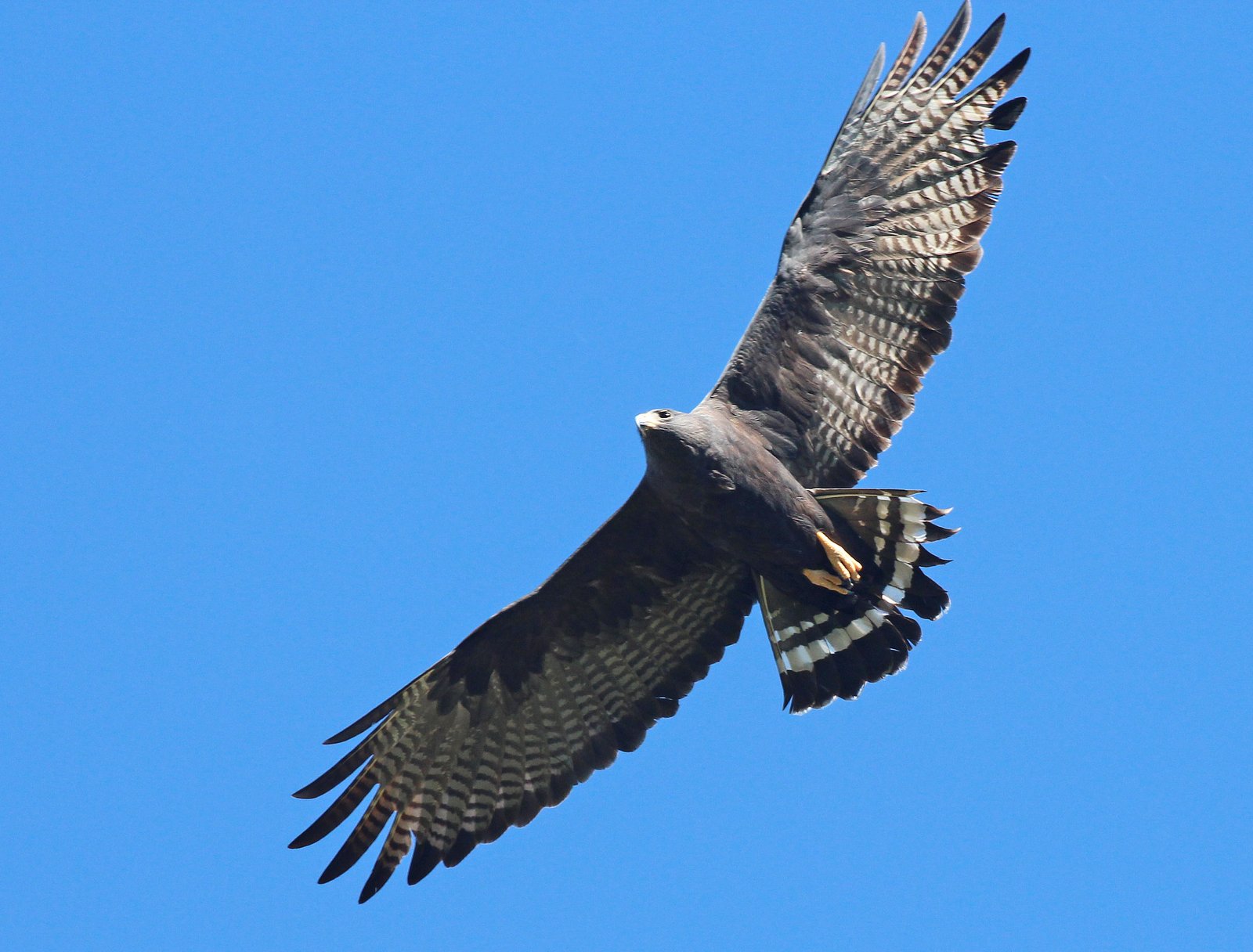
The Zone-tailed Hawk is a slim, black buteo that in flight closely resembles a Turkey Vulture. It soars with its wings held in a V and rocks like a vulture, and often mixes with soaring vultures. At close range the grey tail bands and the yellow legs and cere can be seen.
Voice
A hoarse, drawn-out, descending scream, kreeeeear, mainly at the nest.
Recording: Bobby Wilcox — CC BY-NC-SA 4.0 · xeno-canto
Identification
48–56 cm; the female is larger. Long, rather narrow wings and a medium-length tail. The adult is entirely blackish. The tail is black with three grey bands on the upperside, which look white from below. Cere and legs are yellow. In flight the underwings are two-toned: black coverts and grey, finely barred flight feathers with a dark trailing edge. Juveniles are blackish brown with small white spots on the breast and belly, and have a grey tail with many narrow dark bands.
Confusion species
Turkey Vulture Cathartes aura has a bare red or grey head, a longer, plain tail and no yellow legs. Common Black Hawk Buteogallus anthracinus and Great Black Hawk Buteogallus urubitinga have broader wings and a tail with a single broad white band. The dark morph of Short-tailed Hawk Buteo brachyurus is smaller and more compact, with shorter wings and a shorter, finely barred tail.
Habitat
Semi-open, often hilly or dry country: dry forest, dry inter-Andean valleys, forest edges, gallery forest, canyons and cliffs, and open land around forest; from sea level to about 3000 m. It soars low over slopes and forest edges and takes lizards, small mammals and birds from the air. The nest is a stick nest in a tall tree, often along a river or on a slope.
Where the bird is most at home, classified by the vegetation units of the Andes and the west coast.


Range and movements
In Colombia locally in the Caribbean lowlands, the inter-Andean valleys and the llanos. In Ecuador mainly in the dry west and in the Andean valleys. In Peru along the west slope and the coast, in the Marañón Valley and locally in the east. In Bolivia locally in the dry valleys and the lowlands. Outside the guide area from the south-western United States and Mexico through Central America to Venezuela, the Guianas, Brazil, Paraguay and northern Argentina; northern birds migrate south.
- Resident
- dark = core range, pale = thinly spread
How and when to look
Check every group of soaring Turkey Vultures over dry slopes: a bird with a feathered head, yellow legs and a banded tail is a Zone-tailed Hawk.
Conservation status
Least Concern. Widespread, but scarce everywhere in the guide area.
Scientific name
Buteo albonotatus | Kaup, 1847
Kaup described the species in 1847 and placed it straight away in the genus where it still stands. The genus Buteo was introduced in 1799 by De Lacépède. The genus name is Latin buteo, the Roman name for the Common Buzzard. The species name comes from Latin albus, 'white', and notatus, 'marked', after the white bands in the tail. The specimen the first description was based on came from Mexico.