All species › Birds of prey › Kites, Old World vultures, eagles and hawks › Broad-winged Hawk
Broad-winged Hawk | Buteo platypterus
Breedvleugelbuizerd | Gavilán aludo | Gavião-de-asa-larga
The Broad-winged Hawk is a compact North American buteo that migrates to South America in large numbers. In October and in March and April flocks pass through Central America and Colombia, rising in thermals and then gliding onwards. In winter it is spread along forest edges, mainly on the slopes of the Andes.
Voice
Usually silent on the wintering grounds. The call is a high, thin whistle, pee-teeeee.
Recording: Thomas Magarian — CC BY-NC-SA 4.0 · xeno-canto
Identification
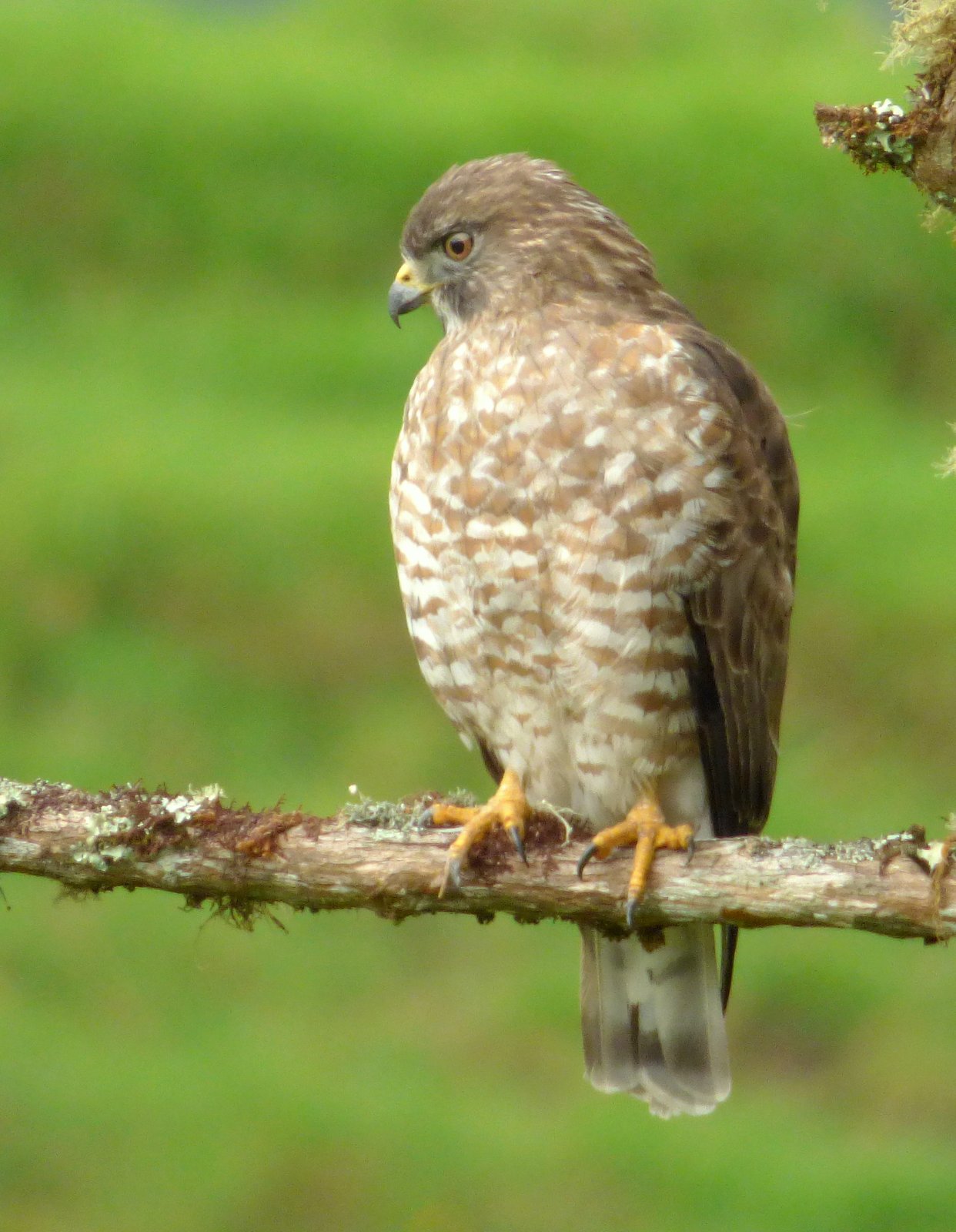
34–41 cm; the female is slightly larger. Compact, with broad, rather pointed wings and a short tail. The adult is dark brown above, with rufous barring on the breast and flanks. The tail is black with one broad and one narrower white band. In flight the underwings are white with a broad dark trailing edge and dark tips. Juveniles are white to buff below with dark streaks, mainly on the breast sides, have a dark moustachial stripe and a brown tail with narrow dark bands. There is a rare dark morph.
Confusion species
Grey-lined Hawk Buteo nitidus is grey with fine grey barring below and has a white rump. Roadside Hawk Rupornis magnirostris has rufous primaries and a tail with four or five narrow bands. Juveniles resemble juvenile Short-tailed Hawks Buteo brachyurus, which have an unstreaked breast, and juvenile Grey-lined Hawks, which have a white rump. Swainson's Hawk Buteo swainsoni is larger, with longer, more pointed wings and dark flight feathers.
Habitat
In winter in forest edges, open woodland, cloud forest, secondary forest, coffee plantations and semi-open country with trees, mainly between about 500 and 2500 m on the slopes of the Andes, also in the lowlands. It hunts from a perch at the forest edge, taking lizards, frogs, small mammals and large insects. It breeds in North America.
Where the bird is most at home, classified by the vegetation units of the Andes and the west coast.


Range and movements
In Colombia common on passage and in winter, mainly in the Andes. In Ecuador a winter visitor on both slopes of the Andes and in the lowlands. In Peru mainly on the east slope of the Andes. In Bolivia scarce, in the Yungas and the lowlands. It breeds in eastern North America and winters from southern Mexico to Bolivia and western Brazil; resident subspecies live on Caribbean islands.
- Resident
- Winter visitor (c. Oct–Mar)
- Passage (Mar–Apr, Oct–Nov)
- dark = core range, pale = thinly spread
How and when to look
In October and in March, watch from viewpoints in the Colombian Andes and over the Magdalena Valley for migrating flocks rising in thermals. In winter it often perches on an open branch at the edge of montane forest or coffee plantations.
Conservation status
Least Concern. The population is large; on the migration routes through Central America tens of thousands of birds are sometimes counted in a single day.
Scientific name
Buteo platypterus | (Vieillot, 1823)
Vieillot described the species in 1823 as Sparvius Platypterus; because it was later moved to another genus, the author and year stand in brackets. The genus Buteo was introduced in 1799 by De Lacépède. The genus name is Latin buteo, the Roman name for the Common Buzzard. The species name comes from Greek platus, 'broad', and pteron, 'wing'. The specimen the first description was based on came from Schuylkill River, Pennsylvania, USA.