All species › Passerines › Antbirds › Blackish Antbird
Blackish Antbird | Cercomacroides nigrescens
Zwartachtige miervogel | Hormiguero negruzco | Chororó-negro
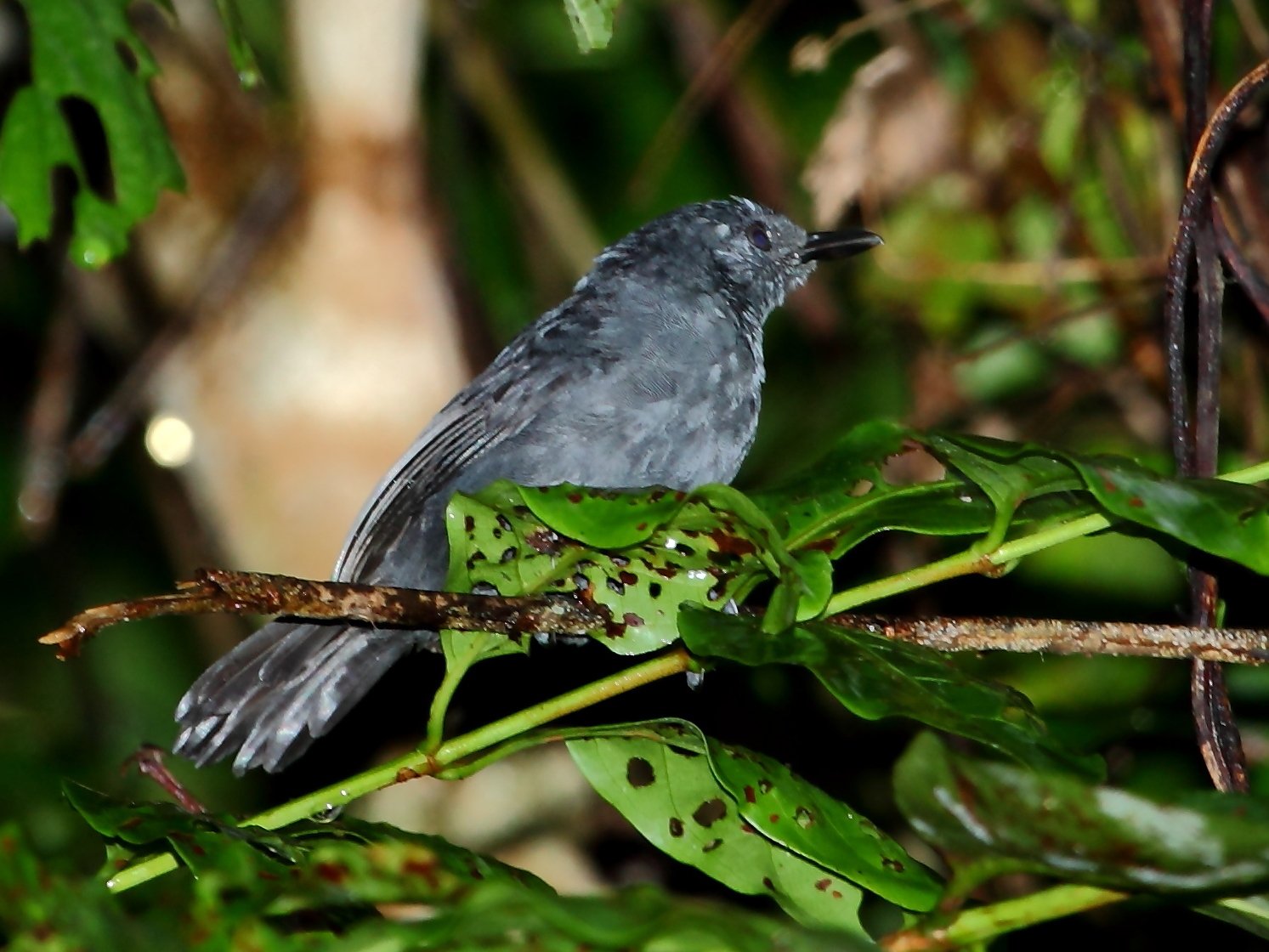
The Blackish Antbird is a grey antbird of dense riverside growth and shrubbery in the Amazon basin and at the foot of the Andes. In the lowlands it lives mainly along rivers, on river islands and in young forest on sandbars; in the foothills in dense shrubbery at forest edges. The lowland birds of riverbanks are treated by some authors as a separate species, Cercomacroides fuscicauda.
Voice
The song is a short series of a few clear notes; in lowland birds a slightly rising, nasal series like chu-chee-chee-chee, in foothill birds a faster, more rattling series. The female often answers. Calls are a dry chek and a short rattle.
Recording: Juan Freile — CC BY-NC-SA 4.0 · xeno-canto
Identification
15 cm. The male is dark slate-grey, slightly paler below, with narrow white edges to the wing coverts, a hidden white patch between the scapulars and a blackish tail. The female is olive-brown above, with a rufous forehead and face and warm rufous underparts.
Confusion species
Black Antbird Cercomacroides serva lives mainly in the foothills; the male is blacker, and the female closely resembles the female Blackish Antbird, so the song is the most reliable feature. Grey Antbird Cercomacra cinerascens lives higher in vine tangles in the forest mid-storey; the male has broad white tail tips. Mato Grosso Antbird Cercomacra melanaria occurs in the guide area only in eastern Bolivia; the male is black and the female grey below.
Habitat
Dense riverside growth, young forest on sandbars and river islands, edges of várzea and Heliconia thickets in the lowlands, and dense shrubbery at forest edges in the foothills up to about 1700 m. It forages in pairs low in the vegetation for insects. The nest is a hanging cup in dense growth.
Where the bird is most at home, classified by the vegetation units of the Andes and the west coast.


Range and movements
Colombia: in the south-east, in the Amazonian lowlands and at the foot of the Andes. Ecuador: in the east, along rivers in the lowlands and in the foothills. Peru: in the Amazonian lowlands and the foothills of the eastern slope along the whole length of the country. Bolivia: in the north and north-west. Absent from the Galápagos. Outside the guide area in southern Venezuela, the Guianas and Amazonian Brazil.
- Resident
- dark = core range, pale = thinly spread
How and when to look
Search riverbanks and river islands in the eastern lowlands, for instance from a boat, and forest edges with dense shrubs in the foothills. The song often comes from dense growth just above the water.
Conservation status
Least Concern. Fairly common in suitable habitat; riverside growth and young forest on sandbars are constantly renewed by the rivers.
Scientific name
Cercomacroides nigrescens | (Cabanis & Heine, 1860) (GBIF: Cercomacra nigrescens)
Cabanis & Heine described the species in 1860 as Percnostola nigrescens; because it was later moved to another genus, the author and year stand in brackets. The genus Cercomacroides was introduced in 2014 by Tello & Raposo. The genus name is Cercomacra with Greek -oidēs, 'resembling', so 'resembling Cercomacra'. The species name nigrescens is Latin for 'blackish, turning black'. The specimen the first description was based on came from Cayenne, French Guiana.