All species › Passerines › Antbirds › Black Antbird
Black Antbird | Cercomacroides serva
Zwarte miervogel | Hormiguero negro | Chororó-preto
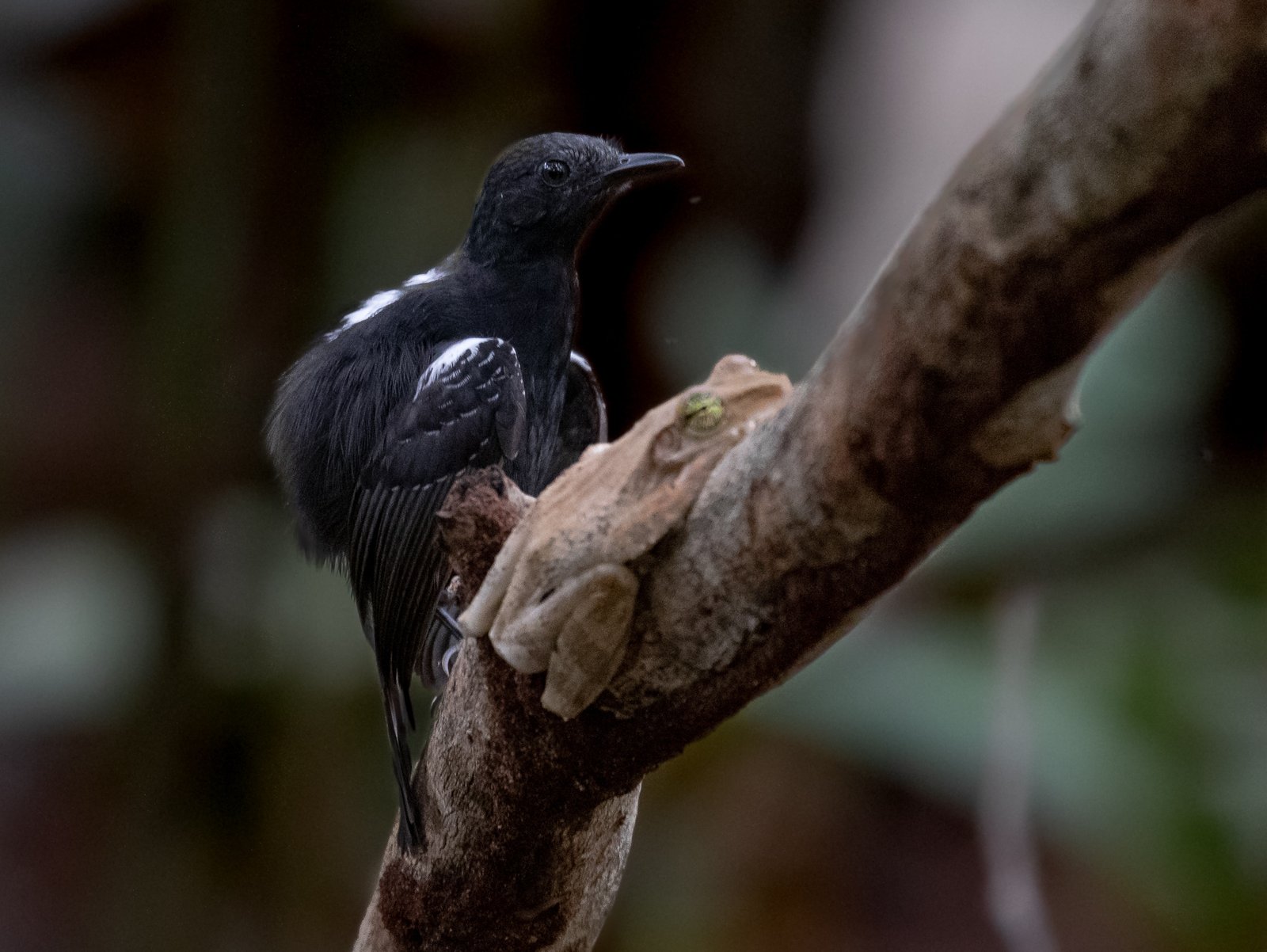
The Black Antbird is an antbird of dense shrubbery at forest edges in the foothills of the eastern Andes and the adjacent Amazonian lowlands. Pairs live low in the vegetation, at treefalls, in bamboo and in secondary growth. The male is almost black, the female warm rufous below.
Voice
The song is a short series of three to six burry, slightly rising notes, zhee-zhee-zhee-zhee, often in duet with the female. Calls are a dry chek and a short rattle.
Recording: Juan Freile — CC BY-NC-SA 4.0 · xeno-canto
Identification
14 cm. The male is blackish slate, with narrow white edges to the wing coverts, a hidden white patch between the scapulars and a dark tail with at most fine pale tips. The female is olive-brown above, with a rufous face, warm orange-brown throat, breast and belly and narrow pale edges to the wing coverts.
Confusion species
Blackish Antbird Cercomacroides nigrescens lives mainly along rivers in the lowlands and in the foothills; the male is greyer, and the female closely resembles the female Black Antbird, so the song is the most reliable feature. Grey Antbird Cercomacra cinerascens lives higher in vine tangles in the mid-storey; the male has broad white tail tips and the female is olive-yellow below. Manu Antbird Cercomacra manu lives in bamboo, and the female is grey below.
Habitat
Dense undergrowth at forest edges, at treefalls, in bamboo and in secondary forest, mainly in the foothills between about 300 and 1500 m, locally lower in the adjacent lowlands. It forages in pairs for insects in the low vegetation. The nest is a hanging cup in dense growth.
Where the bird is most at home, classified by the vegetation units of the Andes and the west coast.


Range and movements
Colombia: in the south-east, at the foot of the Andes and in the adjacent lowlands. Ecuador: in the east, mainly in the foothills. Peru: along the eastern slope of the Andes and in the adjacent lowlands along the whole length of the country. Bolivia: in the north and north-west, in the foothills and adjacent lowlands. Absent from the Galápagos. Outside the guide area in western Amazonian Brazil.
- Resident
- dark = core range, pale = thinly spread
How and when to look
Search roads and trails in the foothills on the eastern side of the Andes where dense shrubbery grows at forest edges. Listen for the burry series of the pair and wait for the birds to come to the edge of the growth.
Conservation status
Least Concern. Fairly common in the foothills; the species tolerates forest edges and secondary growth.
Scientific name
Cercomacroides serva | (Sclater, 1858) (GBIF: Cercomacra serva)
Sclater described the species in 1858 as Pyriglena serva; because it was later moved to another genus, the author and year stand in brackets. The genus Cercomacroides was introduced in 2014 by Tello & Raposo. The genus name is Cercomacra with Greek -oidēs, 'resembling', so 'resembling Cercomacra'. The species name comes from Latin servus, 'servile, inferior, slave'. Sclater distinguished the species from related antbirds by its smaller size. The specimen the first description was based on came from Río Napo, Ecuador.