All species › Passerines › Antbirds › Dusky Antbird
Dusky Antbird | Cercomacroides tyrannina
Tiranmiervogel | Hormiguero tirano | Chororó-escuro
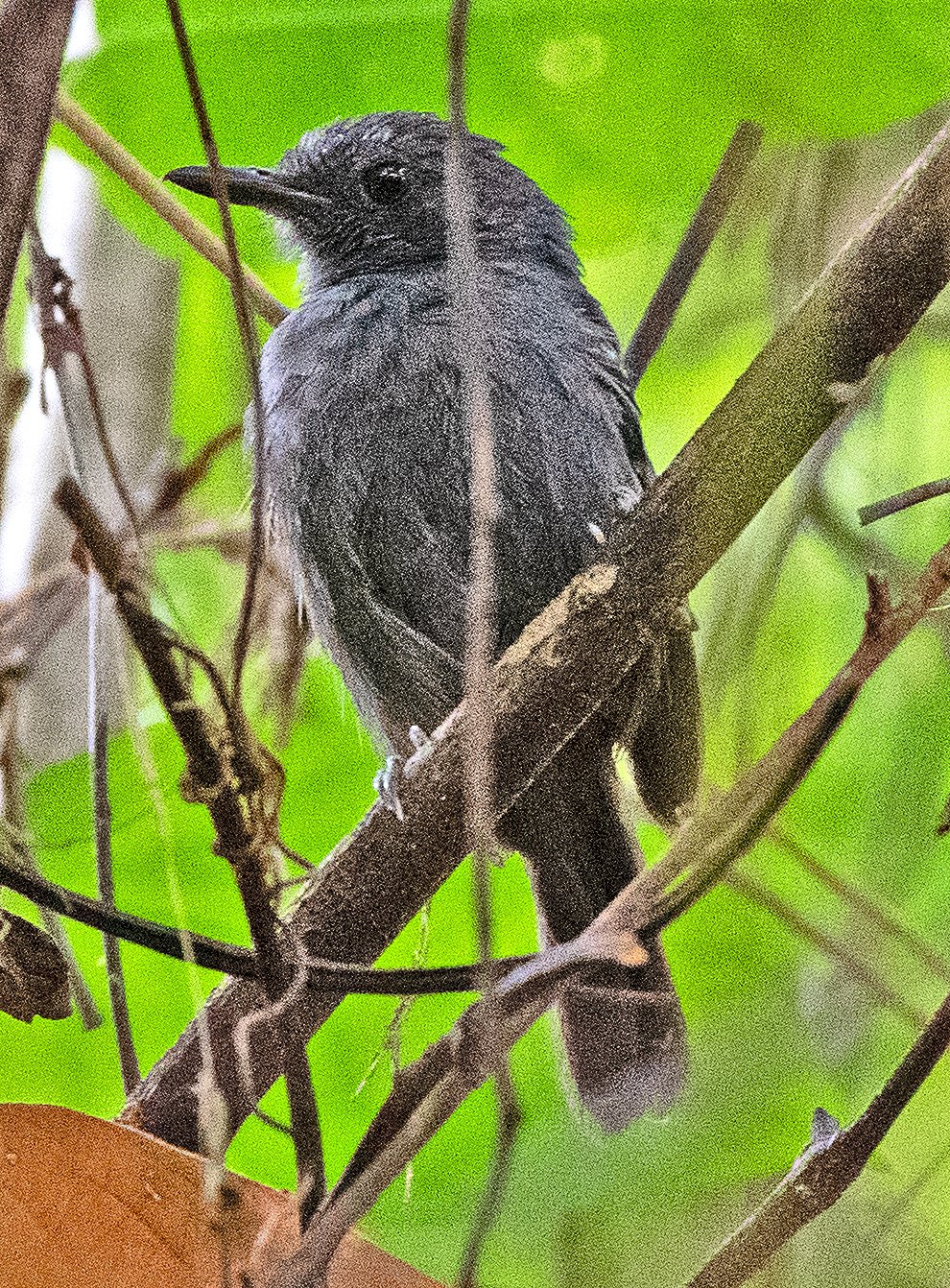
The Dusky Antbird is a small, grey antbird of dense shrubbery at forest edges, from Mexico to western Ecuador and the northern Amazon basin. Pairs keep to the low vegetation and are mostly heard by their accelerating, whistled song. In much of the Colombian lowlands it is one of the commonest antbirds of secondary growth.
Voice
The male's song is an accelerating, slightly rising series of clear whistles, pu pu pu-pu-pu-pupupu; the female often answers with a shorter, higher series. Calls are a dry chek and a short rattle.
Recording: Brian Cox — CC BY-NC-SA 4.0 · xeno-canto
Identification
14 cm. The male is grey, slightly darker on the back, with narrow white edges to the blackish wing coverts, a hidden white patch between the scapulars and a dark tail with narrow white tips. The female is olive-brown above and warm ochre-brown on the throat, breast and belly, with pale edges to the wing coverts.
Confusion species
Jet Antbird Cercomacra nigricans is larger; the male is black with broad white tail tips, and the female blackish grey with white streaks on the throat and breast. Parker's Antbird Cercomacroides parkeri lives higher in the Andes, above about 1100 m; the male is blacker. East of the Andes Blackish Antbird Cercomacroides nigrescens resembles Dusky Antbird; the male is darker slate-grey and the female has a rufous face; the song is the most reliable feature.
Habitat
Dense shrubbery, vine tangles and thickets at forest edges, in openings in the forest, in secondary forest and in overgrown field margins, from sea level to about 1200 m. It forages in pairs low in the vegetation for insects. The nest is a loose, hanging cup in a dense shrub.
Where the bird is most at home, classified by the vegetation units of the Andes and the west coast.


Range and movements
Colombia: widespread in the Pacific lowlands, the north and the inter-Andean valleys, and east of the Andes in the northern Amazon and Orinoco basins. Ecuador: in the western lowlands and foothills, mainly in the north. Absent from Peru, Bolivia and the Galápagos. Outside the guide area from south-eastern Mexico through Central America to Venezuela, the Guianas and northern Brazil.
- Resident
- dark = core range, pale = thinly spread
How and when to look
Along forest edges and streams in the lowlands of western Ecuador and Colombia, listen for the accelerating whistled series; pairs answer each other and show briefly at the edge of the thicket.
Conservation status
Least Concern. Common and widespread; the species tolerates secondary growth and forest edges well.
Scientific name
Cercomacroides tyrannina | (Sclater, 1855) (GBIF: Cercomacra tyrannina)
Sclater described the species in 1855 as Pyriglena tyrannina; because it was later moved to another genus, the author and year stand in brackets. The genus Cercomacroides was introduced in 2014 by Tello & Raposo. The genus name is Cercomacra with Greek -oidēs, 'resembling', so 'resembling Cercomacra'. The species name is Modern Latin tyranninus, 'like a tyrant flycatcher', from Latin tyrannus, 'tyrant'. Sclater noted that the bird had somewhat of a tyrannine aspect. The specimen the first description was based on came from Bogotá, Colombia.