All species › Passerines › Antbirds › Parker's Antbird
Parker's Antbird | Cercomacroides parkeri
Parkers miervogel | Hormiguero de Parker | Chororó-de-parker
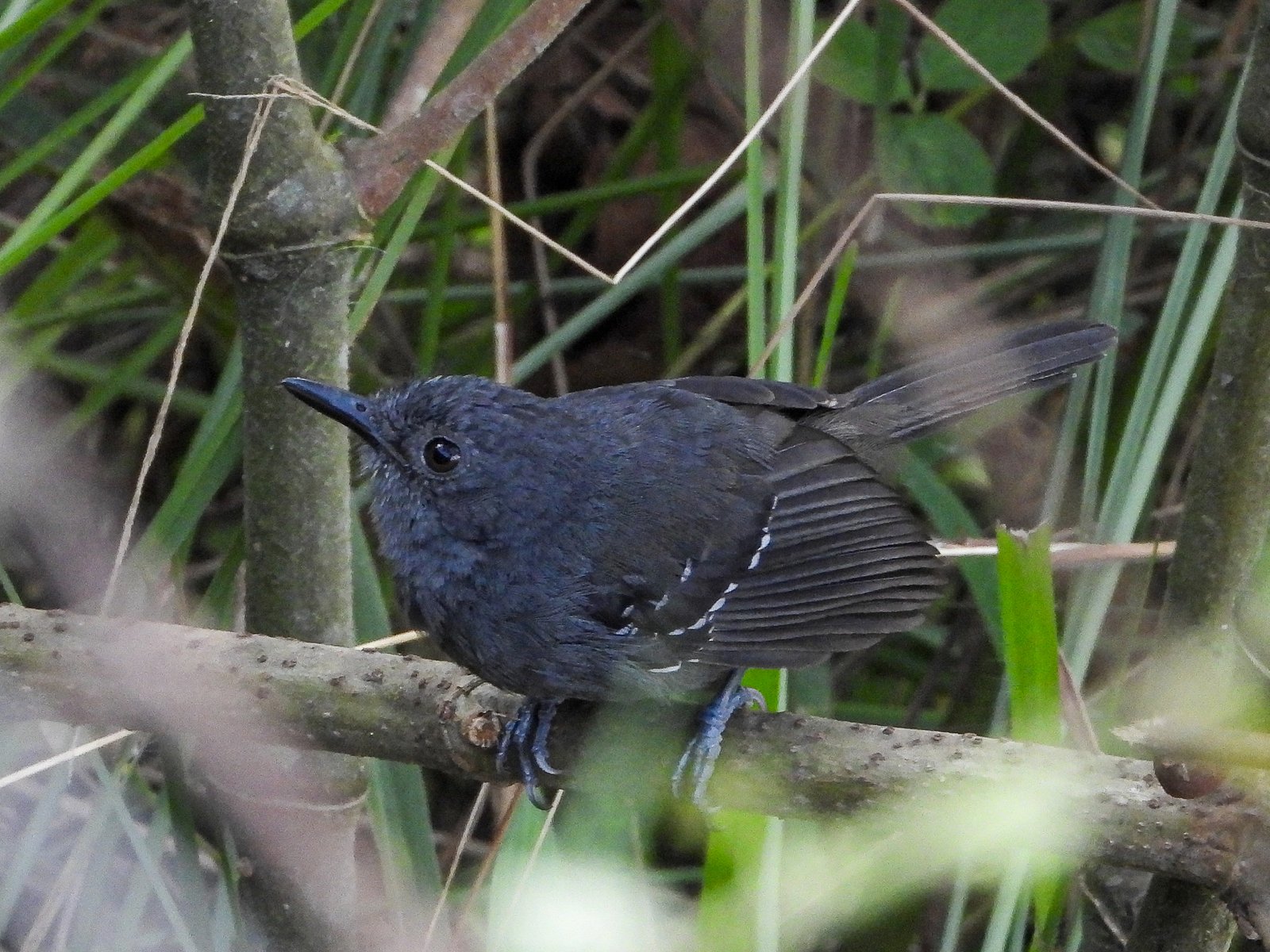
Parker's Antbird occurs only in the Andes of Colombia. The species was described only in 1997 and is named after the American ornithologist Theodore Parker. It lives in dense growth at forest edges at middle elevations, above the range of the Dusky Antbird, which it closely resembles.
Voice
The song is an accelerating series of clear, whistled notes, different from the song of Dusky Antbird; the female often answers with a shorter series of her own. Calls are short, dry notes and a short rattle.
Recording: Julián Andrés Zuleta Marín — CC BY-NC-SA 4.0 · xeno-canto
Identification
14–15 cm, with a fairly long tail. The male is slaty black, with narrow white edges to the wing coverts and a small, usually hidden white patch between the scapulars; the tail has at most narrow pale tips. The female is olive-grey to olive-brown above, with pale edges to the wing coverts, and warm orange-brown on the throat, breast and belly.
Confusion species
Dusky Antbird Cercomacroides tyrannina lives lower, mostly below about 1200 m; the male is paler grey and the song differs. Jet Antbird Cercomacra nigricans lives in the lowlands and on lower slopes; the male has broad white tail tips and the female is grey with white streaks, not orange-brown. Blue-lored Antbird Hafferia immaculata is larger, with blue bare skin around the eye.
Habitat
Dense shrubbery, vine tangles and bamboo at the edges of humid montane forest, in secondary forest and in overgrown ravines, also in shaded coffee plantations, roughly between 1100 and 2000 m. It forages in pairs low to mid-height in the vegetation for insects. Little has been published on the nest.
Where the bird is most at home, classified by the vegetation units of the Andes and the west coast.


Range and movements
Colombia: endemic, on the slopes of the Western and Central Andes, mainly in the centre of the country. Absent from Ecuador, Peru, Bolivia and the Galápagos.
- Resident
- dark = core range, pale = thinly spread
How and when to look
Search the coffee zone of the Central Andes along forest edges and ravines with dense growth between 1100 and 1900 m. Listen for the song of the pair from the thicket.
Conservation status
Least Concern. The range is small and montane forest in the Colombian Andes is heavily fragmented, but the species tolerates secondary growth and shade coffee.
Scientific name
Cercomacroides parkeri | (Graves, 1997) (GBIF: Cercomacra parkeri)
Graves described the species in 1997 as Cercomacra parkeri; because it was later moved to another genus, the author and year stand in brackets. The genus Cercomacroides was introduced in 2014 by Tello & Raposo. The genus name is Cercomacra with Greek -oidēs, 'resembling', so 'resembling Cercomacra'. The species name honours Theodore A. Parker III (1953–1993), American ornithologist and expert on Neotropical bird sounds, who died in a plane crash in Ecuador. The specimen the first description was based on came from Río Negrito near Sonsón, Antioquia, Colombia.