All species › Passerines › Antbirds › Bluish-slate Antshrike
Bluish-slate Antshrike | Thamnomanes schistogynus
Blauwe mierklauwier | Batará azulino | Uirapuru-azul
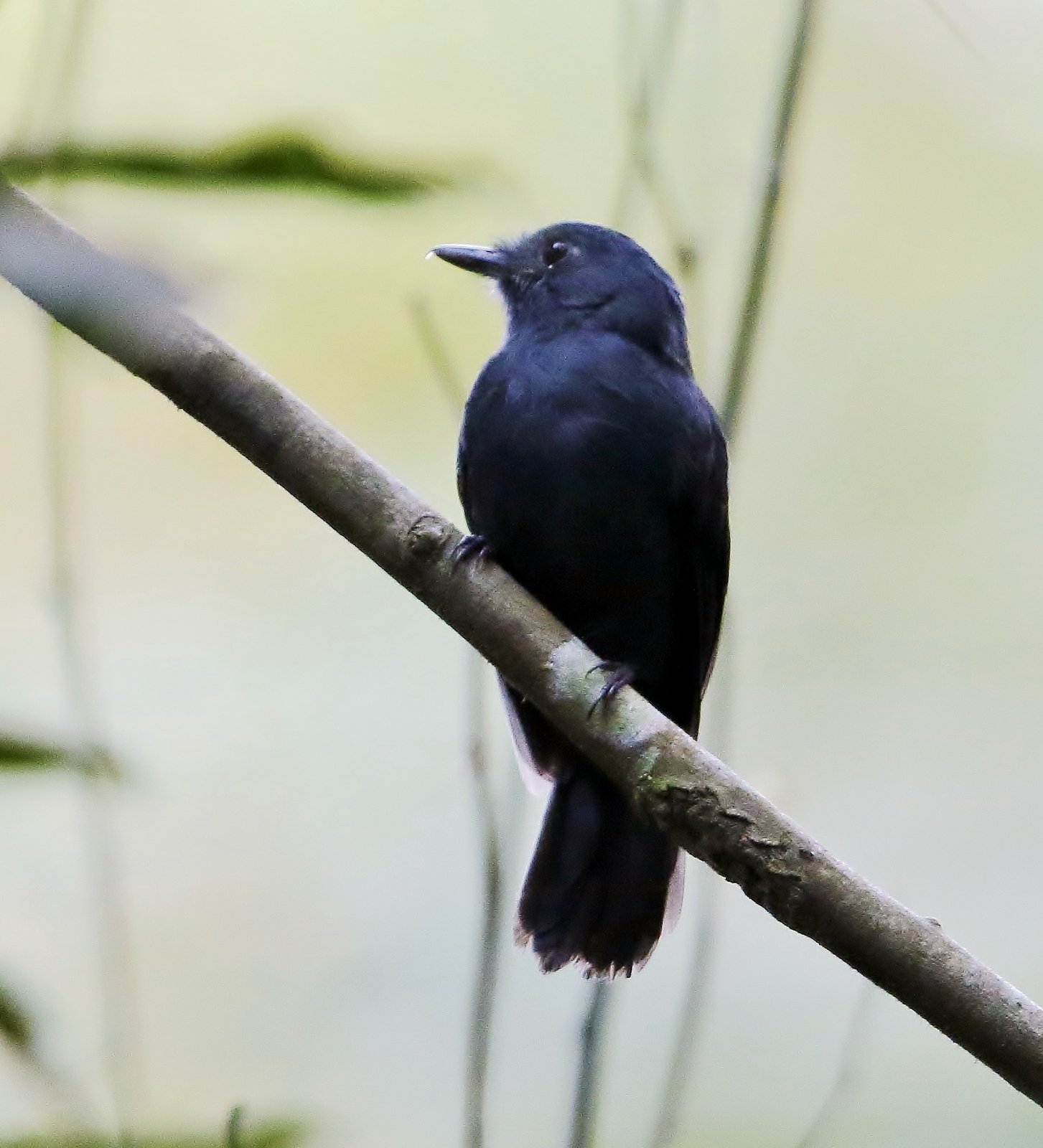
The Bluish-slate Antshrike is the Thamnomanes antshrike of south-western Amazonia. It replaces Cinereous Antshrike south of the Amazon and the Marañón and plays the same role as a nuclear species of understorey mixed flocks. Unlike in its relatives, the female too is largely grey.
Voice
The song is an accelerating, rising series of notes that turns into a short, grating rattle, similar to that of Cinereous Antshrike. Also loud, harsh calls.
Recording: JAYRSON ARAUJO DE OLIVEIRA — CC BY-NC-SA 4.0 · xeno-canto
Identification
14–15 cm, perching upright, with a broad, hook-tipped bill and a fairly long tail. The male is uniformly bluish slate-grey, with a concealed white patch between the shoulders. The female is grey on the head, back and breast, with a paler throat and an orange-rufous belly and undertail coverts.
Confusion species
Cinereous Antshrike Thamnomanes caesius lives mainly north of the Amazon; the male is less blue and the female olive-brown above. Saturnine Antshrike Thamnomanes saturninus has a black throat (male) or olive-brown upperparts and a white throat (female). Dusky-throated Antshrike Thamnomanes ardesiacus has a dark throat and a shorter tail. Plain-winged Antshrike Thamnophilus schistaceus has a heavier bill and a red eye and perches less upright.
Habitat
Understorey and mid-storey of humid terra firme and várzea lowland forest, up into the lower foothills of the eastern slope. It forages in pairs or family groups, usually as the centre of mixed flocks; it catches arthropods in short sallies from a perch and sometimes attends army ants. Little is known about the nest.
Where the bird is most at home, classified by the vegetation units of the Andes and the west coast.


Range and movements
Peru: in the Amazonian lowlands south of the Amazon and the Marañón, from Loreto south to Madre de Dios, Cusco and Puno. Bolivia: in the north (Pando, La Paz, Beni and Cochabamba). Absent from Colombia, Ecuador and the Galápagos. Outside the guide area in western Amazonian Brazil (Acre and south-western Amazonas).
- Resident
- dark = core range, pale = thinly spread
How and when to look
In Madre de Dios, for example at Manu and Tambopata, it is part of most understorey mixed flocks. Look for a grey bird perching upright on an open branch and giving harsh calls.
Conservation status
Least Concern. Common in undisturbed forest; deforestation is the main threat.
Scientific name
Thamnomanes schistogynus | Hellmayr, 1911
Hellmayr described the species in 1911 and placed it straight away in the genus where it still stands. The genus Thamnomanes was introduced in 1847 by Cabanis. The genus name comes from Greek thamnos, 'bush', and -manēs, 'passionately fond of'. The species name comes from Greek schistos, here 'slaty', and gunē, 'female': the female is slate-grey. The specimen the first description was based on came from San Mateo, Cochabamba, Bolivia.