All species › Passerines › Antbirds › Cinereous Antshrike
Cinereous Antshrike | Thamnomanes caesius
Temmincks mierklauwier | Batará cinéreo | Ipecuá
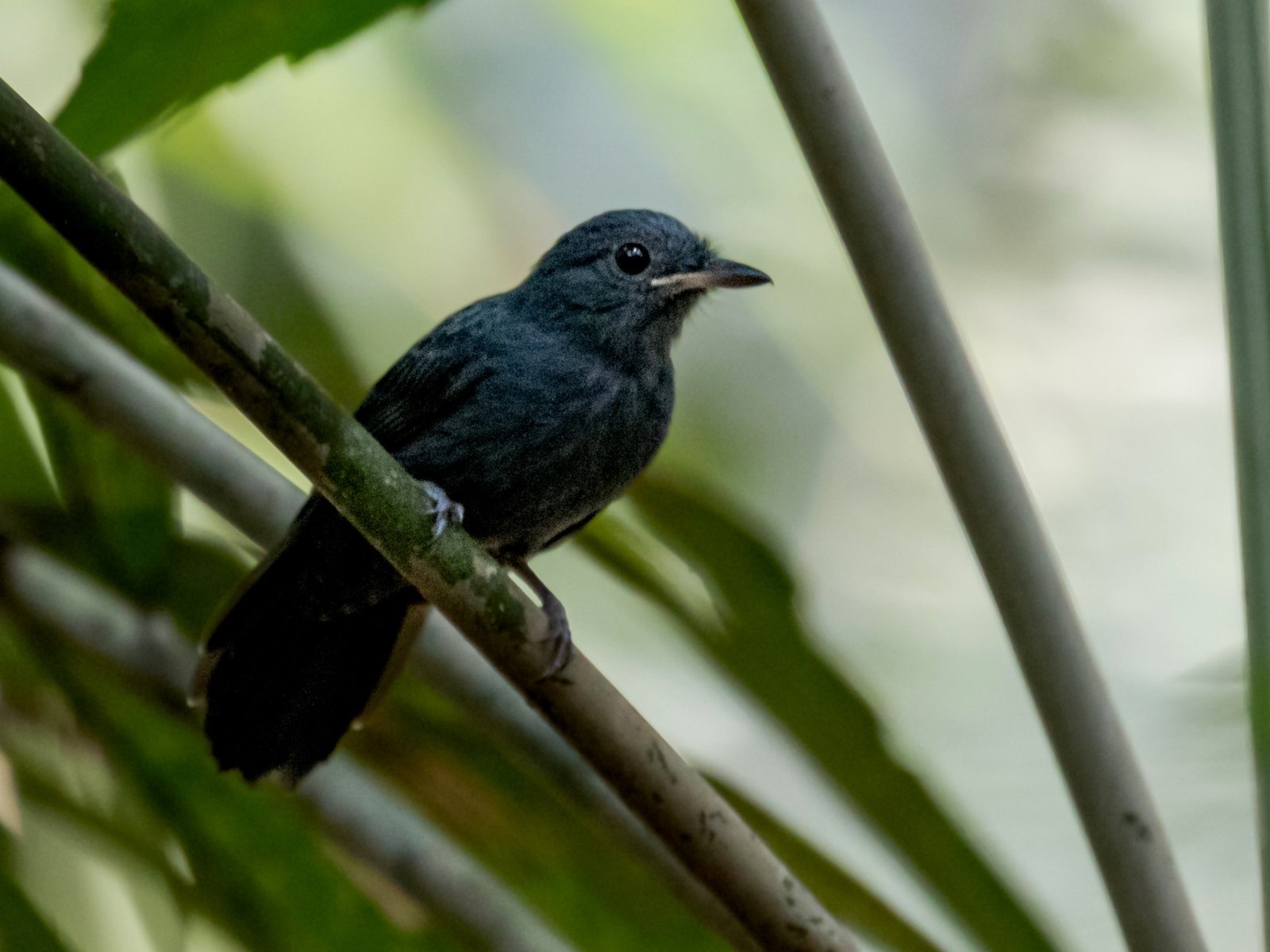
The Cinereous Antshrike is a uniformly grey, upright-perching antshrike of Amazonian forest. It is a nuclear species of understorey mixed flocks: other species gather around pairs or family groups of this antshrike, which sit in the centre of the flock giving loud calls. In the guide area it lives in the Amazonian lowlands of Colombia, Ecuador and northern Peru.
Voice
The song starts with a few slow, sharply rising notes and turns into a short, falling rattle. Calls are staccato, such as wer-chicory and wu-chididik.
Recording: João Capurucho — CC BY-NC-SA 4.0 · xeno-canto
Identification
14–15 cm, slim, with an upright posture, a broad, hook-tipped bill and a fairly long tail. The male is almost uniformly dark grey, with white underwing coverts; birds in the guide area have a paler, whitish throat and a large, usually concealed white patch between the shoulders. The female is olive-brown above, with rufous-tinged wings and tail, a buff throat and a deep tawny-rufous belly and flanks.
Confusion species
Bluish-slate Antshrike Thamnomanes schistogynus replaces this species south of the Amazon and the Marañón; the male is bluer grey and the female grey above, with only a rufous belly. Dusky-throated Antshrike Thamnomanes ardesiacus has a shorter tail and a dark throat and forages lower. Grey Antbird Cercomacra cinerascens is also grey, but has a longer, white-tipped tail and lives higher, in vines. Mouse-colored Antshrike Thamnophilus murinus is browner grey, with a heavier bill, and the female lacks the rufous belly.
Habitat
Understorey and mid-storey of terra firme, várzea and igapó evergreen lowland forest, seldom in secondary forest, mostly below 600 m and up to about 700 m in Colombia. It forages singly, in pairs or in family groups, almost always as the centre of a mixed flock, from just above the ground to about 20 m; it catches arthropods mainly in short sallies from a perch and occasionally attends army ants. The nest is a deep cup resembling a pile of debris, with two eggs.
Where the bird is most at home, classified by the vegetation units of the Andes and the west coast.


Range and movements
Colombia: in the Amazonian lowlands east of the Andes. Ecuador: in the eastern lowlands. Peru: in the north-east, mainly north of the Amazon and the Marañón (Loreto). Bolivia: only in the extreme north-east. Absent from the Galápagos. Outside the guide area in Venezuela, the Guianas and much of Amazonian and eastern Brazil.
- Resident
- dark = core range, pale = thinly spread
How and when to look
Search for understorey mixed flocks in lowland forest around Iquitos or in eastern Ecuador. The loud calls of this antshrike are often the first sign of an approaching flock.
Conservation status
Least Concern. Common in undisturbed Amazonian forest; the species avoids heavily degraded forest and is declining locally through deforestation.
Scientific name
Thamnomanes caesius | (Temminck, 1820)
Temminck described the species in 1820 as Muscicapa caesia; because it was later moved to another genus, the author and year stand in brackets. The genus Thamnomanes was introduced in 1847 by Cabanis. The genus name comes from Greek thamnos, 'bush', and -manēs, 'passionately fond of'. The species name comes from Latin caesius, 'bluish grey'. The specimen the first description was based on came from Bahia, Brazil.