All species › Passerines › Antbirds › Saturnine Antshrike
Saturnine Antshrike | Thamnomanes saturninus
Sombere mierklauwier | Batará saturnino | Uirapuru-selado
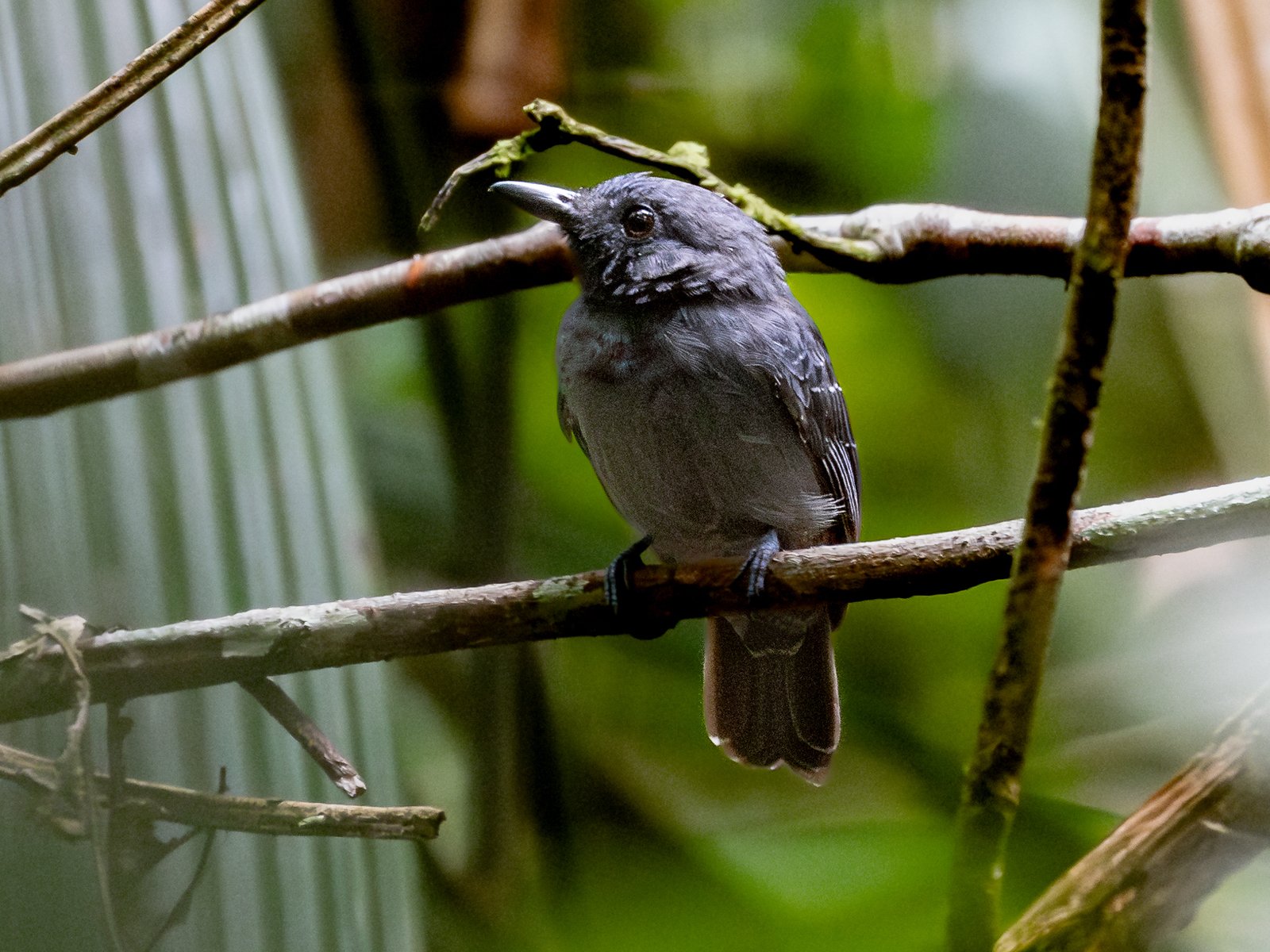
The Saturnine Antshrike is a dark grey antshrike of the genus Thamnomanes from the understorey of Amazonian forest south of the Amazon. The male has a black throat and upper breast. Like its relatives it is a regular member of understorey mixed flocks, where it perches upright on a branch and catches insects in short sallies. In the guide area it lives in north-eastern Peru and extreme north-eastern Bolivia.
Voice
The song is an accelerating, rising series of notes that begins grating and turns into sharp, piercing notes. Calls are a short rattle, a downslurred rasp and an abrupt, clearer note.
Recording: Guilherme Melo — CC BY-NC-SA 4.0 · xeno-canto
Identification
14 cm, with an upright posture, a broad, hook-tipped bill and a fairly long tail. The male is dark slate-grey, with a black throat and upper breast and a concealed white patch between the shoulders; the wing coverts have narrow white tips and the tail small white tips. In birds from Peru the black on the throat is less extensive. The female is olive-brown above, with rufous wings and tail, a white throat (grey-spotted in Peru), an olive breast and a deep tawny-buff belly.
Confusion species
Dusky-throated Antshrike Thamnomanes ardesiacus is very similar, but the male has less black on the throat and breast and a shorter tail; in Peru that species lives mainly north of the Amazon and the Marañón. Bluish-slate Antshrike Thamnomanes schistogynus is bluer grey, without a black throat, and the female is grey above with only a rufous belly. Cinereous Antshrike Thamnomanes caesius lacks the black throat; the female has a buff, not white, throat. Plain-winged Antshrike Thamnophilus schistaceus has a heavier bill and a red eye and perches less upright.
Habitat
Understorey of terra firme evergreen forest, less often in várzea, mostly below 300 m and up to about 650 m in Bolivia. It forages 1–4 m above the ground, singly, in pairs or in family groups, almost always in mixed flocks; it catches insects and other arthropods by sallying from a perch to foliage and stems and sometimes attends army ants. The nest is a cup between two limbs of a sapling, a few metres up.
Where the bird is most at home, classified by the vegetation units of the Andes and the west coast.


Range and movements
Peru: in the north-east, south of the Amazon and the Marañón (Loreto, extending into San Martín). Bolivia: only in the extreme north-east (Santa Cruz, possibly also Pando and Beni). Absent from Colombia, Ecuador and the Galápagos. Outside the guide area in southern Amazonian Brazil, from Acre east to the Tapajós.
- Resident
- dark = core range, pale = thinly spread
How and when to look
Search understorey mixed flocks in terra firme forest in Loreto. This antshrike often perches upright on an open branch in the middle of the flock and gives loud calls.
Conservation status
Least Concern. The species depends on undisturbed forest; numbers are thought to be declining through deforestation in southern Amazonia.
Scientific name
Thamnomanes saturninus | (Pelzeln, 1868)
Pelzeln described the species in 1868 as Thamnophilus saturninus; because it was later moved to another genus, the author and year stand in brackets. The genus Thamnomanes was introduced in 1847 by Cabanis. The genus name comes from Greek thamnos, 'bush', and -manēs, 'passionately fond of'. The species name comes from Medieval Latin saturninus, 'gloomy, leaden'; in alchemy the god Saturn was identified with lead. The specimen the first description was based on came from Borba, Rio Madeira, Brazil.