All species › Woodpeckers and allies › Toucans › Blue-banded Toucanet
Blue-banded Toucanet | Aulacorhynchus coeruleicinctis
Blauwbandarassari | Tucanete pechiazul | Tucaninho-de-faixa-azul
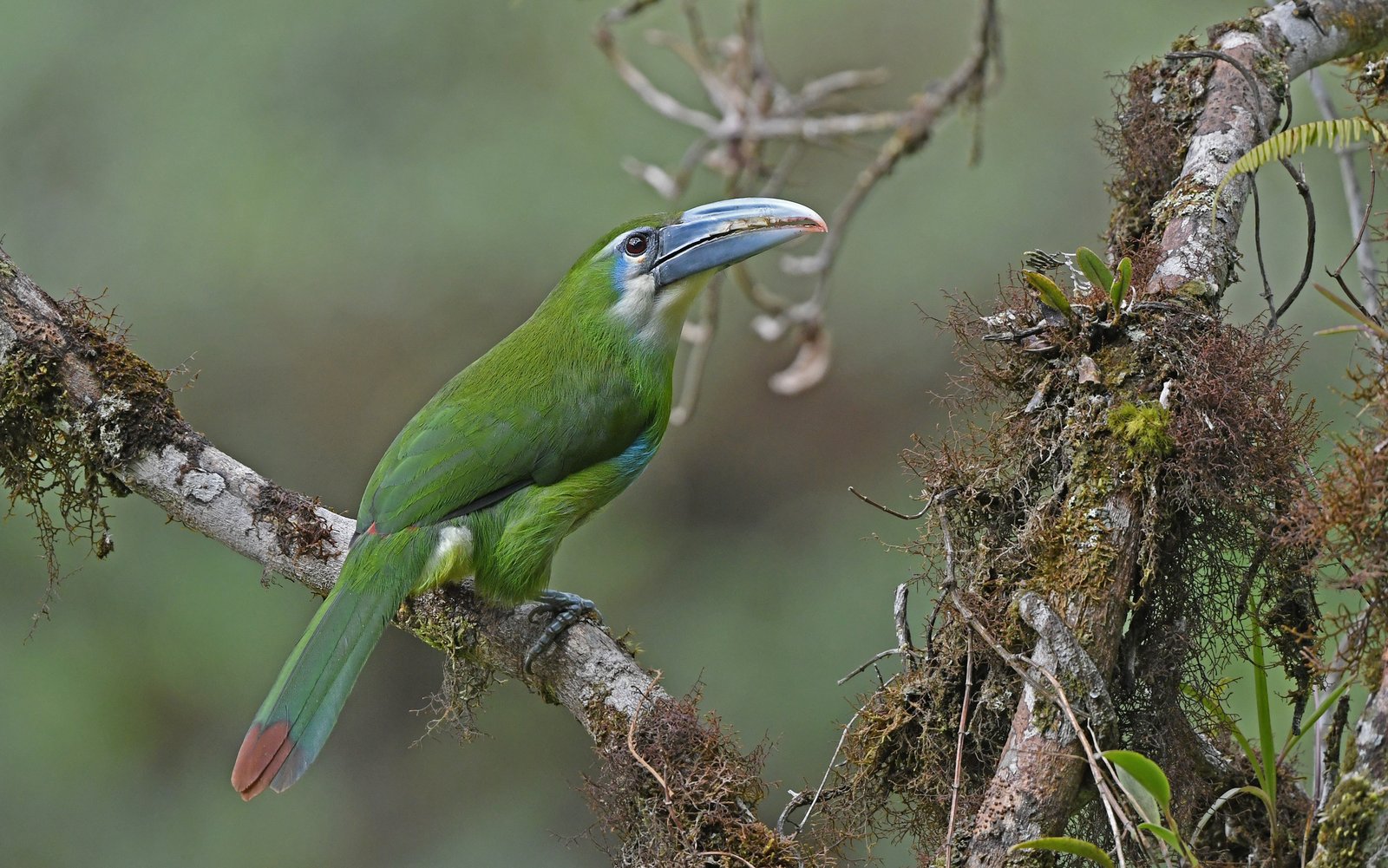
The Blue-banded Toucanet is a green toucanet of cloud forest on the eastern slope of the Andes in central and southern Peru and in Bolivia. The blue breast band, the red rump and the pale iris separate it from the other toucanets in its range. It lives higher than most of its relatives.
Voice
Series of barking and growling notes of varying pitch, also rattling calls and yelping cries.
Recording: Sjoerd Mayer — CC BY-NC-SA 3.0 · xeno-canto
Identification
40–44 cm. Mainly green, with a white throat, a faint blue band across the breast, a blue-and-white eyebrow and pale blue below the eye. The rump is red, the undertail coverts greenish yellow and the central tail feathers have rusty tips. The bill is bluish horn; the iris varies from white through yellow to red-brown, surrounded by dark grey bare skin. The sexes are alike; juveniles are duller.
Confusion species
Southern Emerald Toucanet Aulacorhynchus albivitta has a black throat in this region, a black bill with yellow, chestnut undertail coverts and a green rump, and usually lives lower. Chestnut-tipped Toucanet Aulacorhynchus derbianus has a black-and-red bill and a green rump, and lives lower. Yellow-browed Toucanet Aulacorhynchus huallagae, further north, has a yellow stripe behind the eye and golden-yellow undertail coverts.
Habitat
Humid montane forest and cloud forest, from about 1500 to 3000 m, usually between 1600 and 2500 m. It forages at all levels of the forest, alone, in pairs or in small groups, and eats mainly fruit and insects. It nests in a tree cavity; in Peru mainly in the first months of the year, in Bolivia from August to January.
Where the bird is most at home, classified by the vegetation units of the Andes and the west coast.


Range and movements
In Peru on the eastern slope of the Andes from Huánuco southwards. In Bolivia on the eastern slope south to Santa Cruz. Absent from Colombia, Ecuador and the Galápagos. Does not occur outside the guide area.
- Resident
- dark = core range, pale = thinly spread
How and when to look
Along the road through cloud forest to the Manu area in Peru and in the Yungas of La Paz in Bolivia, often at fruiting trees along the forest edge.
Conservation status
Least Concern. Much of the range is still forested.
Scientific name
Aulacorhynchus coeruleicinctis | d'Orbigny, ACVMD, 1840
D'Orbigny, ACVMD described the species in 1840 and placed it straight away in the genus where it still stands. The genus Aulacorhynchus was introduced in 1835 by Gould. The genus name comes from Greek aulax, 'furrow', and rhunkhos, 'bill'. The species name comes from Latin caeruleus, 'blue', and cinctus, 'girdled', for the blue breast band. The specimen the first description was based on came from Yungas, La Paz, Bolivia.