All species › Woodpeckers and allies › Toucans › Grey-breasted Mountain Toucan
Grey-breasted Mountain Toucan | Andigena hypoglauca
Zwartmaskerbergtoekan | Tucán andino pechigrís | Tucano-andino-de-peito-cinza
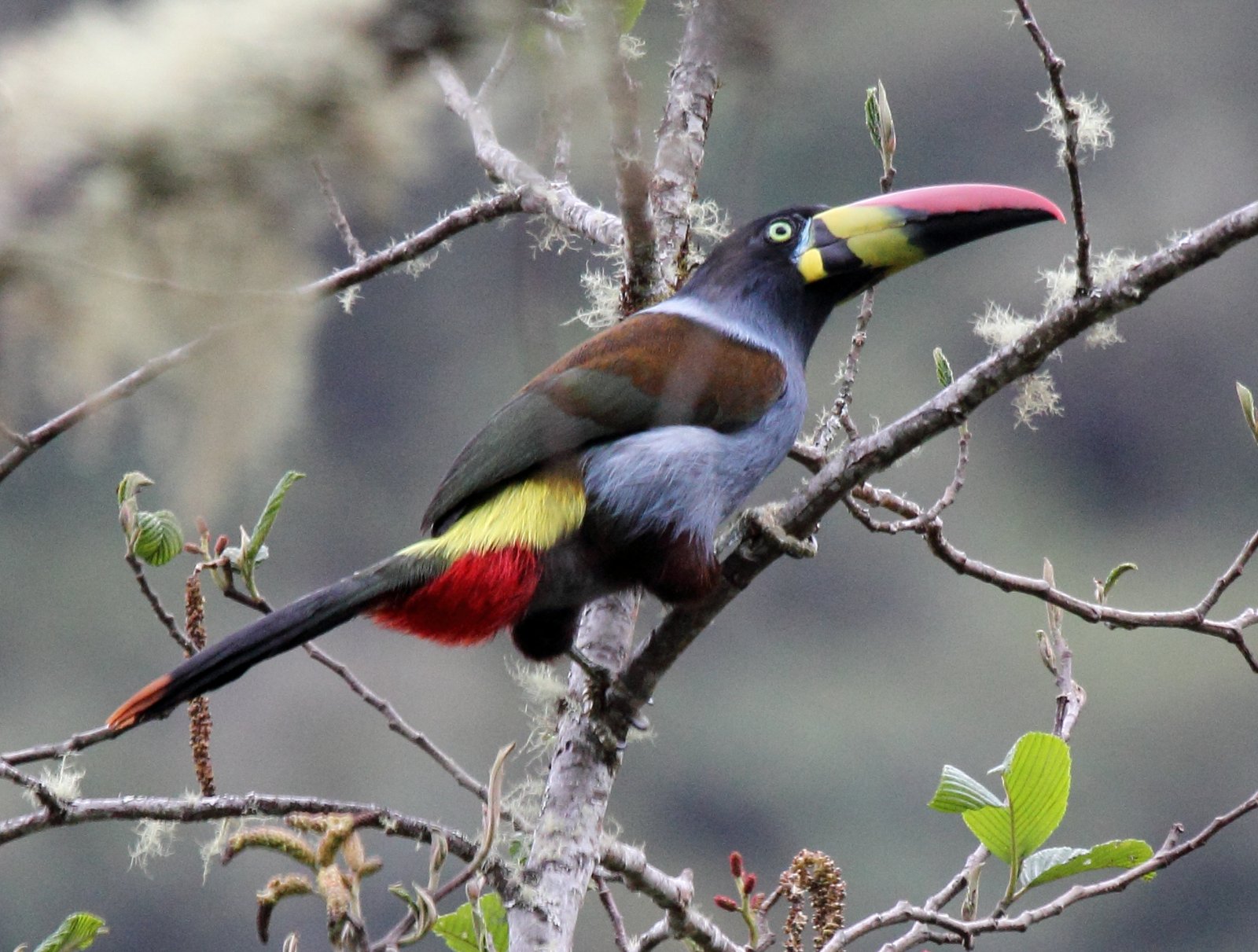
The Grey-breasted Mountain Toucan is a colourful mountain toucan of the high cloud forest of the northern and central Andes. With its blue-grey underparts, black head and multicoloured bill it is one of the characteristic birds of the forest just below the treeline. It lives in pairs or small groups and despite its colours often stays hidden in the mossy canopy.
Voice
A loud, nasal, braying call that is often repeated, sometimes with clattering bill sounds.
Recording: David Monroy Rengifo — CC BY-NC-SA 4.0 · xeno-canto
Identification
41–48 cm, with a large, multicoloured bill: red, black and yellowish green at the base. The crown and nape are black, the throat, breast and belly blue-grey. The back is olive-brown, the rump yellow, the thighs chestnut and the undertail coverts red. The tail is black with chestnut tips. Around the eye is bare blue skin. The sexes are alike; juveniles are duller, with a less colourful bill.
Confusion species
Black-billed Mountain Toucan Andigena nigrirostris has a white throat and a mainly black bill. Plate-billed Mountain Toucan Andigena laminirostris lives only on the western slope, has a yellow flank patch and an ivory plate on the upper mandible. Hooded Mountain Toucan Andigena cucullata, further south, has an all-black head and a yellowish green bill with a black tip. Toucanets of the genus Aulacorhynchus, such as Southern Emerald Toucanet Aulacorhynchus albivitta, are smaller and mainly green.
Habitat
Humid, mossy cloud forest and upper montane forest, also forest edges and elfin forest up to the treeline, at roughly 2000 to 3600 m. It eats mainly fruit and also insects and sometimes eggs or young of other birds. It nests in a tree cavity.
Where the bird is most at home, classified by the vegetation units of the Andes and the west coast.


Range and movements
In the Andes of Colombia; in Ecuador mainly on the eastern slope; in Peru on the eastern slope. Absent from Bolivia and the Galápagos, and does not occur outside the guide area.
- Resident
- dark = core range, pale = thinly spread
How and when to look
On the eastern slope in Ecuador, for example around Guango near Papallacta, and in the Río Blanco reserve near Manizales in Colombia, often at fruiting trees or fruit feeders. Pairs and small groups call loudly from the canopy.
Conservation status
Least Concern, but numbers are declining through clearance of cloud forest.
Scientific name
Andigena hypoglauca | (Gould, 1833)
Gould described the species in 1833 as Pteroglossus hypoglaucus; because it was later moved to another genus, the author and year stand in brackets. The genus Andigena was introduced in 1851 by Gould. The genus name comes from the Andes and Latin -gena, 'born in', thus 'Andes-born'. The species name comes from Greek hupo, 'below', and glaukos, 'bluish grey', for the grey-blue underparts. The specimen the first description was based on came from Colombia.