All species › Woodpeckers and allies › Toucans › Plate-billed Mountain Toucan
Plate-billed Mountain Toucan | Andigena laminirostris
Zwartkruinbergtoekan | Tucán andino piquilaminado | Tucano-andino-de-bico-laminado
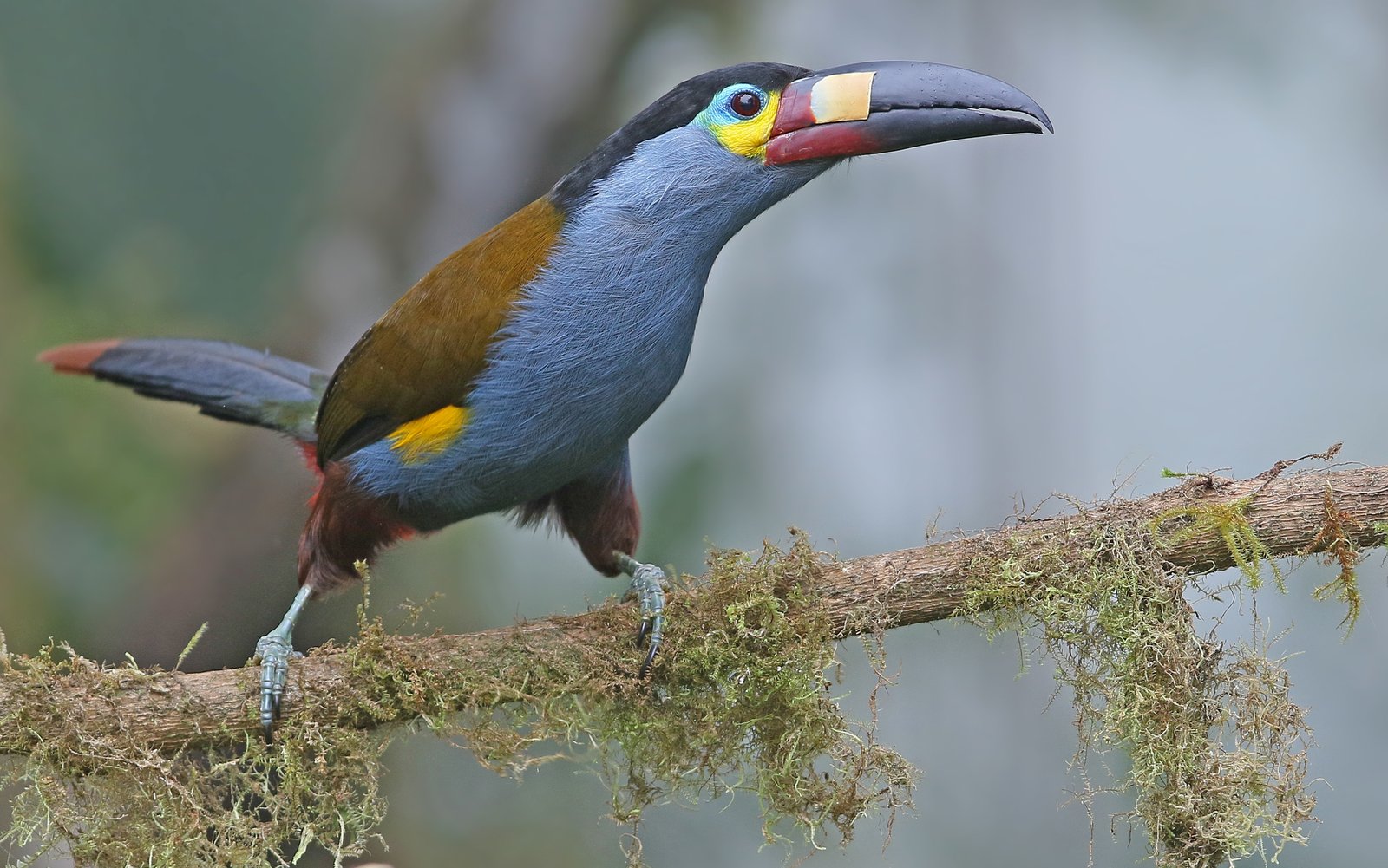
The Plate-billed Mountain Toucan is a mountain toucan of the western slope of the Andes in south-western Colombia and western Ecuador. The yellowish ivory plate at the base of the upper mandible, which gives it its English and Spanish names, is found in no other toucan. It lives in pairs or small groups in humid, mossy montane forest.
Voice
A long series of loud, nasal, rattling trrrrk calls, often mixed with clattering bill sounds.
Recording: Juan Freile — CC BY-NC-SA 4.0 · xeno-canto
Identification
46–51 cm. The crown and nape are black, the throat, breast and belly blue-grey, with a yellow patch on the flank. The back is olive-brown, the rump yellow, the thighs chestnut and the undertail coverts red. The tail is black with chestnut tips. The bill is black with a red base and a raised, yellowish ivory plate at the base of the upper mandible. Bare yellow skin lies in front of the eye, blue skin below it. The sexes are alike; juveniles have a smaller plate and duller plumage.
Confusion species
Grey-breasted Mountain Toucan Andigena hypoglauca lives mainly on the eastern slope, lacks the yellow flank patch and has a multicoloured bill without a plate. Black-billed Mountain Toucan Andigena nigrirostris has a white throat and a bill without a plate. Crimson-rumped Toucanet Aulacorhynchus haematopygus in the same forest is much smaller and mainly green, with a red rump.
Habitat
Humid, mossy montane forest and cloud forest, also forest edges and old secondary forest, at roughly 1200 to 3200 m, usually between 1600 and 2600 m. It eats mainly fruit, also insects and sometimes eggs or nestlings of other birds. It nests in a tree cavity.
Where the bird is most at home, classified by the vegetation units of the Andes and the west coast.


Range and movements
In Colombia only on the western slope in the south-west, in Nariño. In Ecuador on the western slope of the Andes, mainly in the north and centre of the country. Absent from Peru, Bolivia and the Galápagos. Does not occur outside the guide area.
- Resident
- dark = core range, pale = thinly spread
How and when to look
Cloud forest on the western slope in Ecuador, such as around Mindo, Tandayapa and the Bellavista reserve, often at fruiting trees or fruit feeders. The rattling call carries far through the forest.
Conservation status
Near Threatened. The range is limited and montane forest on the western slope is being cleared and fragmented.
Scientific name
Andigena laminirostris | Gould, 1851
Gould described the species in 1851 and placed it straight away in the genus where it still stands. He introduced the genus Andigena in that same work. The genus name comes from the Andes and Latin -gena, 'born in', thus 'Andes-born'. The species name comes from Latin lamina, 'plate', and rostrum, 'bill', for the yellow plate on the upper mandible. The specimen the first description was based on came from Quito, Ecuador.