All species › Swifts › Hummingbirds › Blue-chested Hummingbird
Blue-chested Hummingbird | Polyerata amabilis
Blauwborstamazilia | Amazilia amable | Amazília-de-peito-azul
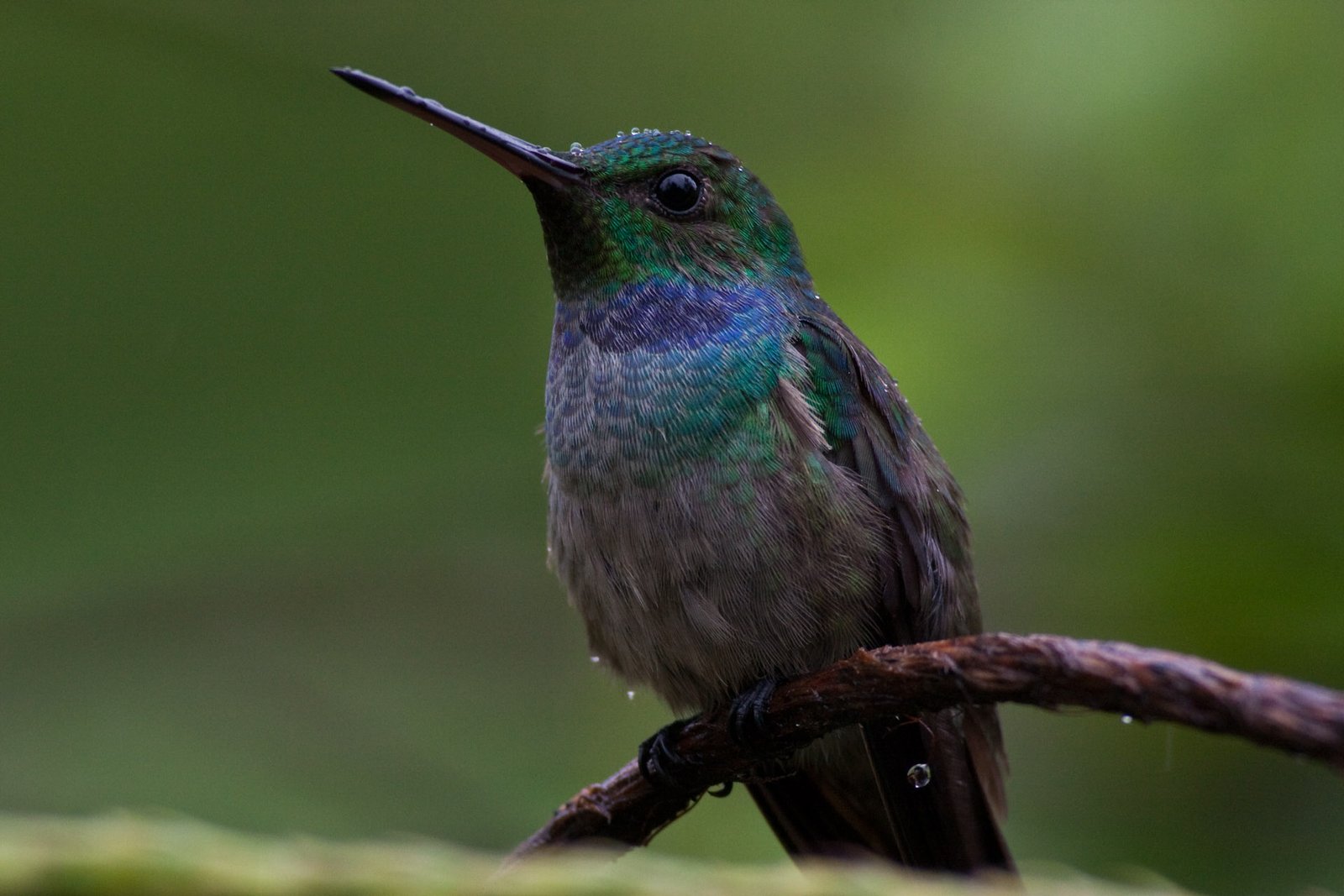
The Blue-chested Hummingbird is a small hummingbird of humid lowland forest in Central America and north-western South America. The male has a glittering violet-blue patch on the breast below a green throat. Males sing in small, loose groups at fixed sites in the lower levels of forest and forest edge.
Voice
The song is a long, sustained series of high, squeaky and chipping notes from a fixed song perch. The call is a dry tsik.
Recording: Juan Freile — CC BY-NC-SA 4.0 · xeno-canto
Identification
9 cm, with a straight, medium-length bill; the upper mandible is black and the lower mandible has a flesh-coloured base. The male is green above, with a glittering green crown, a green throat, a glittering violet-blue breast patch and a greyish belly with green flanks; the tail is dark bronzy to blackish. The female is green above and grey below, with small green spots on the throat and breast and sometimes a tinge of blue on the breast. Young birds resemble the female.
Confusion species
Purple-chested Hummingbird Polyerata rosenbergi of the Chocó has a darker, purple breast patch and paler undertail coverts. Rufous-tailed Hummingbird Amazilia tzacatl is larger, with a rufous tail and a mostly red bill. Violet-bellied Hummingbird Chlorestes julie is smaller, with a shorter bill, and the male has a violet-blue breast and belly. Sapphire-throated Hummingbird Chrysuronia coeruleogularis has a blue throat instead of a blue breast and a forked tail.
Habitat
Edges of humid forest, clearings, secondary forest, old plantations and scrub along streams, in the lowlands and foothills up to about 1000 m. It takes nectar in the lower and middle levels, often at flowering shrubs, herbs and heliconias, and catches small insects. The cup nest is placed low on a twig or a leaf.
Where the bird is most at home, classified by the vegetation units of the Andes and the west coast.


Range and movements
In Colombia in the Pacific lowlands and in the north, in the Caribbean lowlands and the middle Magdalena valley. In Ecuador in the north-western lowlands, mainly in Esmeraldas. Absent from Peru, Bolivia and the Galápagos. Outside the guide area from Nicaragua to Panama.
- Resident
- dark = core range, pale = thinly spread
How and when to look
Search in the early morning along forest edges and clearings in the lowlands of the Chocó and Esmeraldas; singing males give themselves away by their persistent, squeaky song, always from the same spot.
Conservation status
Least Concern. The species lives at forest edges and in secondary forest and tolerates some disturbance, but remains dependent on nearby forest.
Scientific name
Polyerata amabilis | (Gould, 1853)
Gould described the species in 1853 as Trochilus (--?) amabilis; because it was later moved to another genus, the author and year stand in brackets. The genus Polyerata was introduced in 1863 by Heine. The genus name comes from Greek poluēratos, 'very lovely'. The specific name is Latin amabilis, 'lovely'. The specimen the first description was based on came from Colombia.