All species › Swifts › Hummingbirds › Purple-chested Hummingbird
Purple-chested Hummingbird | Polyerata rosenbergi
Purperborstamazilia | Amazilia de Rosenberg | Beija-flor-de-peito-roxo
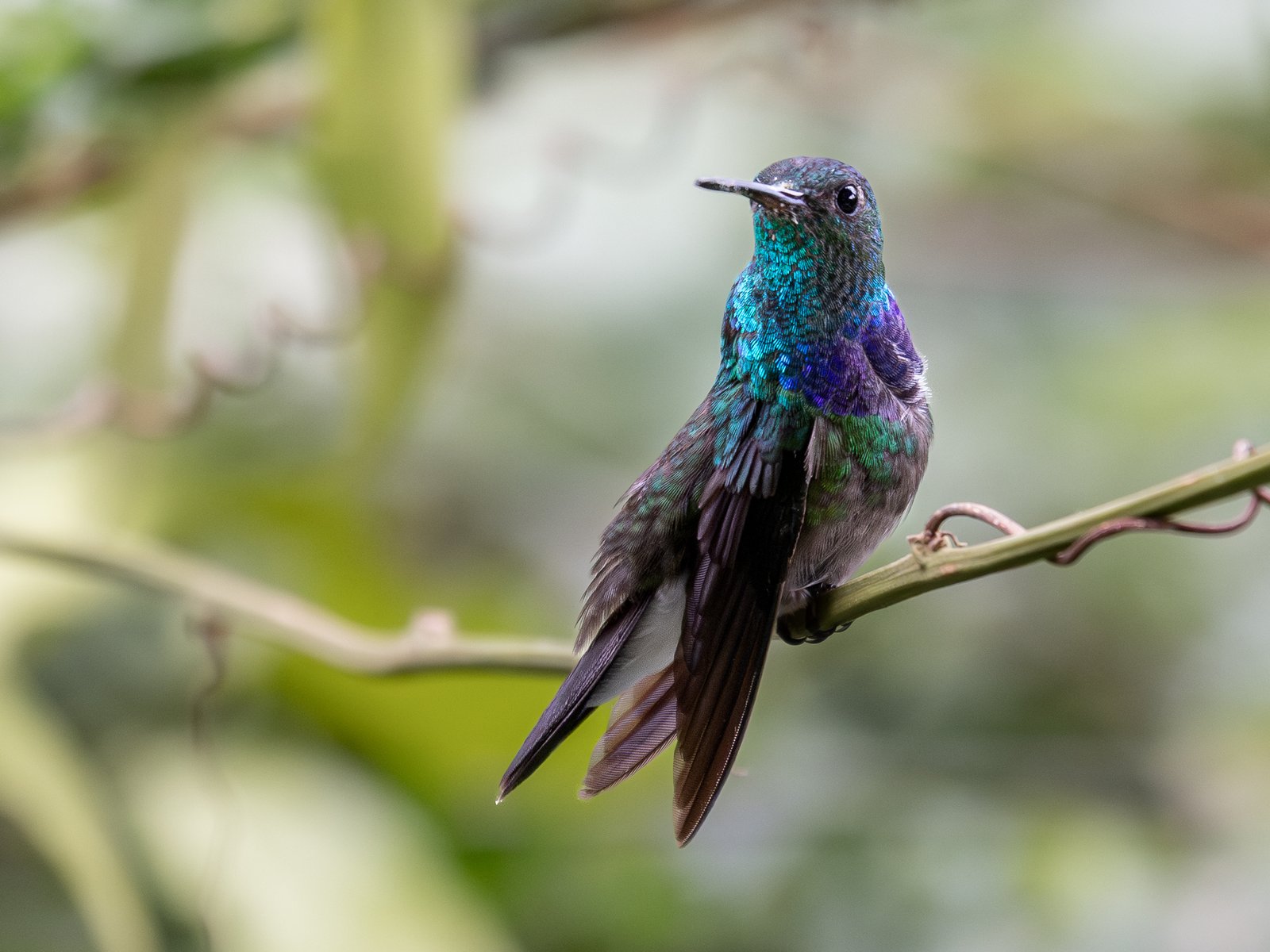
The Purple-chested Hummingbird is a small hummingbird of the Chocó rainforest in western Colombia and north-western Ecuador. The male has a purple-blue breast patch below a green throat. It lives in the lower strata of humid forest and at forest edges.
Voice
A repeated, dry tsip and a high, thin twitter. The song is a series of high, squeaky notes.
Recording: Sidnei Dantas — CC BY-NC-SA 4.0 · xeno-canto
Identification
8–9 cm, with a straight bill; the upper mandible is black, the lower mandible pink with a dark tip. The male is shining green above, with a glittering green throat, a purple-blue breast patch, a greyish-white belly with green flanks and a blue-black tail. The female is green above and greyish white below, with small green spots on the throat and breast and no purple-blue patch; the tail is blue-black with grey tips to the outer feathers. Young birds resemble the female.
Confusion species
Blue-chested Hummingbird Polyerata amabilis is very similar; the male has a bluer, less purple breast patch and a browner grey belly. The two ranges meet in north-western Colombia. Rufous-tailed Hummingbird Amazilia tzacatl is larger, with a rufous tail and a grey belly. The male Violet-bellied Hummingbird Chlorestes julie has a violet belly and a green breast.
Habitat
Understorey and edges of humid lowland forest, secondary forest, clearings and plantations, mostly below 500 m, locally up to about 900 m. It takes nectar from understorey flowers such as heliconias and catches small insects. The cup nest is placed low in the vegetation.
Where the bird is most at home, classified by the vegetation units of the Andes and the west coast.


Range and movements
In Colombia in the Pacific lowlands, from the Chocó south to Nariño. In Ecuador in the north-west, mainly in Esmeraldas. Absent from Peru, Bolivia and the Galápagos. Does not occur outside the guide area.
- Resident
- dark = core range, pale = thinly spread
How and when to look
Look at flowering heliconias and shrubs along forest edges and trails in the lowlands of Esmeraldas and the Colombian Pacific coast; birds forage low and often follow a fixed route between flowers.
Conservation status
Least Concern. The range is limited, and the Chocó lowland forest is locally cleared for farming and oil palm.
Scientific name
Polyerata rosenbergi | Boucard, 1895
Boucard described the species in 1895 and placed it straight away in the genus where it still stands. The genus Polyerata was introduced in 1863 by Heine. The genus name comes from Greek poluēratos, 'very lovely'. The specific name honours William Frederick Henry Rosenberg (1868–1957), British natural-history dealer and collector in tropical America. The specimen the first description was based on came from Río Dagua, Colombia.