All species › Swifts › Hummingbirds › White-bellied Hummingbird
White-bellied Hummingbird | Elliotomyia chionogaster
Sneeuwbuikamazilia | Amazilia ventrinívea | Beija-flor-de-barriga-branca
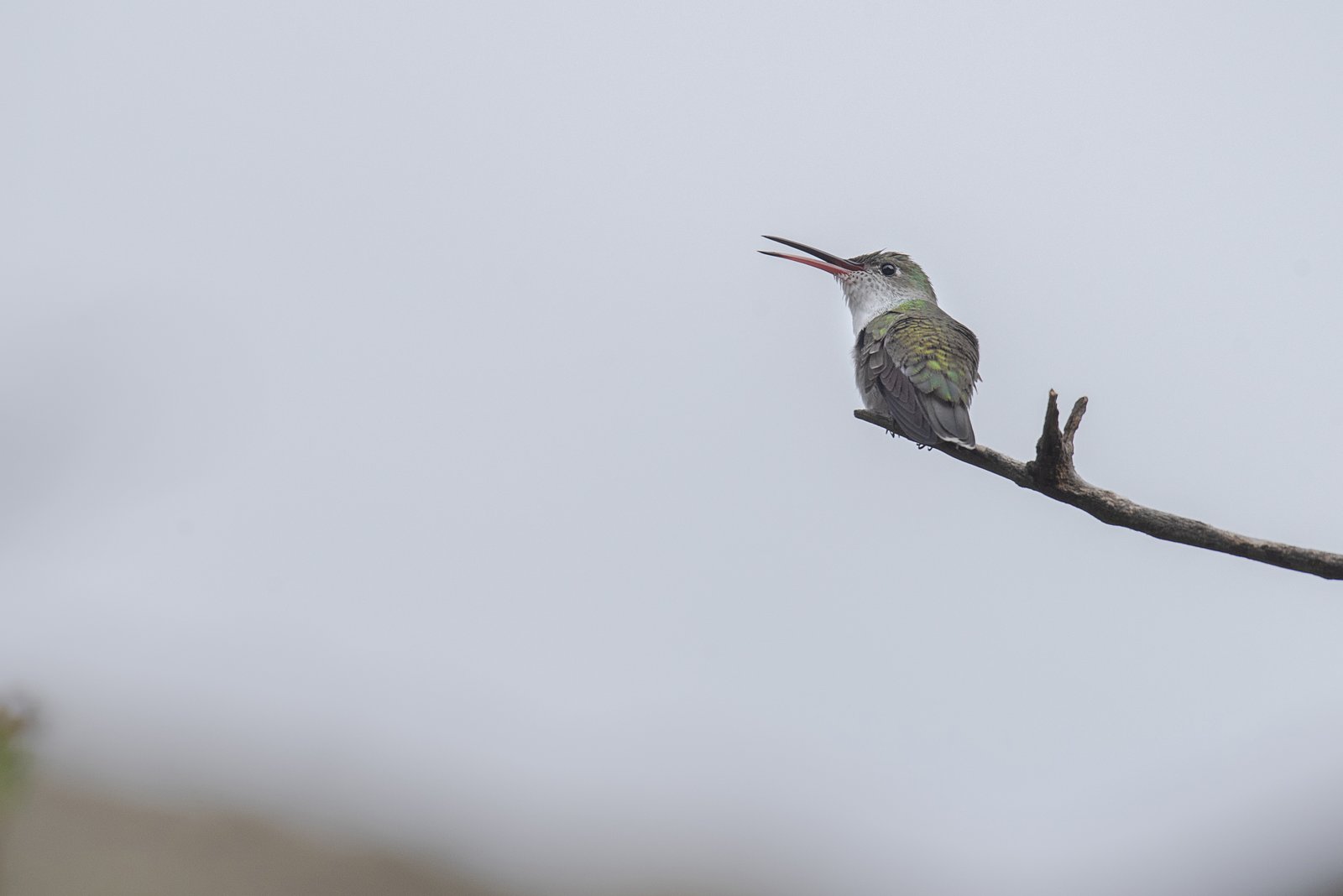
The White-bellied Hummingbird is a medium-sized hummingbird with white underparts, found in the Andes of Peru and Bolivia south to north-western Argentina. It lives mainly in dry to semi-humid valleys and on the lower slopes. In gardens and villages it regularly visits flowering shrubs.
Voice
A dry, repeated tchip and a fast, squeaky twitter during chases. The song is a series of high, thin notes.
Recording: Étienne Leroy — CC BY-NC-SA 4.0 · xeno-canto
Identification
10–11 cm, with a straight bill; the upper mandible is black, the lower mandible pink with a dark tip. Both sexes are bronze-green above and white below, with green spots on the sides of the throat and breast. The tail is bronze-green, the outer feathers with white or greyish-white inner webs. The female is duller. Young birds have brownish fringes to the feathers of the upperparts.
Confusion species
Green-and-white Hummingbird Elliotomyia viridicauda has a uniformly green tail without white and is purer green above; it lives in more humid forest in central and southern Peru. Many-spotted Hummingbird Taphrospilus hypostictus is larger and has densely green-spotted underparts. Amazilia Hummingbird Amazilis amazilia has a rufous belly and tail. Olive-spotted Hummingbird Talaphorus chlorocercus is smaller, with a shorter bill and olive-green spots on the throat and breast, and lives along rivers in the lowlands.
Habitat
Dry and semi-humid forest and scrub, gallery forest, forest edges, gardens and villages in Andean valleys and on the lower eastern slope, roughly between 500 and 2900 m. It takes nectar from flowering shrubs and trees, also from planted flowers, and catches small insects. The cup nest is placed on a branch or twig in a shrub or tree.
Where the bird is most at home, classified by the vegetation units of the Andes and the west coast.


Range and movements
In Peru in the dry and semi-humid Andean valleys and on the eastern slope, from the Marañón valley in the north to Puno in the south. In Bolivia on the eastern slope and in the dry Andean valleys, south to Tarija. Absent from Colombia, Ecuador and the Galápagos. Outside the guide area in north-western Argentina; there are also a few records from western Brazil.
- Resident
- dark = core range, pale = thinly spread
How and when to look
Look at flowering shrubs and trees in gardens, along roads and in villages in the dry valleys, for example in the Urubamba valley and around Cochabamba and Samaipata.
Conservation status
Least Concern. The species also occurs in heavily modified habitats such as gardens, villages and field edges.
Scientific name
Elliotomyia chionogaster | (Tschudi, 1846)
Tschudi described the species in 1846 as Trochilus chionogaster; because it was later moved to another genus, the author and year stand in brackets. The genus Elliotomyia was introduced in 2019 by Stiles & Remsen. The genus name honours the American ornithologist Daniel Giraud Elliot (1835–1915), a founding member of the AOU, and contains Greek muia, 'fly', a common element in hummingbird genera. The species name combines Greek khiōn, 'snow', with gastēr, 'belly': 'snow-bellied'. The specimen the first description was based on came from Peru.