All species › Swifts › Hummingbirds › Green-and-white Hummingbird
Green-and-white Hummingbird | Elliotomyia viridicauda
Groen-witte amazilia | Amazilia blanquiverde | Beija-flor-verde-e-branco
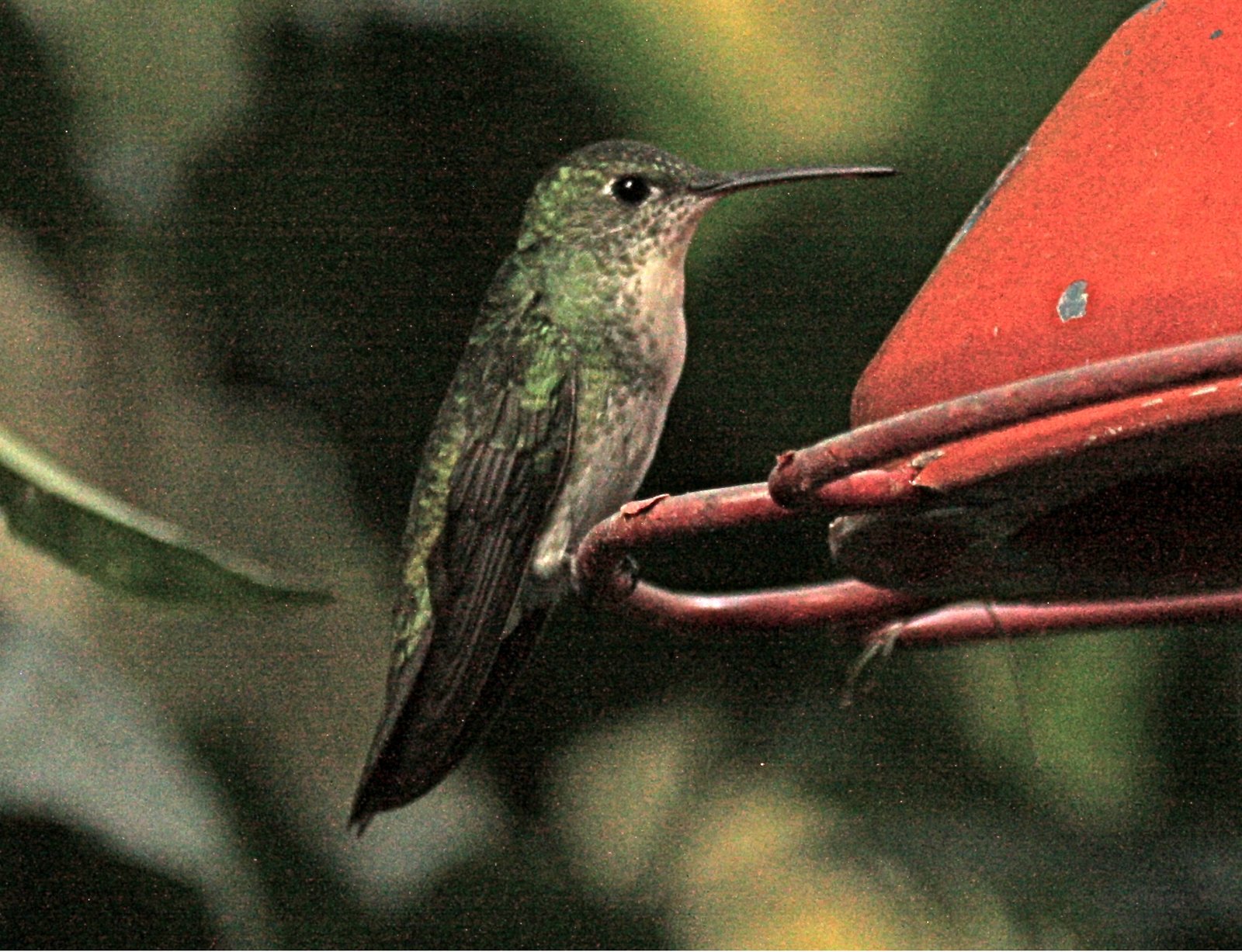
The Green-and-white Hummingbird is a hummingbird found only in Peru, on the eastern slope of the Andes in the centre and south of the country. It is green above and white below. In the Urubamba valley around Machu Picchu it is one of the commonest hummingbirds.
Voice
A repeated, dry tsit and high, squeaky series during chases. The song is a series of thin, high notes.
Recording: Dries Van de Loock — CC BY-NC-SA 4.0 · xeno-canto
Identification
10–11 cm, with a straight bill; the upper mandible is black, the lower mandible reddish with a dark tip. Both sexes are shining green above and white from the throat to the undertail coverts, with green spots on the sides of the throat and breast and green flanks. The tail is bronze-green to olive-green, without white. The female has slightly more green spotting on the underparts. Young birds have brownish fringes to the feathers of the head and back.
Confusion species
White-bellied Hummingbird Elliotomyia chionogaster is very similar, but has white inner webs to the outer tail feathers, visible mainly when the bird spreads its tail, and is more bronzy above; it lives mainly in drier valleys, but the two species locally occur together. Many-spotted Hummingbird Taphrospilus hypostictus is larger, with dense green spotting over the whole underside.
Habitat
Edges of humid montane forest, secondary forest, scrub, plantations and gardens on the eastern slope of the Andes, roughly between 1000 and 2600 m. It takes nectar from flowering shrubs and trees, also in gardens, and catches small insects. The cup nest is placed on a twig in a shrub or small tree.
Where the bird is most at home, classified by the vegetation units of the Andes and the west coast.


Range and movements
Only in Peru, on the eastern slope of the Andes in the centre and south of the country, mainly in Cusco, including the Urubamba valley. Absent from Colombia, Ecuador, Bolivia and the Galápagos. Does not occur outside the guide area.
- Resident
- dark = core range, pale = thinly spread
How and when to look
Look at flowering shrubs in gardens and along the railway and roads around Aguas Calientes and Machu Picchu, and in gardens elsewhere in the Urubamba valley.
Conservation status
Least Concern. The range is limited, but the species also occurs in man-made habitats such as gardens and plantations.
Scientific name
Elliotomyia viridicauda | (Berlepsch, 1883)
Berlepsch described the species in 1883 as Leucippus viridicauda; because it was later moved to another genus, the author and year stand in brackets. The genus Elliotomyia was introduced in 2019 by Stiles & Remsen. The genus name honours the American ornithologist Daniel Giraud Elliot (1835–1915), a founding member of the AOU, and contains Greek muia, 'fly', a common element in hummingbird genera. The species name combines Latin viridis, 'green', with cauda, 'tail'. The specimen the first description was based on came from Huiro, Cusco, Peru.