All species › Parrots › African and New World parrots › Blue-headed Macaw
Blue-headed Macaw | Primolius couloni
Blauwkopara | Guacamayo cabeciazul | Maracanã-de-cabeça-azul
The Blue-headed Macaw is a small macaw with a blue head, restricted to south-western Amazonia. Almost its entire range lies in eastern Peru. It lives in pairs or small groups at forest edges and along rivers and is seen in small numbers throughout.
Voice
Harsh, grating cries, mainly in flight, higher and weaker than those of the large macaws.
Recording: Jacob Wijpkema — CC BY-NC-SA 4.0 · xeno-canto
Identification
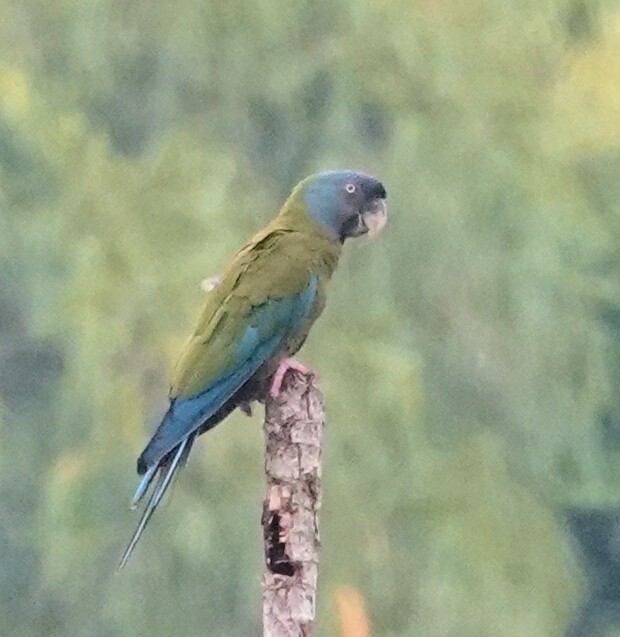
41 cm, with a long, pointed tail and a dark bill with a paler tip. The whole head is blue; the bare skin around the eye and at the base of the bill is grey. The body is green and the flight feathers are blue. The tail is reddish brown above with a blue tip and, like the underwing, olive-yellow below. The eye is yellow. The sexes are alike; juveniles have a dark eye.
Confusion species
Chestnut-fronted Macaw Ara severus is larger, with a chestnut forehead, a bare white face and red underwing coverts. Red-bellied Macaw Orthopsittaca manilatus has a bare yellowish face and a red patch on the belly. Golden-collared Macaw Primolius auricollis has a blackish forecrown and a yellow collar and lives further south-east, in Bolivia. Parakeets such as White-eyed Parakeet Psittacara leucophthalmus are entirely green, without a blue head.
Habitat
Forest edges, clearings and secondary forest, riverine forest and foothill forest, including bamboo forest, from the lowlands up to about 1300 m. It eats seeds, fruit and flowers and visits clay licks along rivers. It nests in tree cavities.
Where the bird is most at home, classified by the vegetation units of the Andes and the west coast.


Range and movements
Mainly in eastern Peru, from San Martín and Huánuco through Ucayali, Pasco, Junín and Cusco to Madre de Dios and Puno. In Bolivia only in the north-west, in Pando and northern La Paz. Absent from Colombia, Ecuador and the Galápagos. Outside the guide area in western Brazil, in Acre.
- Resident
- dark = core range, pale = thinly spread
How and when to look
Along rivers and at forest edges in the foothills and lowlands of Ucayali and Madre de Dios, for example around Manu and Tambopata, sometimes at clay licks together with other parrots.
Conservation status
Vulnerable. The population is declining through trapping for the cage-bird trade and deforestation; the species is listed on Appendix I of CITES.
Scientific name
Primolius couloni | (Sclater, 1876)
Sclater described the species in 1876 as Ara couloni; because it was later moved to another genus, the author and year stand in brackets. The genus Primolius was introduced in 1857 by Bonaparte. The genus name honours Count Pietro Primoli di Foglia (1821–1883), husband of Charlotte Bonaparte and thus son-in-law of Charles Lucien Bonaparte, who described the genus. The species name honours the Swiss zoologist Paul Louis de Coulon (1804–1894), director of the museum in Neuchâtel. The specimen the first description was based on came from Eastern Peru.