All species › Parrots › African and New World parrots › Nanday Parakeet
Nanday Parakeet | Aratinga nenday
Nandayparkiet | Aratinga ñanday | Periquito-de-cabeça-preta
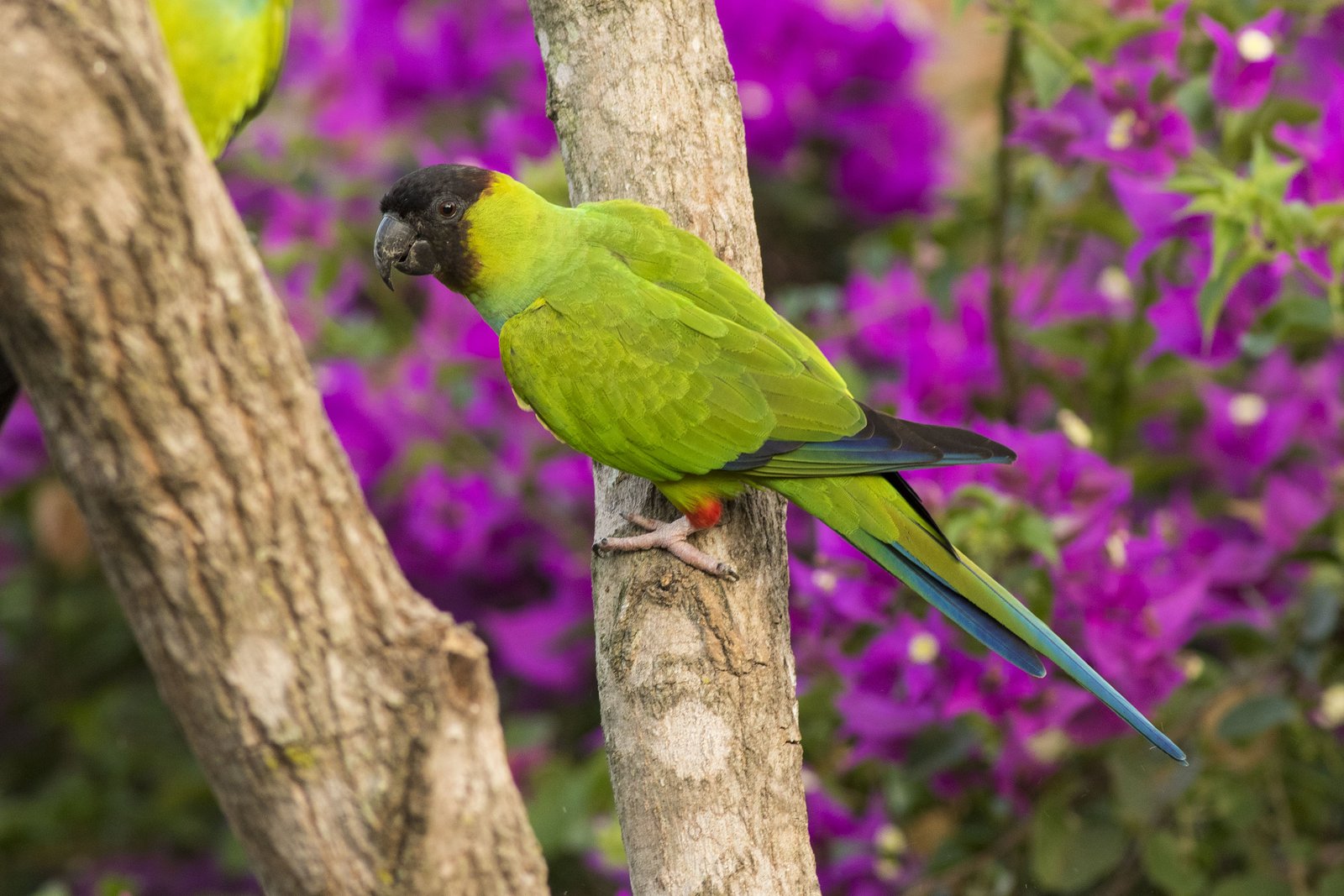
The Nanday Parakeet is a green parakeet with a black hood, from the wet savannas and palm landscapes in the heart of South America. In the guide area it occurs only in the far east of Bolivia, at the edge of the Pantanal. It lives in noisy flocks and is widely kept as a cage bird; outside South America escaped birds have become established in several places.
Voice
A shrill, piercing, repeated kree-ah, mainly in flight; flocks are very noisy at roosts and feeding sites.
Recording: Guilherme Melo — CC BY-NC-SA 4.0 · xeno-canto
Identification
30 cm, with a long, pointed tail and a black bill. The head is black down to below the eye, with a narrow, bare, greyish-white eye-ring. The body is green, with a blue wash on the throat and upper breast. The thighs are red. The flight feathers are blue, and the tail is green with a blue tip and dark below. The sexes are alike; juveniles are duller, with less blue on the breast.
Confusion species
No other parakeet in the guide area has a black head and red thighs. Monk Parakeet Myiopsitta monachus has a grey forehead and grey breast. Blue-crowned Parakeet Thectocercus acuticaudatus is larger, with a blue forecrown, a pale bill and red on the underside of the tail. White-eyed Parakeet Psittacara leucophthalmus is entirely green, with red and yellow in the underwing.
Habitat
Palm savanna, seasonally flooded grassland, gallery forest, open dry forest and ranchland with scattered trees, in the lowlands. It eats seeds, fruit and flowers, including grain from fields. It nests in a cavity in a tree or palm, sometimes in a wooden post.
Where the bird is most at home, classified by the vegetation units of the Andes and the west coast.


Range and movements
In Bolivia only in eastern Santa Cruz, in the Bolivian Pantanal and adjacent open country along the borders with Brazil and Paraguay. Absent from Colombia, Ecuador, Peru and the Galápagos. Outside the guide area in the Pantanal and south-western Brazil, in Paraguay and in northern Argentina. Feral flocks live in Florida and California, among other places.
- Resident
- dark = core range, pale = thinly spread
How and when to look
In the guide area in the palm savannas and ranchland around Puerto Suárez and in the Bolivian Pantanal, where flocks fly over calling or perch on palms and fence posts.
Conservation status
Least Concern and fairly common in its core range. Many birds are trapped for the cage-bird trade, and locally the species is controlled as a crop pest.
Scientific name
Aratinga nenday | (Vieillot, 1823) (GBIF: Nandayus nenday)
Vieillot described the species in 1823 as Psittacus nenday; because it was later moved to another genus, the author and year stand in brackets. The genus Aratinga was introduced in 1824 by Spix. The genus name comes from the extinct Tupi language of Brazil: ará tinga, 'bright bird' or 'bright parrot'. The species name comes from ñenday, the Guaraní name that Félix de Azara recorded for this parakeet in Paraguay. The specimen the first description was based on came from Paraguay.