All species › Parrots › African and New World parrots › Dusky-headed Parakeet
Dusky-headed Parakeet | Aratinga weddellii
Weddells aratinga | Aratinga cabecifusca | Periquito-de-cabeça-suja
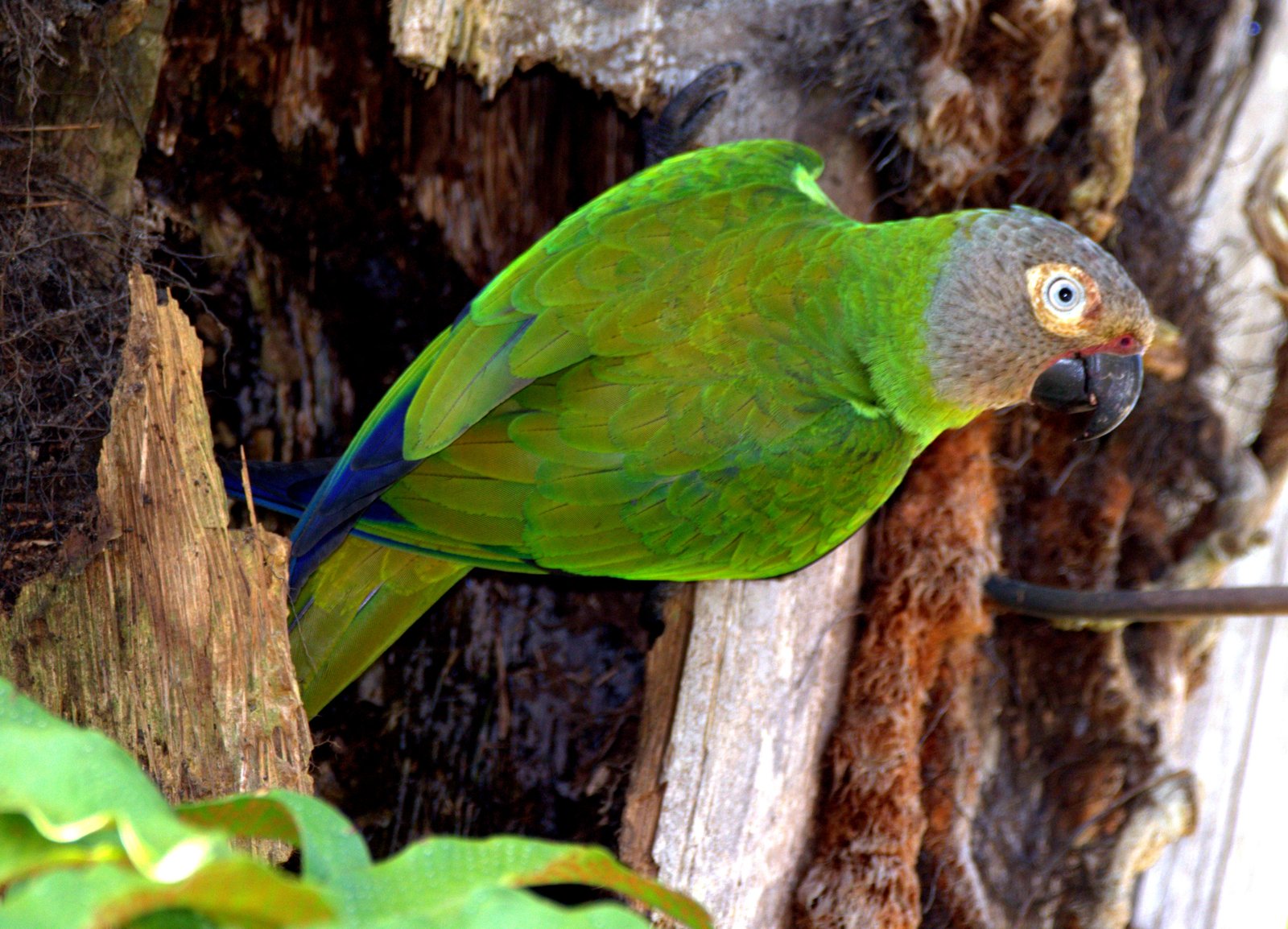
The Dusky-headed Parakeet is a medium-sized green parakeet with a greyish-brown head from the western Amazonian lowlands. It lives in noisy pairs and flocks along rivers, in secondary forest and in open, man-made habitats, including the edges of villages and towns. The name honours the botanist Hugh Algernon Weddell, who travelled through South America with the Castelnau expedition in the 1840s.
Voice
A shrill, harsh, repeated jeet or kree-ek, mainly in flight; flocks keep up a continuous chatter in the trees.
Recording: Daan van der Hoeven — CC BY-NC-SA 4.0 · xeno-canto
Identification
28 cm, with a long, pointed tail and a black bill. The plumage is mostly green, more yellowish on the belly. The head is dull greyish brown, with a bluish-grey tinge on the crown and a broad, bare white ring around the pale yellow eye. The flight feathers are blue above and the tail has a blue tip. In flight the dark head and the blue edge of the wing stand out. The sexes are alike.
Confusion species
White-eyed Parakeet Psittacara leucophthalmus is larger and entirely green, with red and yellow in the wing and a pale bill. Peach-fronted Parakeet Eupsittula aurea has an orange forehead and a dark bill and lives in open country in eastern Bolivia. Chestnut-fronted Macaw Ara severus is much larger, with a chestnut forehead and a bare white face. Parakeets of the genus Brotogeris are smaller, with a shorter tail.
Habitat
Várzea and other riverine forest, forest edges, secondary forest, clearings with scattered trees, plantations and gardens in the lowlands, up to about 750 m. It eats seeds, fruit and flowers, including crops such as maize, and visits clay licks. It nests in a cavity in a tree or in a termite nest.
Where the bird is most at home, classified by the vegetation units of the Andes and the west coast.


Range and movements
Western Amazonia. In Colombia in the south-east, in Caquetá, Putumayo and Amazonas. In Ecuador in the eastern lowlands. In Peru throughout the Amazonian lowlands east of the Andes. In Bolivia in the northern and central lowlands, in Pando, Beni, northern La Paz and Cochabamba and northern Santa Cruz. Absent from the Galápagos. Outside the guide area in western Brazilian Amazonia.
- Resident
- dark = core range, pale = thinly spread
How and when to look
Along riverbanks, on river islands and at the edges of villages and towns in the Amazonian lowlands, such as near Iquitos and Puerto Maldonado. Flocks fly low and calling over the water and settle in fruiting or flowering trees.
Conservation status
Least Concern and common over most of its range. The species benefits from clearings and forest edges created by deforestation, but is trapped locally for the cage-bird trade.
Scientific name
Aratinga weddellii | (Deville, 1851)
Deville described the species in 1851 as Conurus Weddellii; because it was later moved to another genus, the author and year stand in brackets. The genus Aratinga was introduced in 1824 by Spix. The genus name comes from the extinct Tupi language of Brazil: ará tinga, 'bright bird' or 'bright parrot'. The species name honours Hugh Algernon Weddell (1819-1877), an English-born French botanist who travelled through South America with Castelnau's expedition. The specimen the first description was based on came from Pebas, Loreto, Peru.