All species › Parrots › African and New World parrots › Golden-collared Macaw
Golden-collared Macaw | Primolius auricollis
Geelnekara | Guacamayo acollarado | Maracanã-de-colar
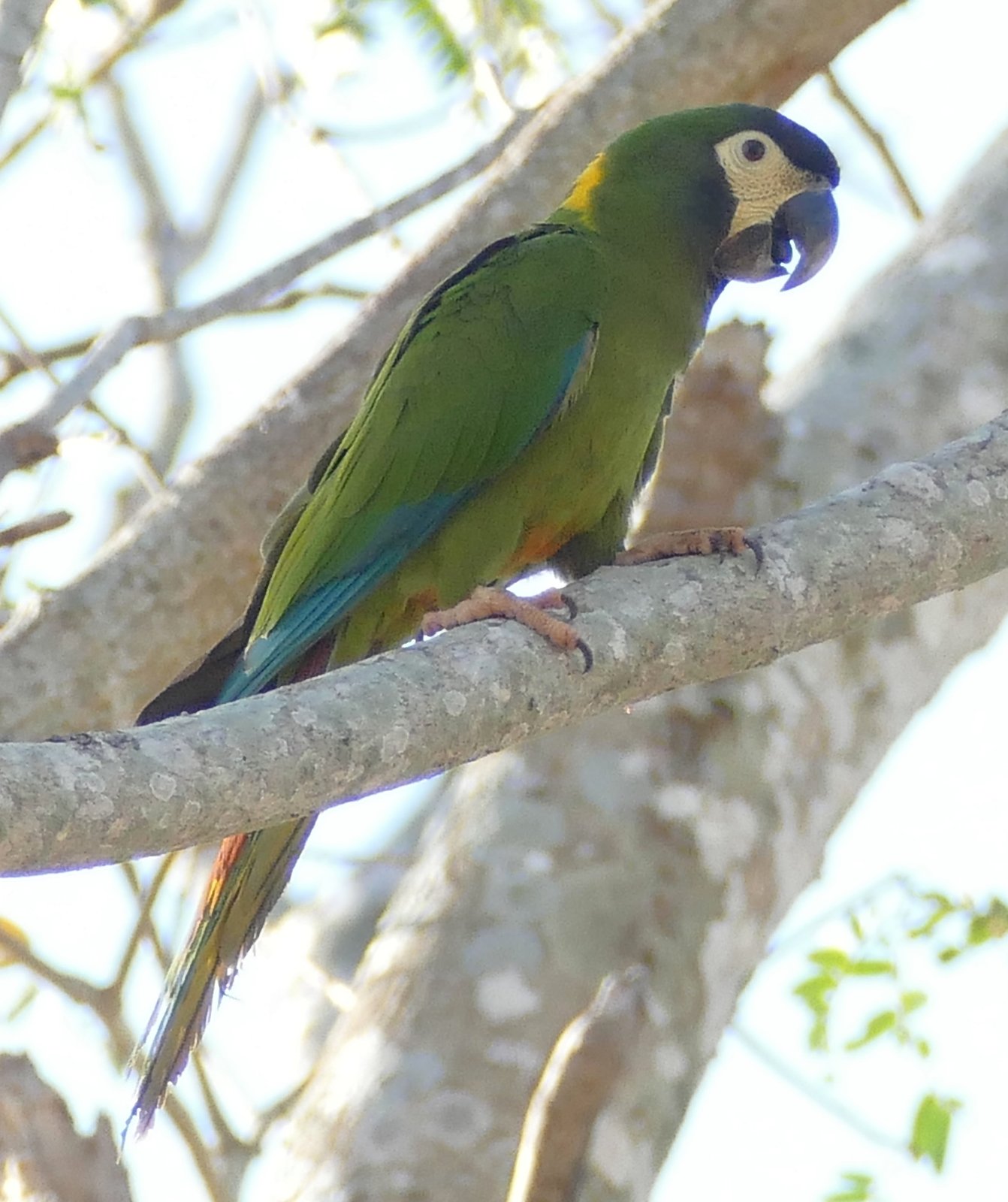
The Golden-collared Macaw is a small green macaw with a yellow band on the nape. It occurs from eastern Bolivia to the Pantanal and the Chaco, in dry forest, gallery forest and savanna. Pairs and flocks fly fast and calling loudly over the landscape.
Voice
A high, harsh, repeated cry, in flight and when landing; flocks are very noisy.
Recording: JAYRSON ARAUJO DE OLIVEIRA — CC BY-NC-SA 4.0 · xeno-canto
Identification
38 cm, with a long, pointed tail and a black bill with a pale, horn-coloured tip. The forehead, forecrown and cheeks are blackish; a broad yellow band runs across the hindneck. The bare skin around the eye is whitish. The body is green and the flight feathers are blue. The tail is reddish brown at the base above and blue towards the tip. The sexes are alike; juveniles have a narrower, less distinct collar.
Confusion species
The yellow collar makes the species recognisable in the guide area. Chestnut-fronted Macaw Ara severus is larger, with a chestnut forehead and no collar, and lives more in humid forest. Blue-headed Macaw Primolius couloni has a blue head and lives in north-western Bolivia and Peru. Red-shouldered Macaw Diopsittaca nobilis is smaller, with a blue forehead and red on the leading edge of the wing. Blue-crowned Parakeet Thectocercus acuticaudatus has a blue forecrown and a pale bill.
Habitat
Semi-deciduous dry forest, Chaco woodland, gallery forest, palm groves and the edges of savanna and fields, from the lowlands into the lower, drier valleys of the eastern slope of the Andes, up to about 1600 m. It eats seeds, fruit and flowers. It nests in tree cavities.
Where the bird is most at home, classified by the vegetation units of the Andes and the west coast.


Range and movements
In Bolivia in the lowlands of Beni and Santa Cruz and in the foothills and dry valleys of the Andes south to Chuquisaca and Tarija. Absent from Colombia, Ecuador, Peru and the Galápagos. Outside the guide area in western Brazil, mainly in Mato Grosso and the Pantanal, in Paraguay and in northern Argentina.
- Resident
- dark = core range, pale = thinly spread
How and when to look
In the dry forest and savannas of Santa Cruz, for example in the Chiquitania and around Santa Cruz de la Sierra, and in the foothills of southern Bolivia. Pairs are often heard first and then pass over in fast flight.
Conservation status
Least Concern and locally common. The species tolerates a partly deforested landscape, but is trapped for the cage-bird trade.
Scientific name
Primolius auricollis | (Cassin, 1853)
Cassin described the species in 1853 as Ara auricollis; because it was later moved to another genus, the author and year stand in brackets. The genus Primolius was introduced in 1857 by Bonaparte. The genus name honours Count Pietro Primoli di Foglia (1821–1883), husband of Charlotte Bonaparte and thus son-in-law of Charles Lucien Bonaparte, who described the genus. The species name comes from Latin aurum, 'gold', and collum, 'neck', for the yellow collar. The specimen the first description was based on came from Bolivia.