All species › Parrots › African and New World parrots › Red-bellied Macaw
Red-bellied Macaw | Orthopsittaca manilatus
Roodbuikara | Guacamayo ventrirrojo | Maracanã-do-buriti
The Red-bellied Macaw is a medium-sized, mainly green macaw closely tied to the aguaje or moriche palm Mauritia flexuosa. It eats the fruit of this palm, nests in the dead trunks and roosts in the palm swamps. At dawn and dusk flocks fly calling over the forest in long lines.
Voice
Higher and less harsh than the large macaws: a shrill, somewhat whining cry, repeated constantly by flocks in flight.
Recording: JAYRSON ARAUJO DE OLIVEIRA — CC BY-NC-SA 4.0 · xeno-canto
Identification
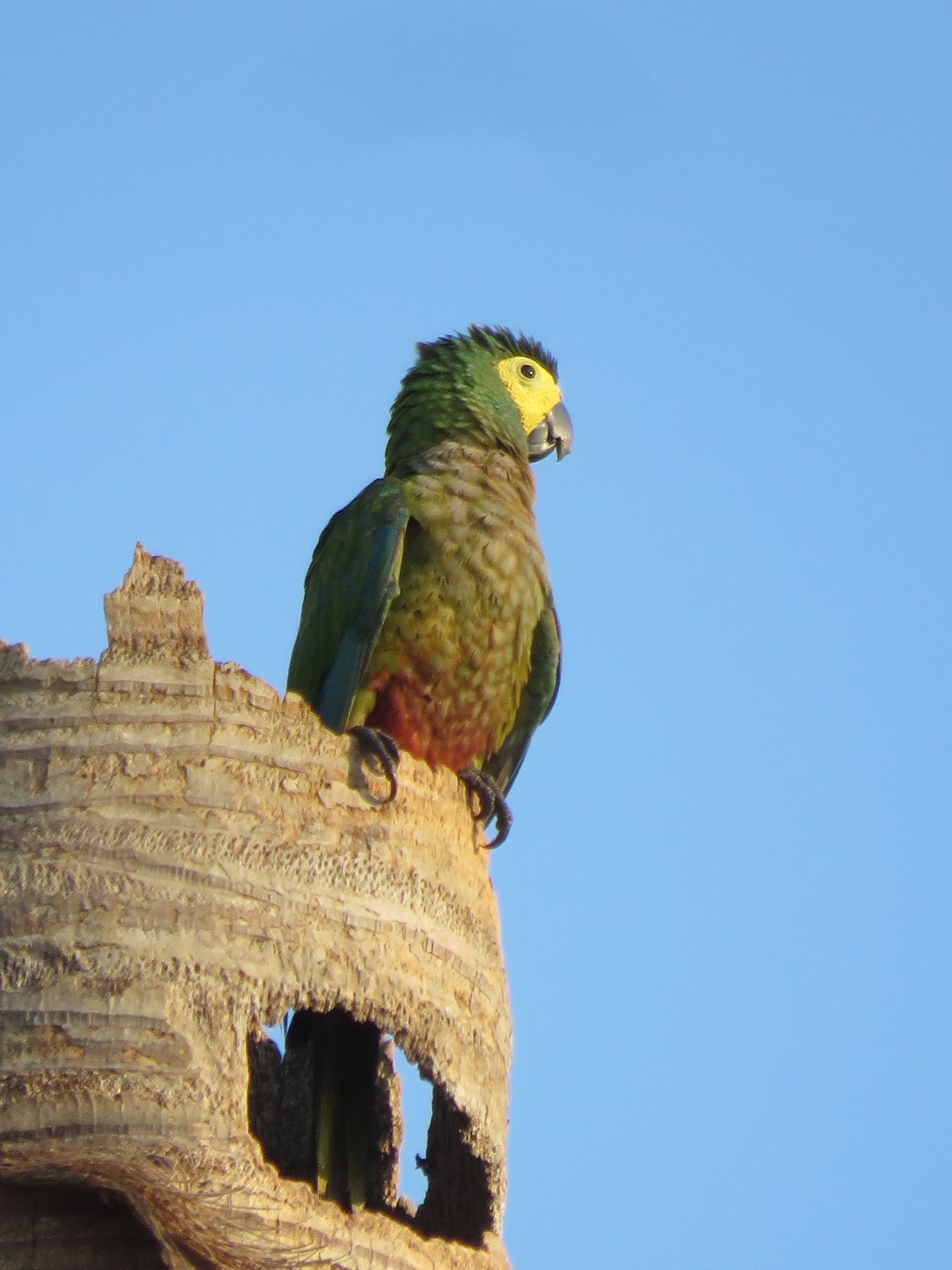
46–50 cm, with a long, pointed tail and a black bill. The face is bare and yellowish. The plumage is green, the forecrown bluish, the throat and breast greyish green with faint scaling. In the middle of the belly is a maroon-red patch. The flight feathers are blue above. Below, the wings and tail are olive-yellow, without red. The sexes are alike.
Confusion species
Chestnut-fronted Macaw Ara severus has a chestnut forehead, a bare white face and red underwing coverts, but no red belly. Blue-headed Macaw Primolius couloni has a blue head, a grey face and a reddish-brown upper side to the tail. Red-shouldered Macaw Diopsittaca nobilis is smaller, with a blue forehead, a white face and a red leading edge to the wing. Parakeets of the genus Psittacara are smaller, with a feathered face.
Habitat
Palm swamps with Mauritia flexuosa and the surrounding lowland forest, also savanna with palm groves and scattered palms in open country, up to about 500 m. It eats mainly the fruit of this palm, as well as other fruit and seeds, and visits clay licks. It nests in cavities in dead palm trunks.
Where the bird is most at home, classified by the vegetation units of the Andes and the west coast.


Range and movements
In Colombia east of the Andes, in the llanos and Amazonia. In Ecuador and Peru in the Amazonian lowlands. In Bolivia in the northern and central lowlands, in Pando, Beni, northern La Paz and northern Santa Cruz. Absent from the Galápagos. Outside the guide area in Venezuela, the Guianas, Brazilian Amazonia and interior Brazil, and on Trinidad.
- Resident
- dark = core range, pale = thinly spread
How and when to look
At the edge of palm swamps at dusk, when flocks come in to roost, for example around Iquitos and in the lowlands of Madre de Dios. By day often in palms with ripe fruit.
Conservation status
Least Concern. The species depends on palm swamps; the felling of palms to harvest the fruit, as around Iquitos, and deforestation are local threats.
Scientific name
Orthopsittaca manilatus | (Boddaert, 1783) (GBIF: Orthopsittaca manilata)
Boddaert described the species in 1783 as Psittacus manilatus; because it was later moved to another genus, the author and year stand in brackets. The genus Orthopsittaca was introduced in 1912 by Ridgway. The genus name comes from Greek orthos, 'straight', and psittakē, 'parrot'. The species name combines Latin manus, 'hand', and latus, 'broad'. The specimen the first description was based on came from Cayenne, French Guiana.