All species › Parrots › African and New World parrots › Blue-crowned Parakeet
Blue-crowned Parakeet | Thectocercus acuticaudatus
Blauwkroonparkiet | Aratinga cabeciazul | Aratinga-de-testa-azul
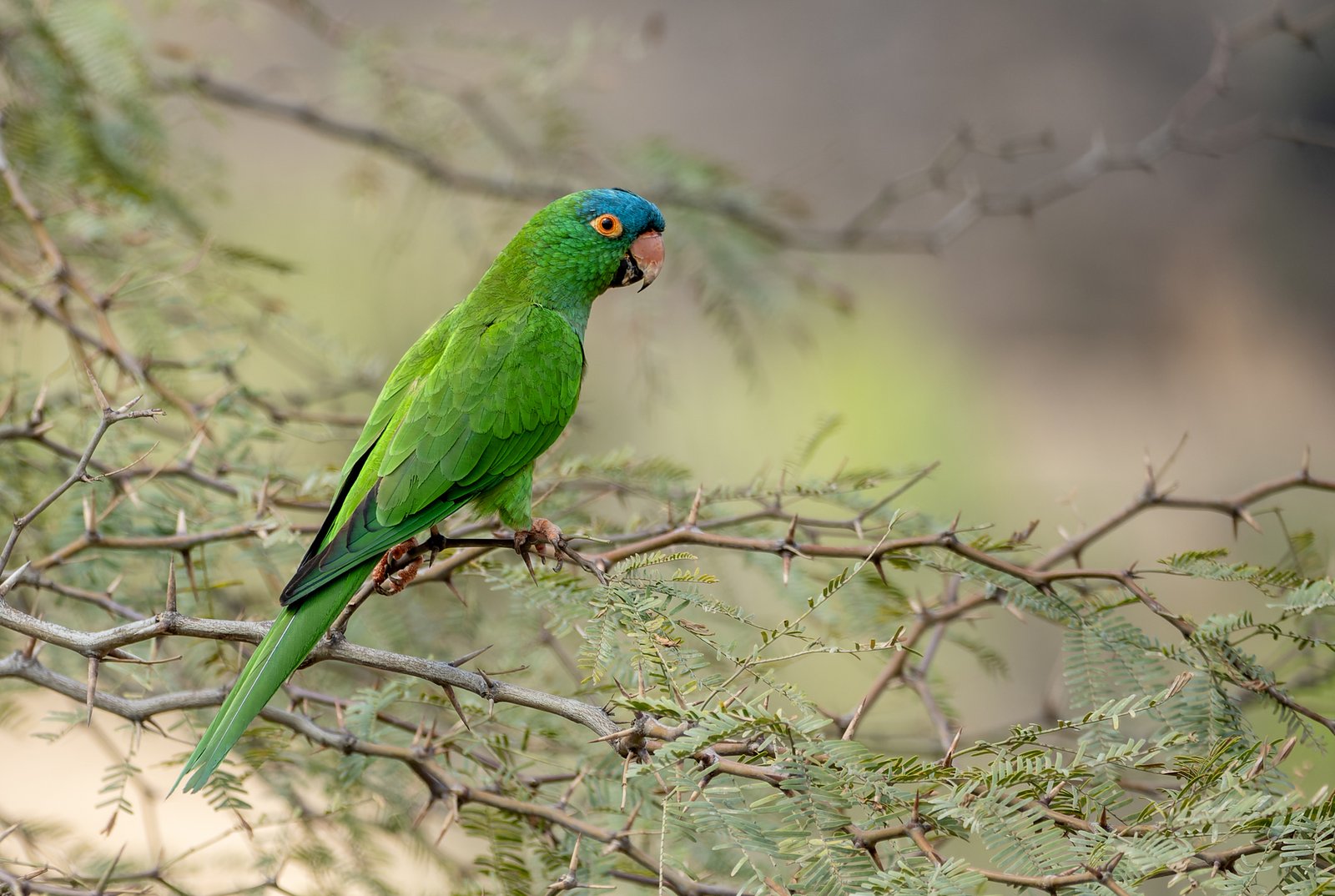
The Blue-crowned Parakeet is a large, green parakeet with a dull blue crown and the only member of the genus Thectocercus. It lives in dry woodland and semi-open country and has a strongly disjunct range: a northern group in the Caribbean lowlands of Colombia and Venezuela, and a southern one from Bolivia to Argentina. In the guide area it is mainly a bird of the dry regions of Bolivia.
Voice
Loud, harsh screeches, such as a repeated chee-ah or kreeh, in flight and at rest; flocks are constantly noisy.
Recording: Dante Buzzetti — CC BY-NC-SA 4.0 · xeno-canto
Identification
35–37 cm, with a long, pointed tail. The plumage is green, with a dull blue crown and forehead; in southern birds the blue extends farther over the head than in northern ones. The upper mandible is pale horn with a dark tip, the lower mandible dark. The eye is orange, with a bare white ring. The underside of the tail is maroon at the base. The underwing is green with olive-yellow flight feathers, without red or yellow on the coverts. The sexes are alike; juveniles have less blue on the head.
Confusion species
Mitred Parakeet Psittacara mitratus has red on the forehead and cheeks and no blue on the head. White-eyed Parakeet Psittacara leucophthalmus has red and yellow underwing coverts and scattered red feathers on the head. Nanday Parakeet Aratinga nenday is smaller, with a black head. Dusky-headed Parakeet Aratinga weddellii is smaller, with a grey-brown head and a dark bill.
Habitat
Dry forest, Chaco, savanna woodland, gallery forest, dry valleys and farmland with trees, in the lowlands and, in Bolivia, in the dry Andean valleys up to about 2600 m. It feeds on seeds, fruit, berries and cactus fruit, and also visits crops. It nests in tree cavities.
Where the bird is most at home, classified by the vegetation units of the Andes and the west coast.


Range and movements
In Colombia in the dry Caribbean lowlands of the north (La Guajira, Magdalena, Cesar). In Bolivia in the lowlands of the east and south and in the dry valleys of the eastern Andean slope (Santa Cruz, Cochabamba, Chuquisaca, Tarija). Absent from Ecuador and the Galápagos; not regularly recorded in Peru. Outside the guide area in northern Venezuela and from eastern Brazil to Paraguay, Uruguay and Argentina.
- Resident
- dark = core range, pale = thinly spread
How and when to look
In Bolivia in the dry forest around Santa Cruz and in the dry valleys of Cochabamba and Chuquisaca, where flocks fly noisily over the country. In Colombia in the dry forest of La Guajira.
Conservation status
Least Concern. It is trapped locally for the cage-bird trade, but the species tolerates semi-open farmland.
Scientific name
Thectocercus acuticaudatus | (Vieillot, 1818) (GBIF: Aratinga acuticaudata)
Vieillot described the species in 1818 as Psittacus acuticaudatus; because it was later moved to another genus, the author and year stand in brackets. The genus Thectocercus was introduced in 1912 by Ridgway. The genus name comes from Greek thēktos, 'sharp' (from thēgō, 'to sharpen'), and kerkos, 'tail', after the pointed tail. Latin acutus, 'pointed', and caudatus, 'tailed': 'sharp-tailed'. The specimen the first description was based on came from Paraguay.