All species › Parrots › African and New World parrots › Brown-hooded Parrot
Brown-hooded Parrot | Pyrilia haematotis
Roodoorpapegaai | Loro cabeza oscura | Papagaio-de-capuz-pardo
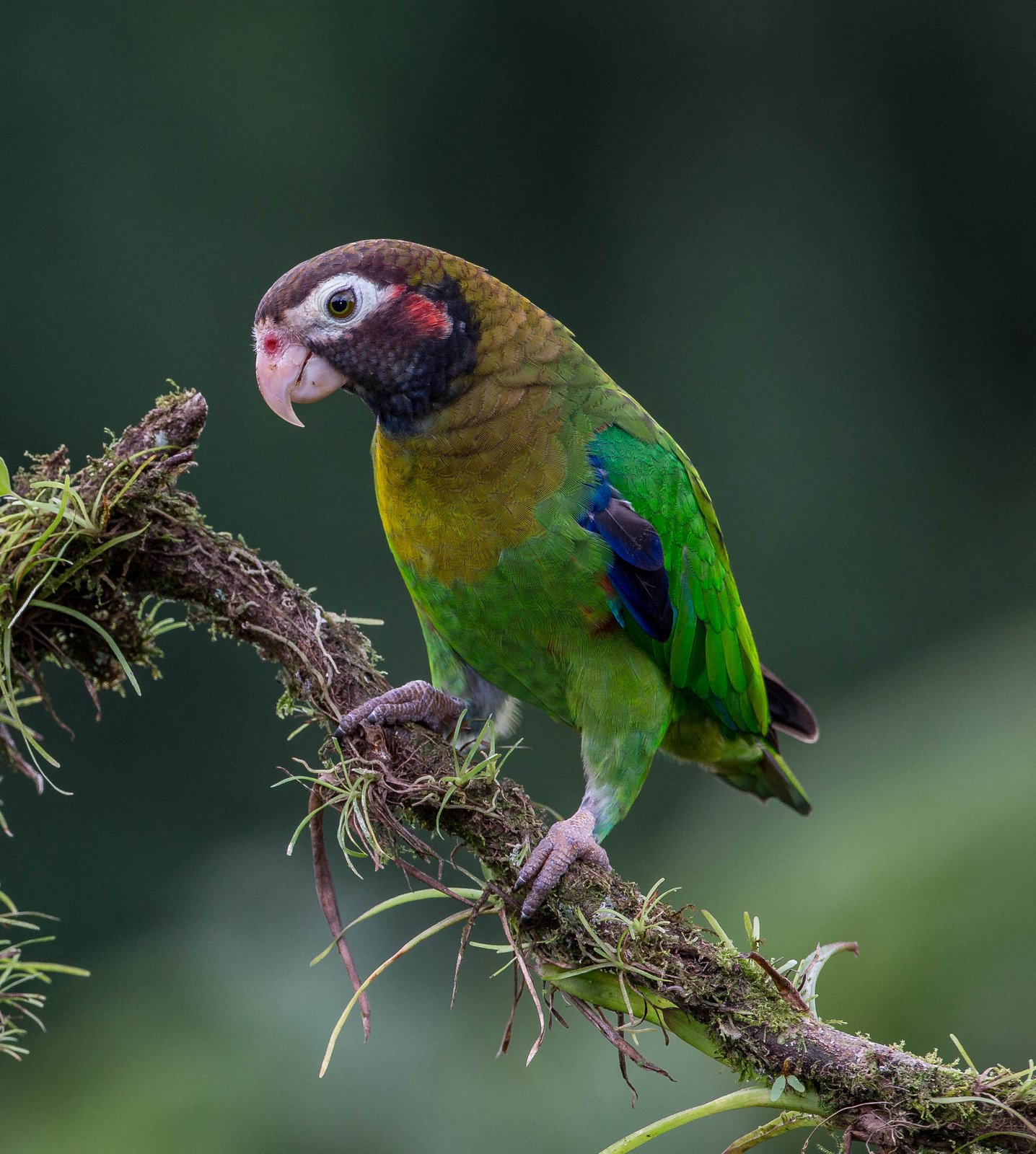
The Brown-hooded Parrot is a small, stocky parrot of humid lowland forest in Central America. In the guide area it reaches the southern edge of its range, in north-western Colombia. It lives in pairs or small groups high in the canopy and shows red underwings in flight.
Voice
A high, nasal and somewhat grating call, often repeated in flight, and softer chatter while feeding.
Recording: Iván Lau — CC BY-NC-SA 4.0 · xeno-canto
Identification
21 cm, with a short, square tail and a pale bill. The head and neck are dark brownish olive, with a red spot on the ear-coverts and a bare, white eye-ring. The body is green, olive on the breast. The axillaries and underwing coverts are red and the flight feathers blue. The sexes are nearly alike; juveniles have a paler head and less red on the ear.
Confusion species
Rose-faced Parrot Pyrilia pulchra has a pink face with a dark border and an orange-yellow shoulder, and lives further south along the Pacific coast. Saffron-headed Parrot Pyrilia pyrilia has an entirely yellow head and lives in the Caribbean lowlands and the Magdalena valley. Blue-headed Parrot Pionus menstruus is larger, with a blue head and red undertail coverts.
Habitat
Humid lowland and foothill forest, forest edges and older secondary forest, mostly below 1200 m. It eats fruit, seeds and flowers in the canopy. The nest is in a tree cavity.
Where the bird is most at home, classified by the vegetation units of the Andes and the west coast.


Range and movements
In Colombia only in the north-west, in northern Chocó and around the Gulf of Urabá. Absent from Ecuador, Peru, Bolivia and the Galápagos. Outside the guide area from southern Mexico through Central America to Panama.
- Resident
- dark = core range, pale = thinly spread
How and when to look
In lowland forest around the Gulf of Urabá and in northern Chocó, watch from forest edges or clearings for small groups flying over the canopy; the red underwings are visible in flight.
Conservation status
Least Concern. Locally the species is declining because of deforestation, especially at the edges of its range.
Scientific name
Pyrilia haematotis | (Sclater & Salvin, 1860) (GBIF: Pionopsitta haematotis)
Sclater & Salvin described the species in 1860 as Pionus haematotis; because it was later moved to another genus, the author and year stand in brackets. The genus Pyrilia was introduced in 1856 by Bonaparte. The genus name combines Greek pur, 'fire', with Latin ilia, 'flanks'. Greek haima, 'blood', and ous (ōtos), 'ear', after the red ear patch. The specimen the first description was based on came from Verapaz, Guatemala.