All species › Parrots › African and New World parrots › Rose-faced Parrot
Rose-faced Parrot | Pyrilia pulchra
Rozewangpapegaai | Loro cachetirrosa | Papagaio-de-face-rosada
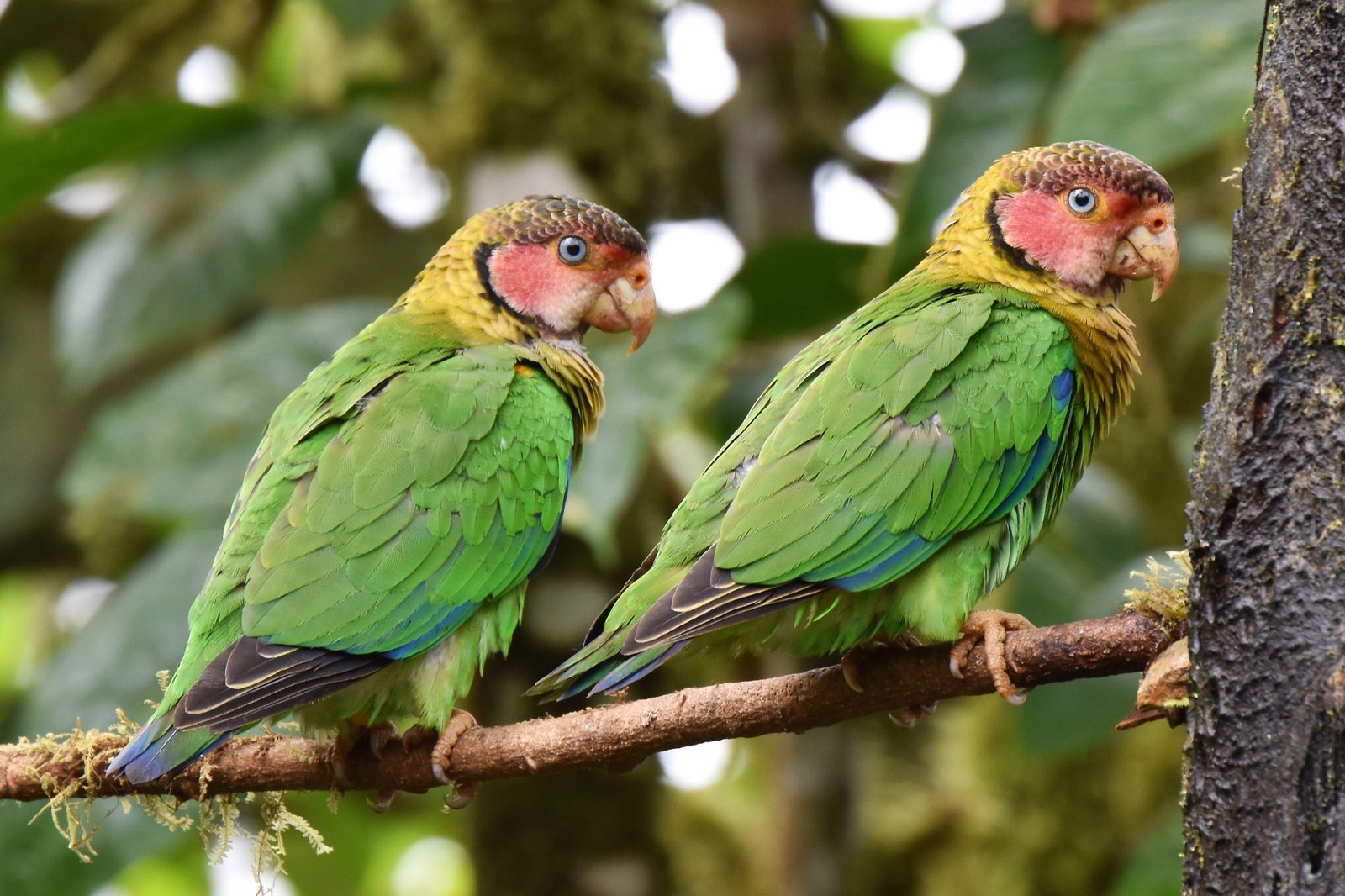
The Rose-faced Parrot is a stocky, short-tailed parrot endemic to the Chocó region of western Colombia and Ecuador. It lives in pairs or small groups in the canopy of humid forest and in semi-open country with tall trees. The pink face with a dark border distinguishes it from the other small parrots on the Pacific side.
Voice
A high, shrill and somewhat nasal call, often repeated in flight, and soft chatter while feeding.
Recording: Sue Riffe — CC BY-NC-SA 4.0 · xeno-canto
Identification
23 cm, stocky, with a short tail and a pale bill. The crown and nape are dark brownish, the face is pink with a narrow dark border, and there is a bare, pale eye-ring. The body is green. The shoulder and leading edge of the wing are orange-yellow, the underwing coverts red and the flight feathers bluish. The female has a less pink face; juveniles have a greenish head.
Confusion species
Brown-hooded Parrot Pyrilia haematotis has a brown head with a red ear spot and occurs only in north-western Colombia. Blue-headed Parrot Pionus menstruus is larger, with a blue head and red undertail coverts. Bronze-winged Parrot Pionus chalcopterus is dark bluish with bronze wings and a pale bill.
Habitat
Humid lowland and foothill forest, forest edges, older secondary forest and semi-open country with tall trees, from sea level to about 1200 m, locally higher. It eats fruit, seeds and flowers in the canopy. The nest is in a tree cavity.
Where the bird is most at home, classified by the vegetation units of the Andes and the west coast.


Range and movements
In Colombia on the Pacific side, from Chocó to Nariño, also on the western slope of the Western Andes. In Ecuador in the west, mainly in the north-west, south to El Oro. Absent from Peru, Bolivia and the Galápagos.
- Resident
- dark = core range, pale = thinly spread
How and when to look
In the foothills of north-western Ecuador or in the Colombian Chocó, watch from clearings and forest edges for pairs flying over the forest. In fruiting trees they often sit still for long periods.
Conservation status
Least Concern. The Chocó forests are being cleared locally, but the species also tolerates semi-open country with tall trees.
Scientific name
Pyrilia pulchra | (Berlepsch, 1897) (GBIF: Pionopsitta pulchra)
Berlepsch described the species in 1897 as Pionopsitta pulchra; because it was later moved to another genus, the author and year stand in brackets. The genus Pyrilia was introduced in 1856 by Bonaparte. The genus name combines Greek pur, 'fire', with Latin ilia, 'flanks'. Latin pulcher, 'pretty, fair'. The specimen the first description was based on came from Río Dagua, Valle del Cauca, Colombia.